

From E-Bike Shakeout to Energy-Resilient Mobility Platforms: A Playbook for the Hormuz Shock Era
Why electric bicycle winners will be defined by lifecycle economics, safety certification, service density, capital discipline, and resilience to oil-price shocks.
The e-bike story is no longer about whether consumers like electric bicycles; it is about whether companies, cities, and countries can turn them into safe, serviceable, financially durable, and energy-resilient mobility systems for everyday short trips.
Electric bikes are no longer only a cycling-industry story. They are becoming a household-cost, urban-resilience, energy-security, and service-infrastructure story. The market correction exposed weak capital structures, fragile supply chains, warranty under-reserving, and distribution models that confused online conversion with durable customer support. Yet the macro case has strengthened. A majority of U.S. vehicle trips are under six miles, while the Strait of Hormuz crisis has reminded consumers, policymakers, and investors that fossil-fuel mobility remains exposed to chokepoint risk, price volatility, and geopolitical disruption. The strategic question is therefore not whether e-bikes have demand. It is whether companies can convert demand into reliable, certified, locally serviced, and financially sustainable mobility systems.
Reading Time: 50 min.
All illustrations are copyrighted and may not be used, reproduced, or distributed without prior written permission.
Summary: The e-bike sector is moving from growth narrative to operating proof. Demand remains structurally supported by short-distance trip patterns, high car-ownership costs, urban congestion, and the need for lower-cost mobility. AAA estimated the annual cost of owning and operating a new vehicle at $11,577, while U.S. Department of Energy data show that most vehicle trips are under six miles, a distance band where e-bikes can be economically and practically relevant. The current Strait of Hormuz disruption strengthens the energy-security argument: EIA reported that about 20 million barrels per day flowed through the strait in 2024, while the IEA’s April 2026 oil-market update said global oil supply fell by 10.1 million barrels per day in March amid attacks and restrictions on tanker movement. However, the oil shock does not automatically rescue weak e-bike models. It also raises freight, energy, component, insurance, and working-capital pressure. The winners will be companies that combine Total Cost of Ownership (TCO)-driven customer value, certified safety, repair density, disciplined inventory, and balance-sheet resilience.
The overall arc is: latent mobility need → household transport economics → Strait of Hormuz oil shock → quantitative stress test → competitive archetypes → capital-market reset → lifecycle unit economics → product architecture discipline → service-backed distribution → safety and regulation → supply-chain resilience → consolidation and M&A → national, city, and destination strategy → energy-resilient mobility platforms.
The Demand Signal Is Structural, but the Boom-Era Sales Curve Was Misread

The strategic opportunity was never the pandemic sales spike itself, but the deeper realization that short-distance mobility demand remains underserved by cars, transit, and conventional bicycles.
The first strategic error in the e-bike sector was not believing in demand; it was misreading the shape of demand. During the pandemic, consumers brought forward purchases that might otherwise have been spread across several years. Leisure cycling, home-centered commuting, avoidance of public transport, and stimulus-supported discretionary spending all combined to create what looked like a permanently steeper adoption curve. But a demand curve temporarily pulled forward is not the same as a demand curve permanently reset. For management teams and investors, the distinction matters because it determines production orders, working capital, warehouse commitments, marketing spend, staffing plans, and after-sales infrastructure. A business that treats a spike as a new baseline will overbuild. A business that treats a spike as a volatility event will scale with buffers, options, and inventory discipline.
The structural case for e-bikes remains strong because the use case is rooted in everyday mobility, not novelty. In the United States, a majority of vehicle trips are less than six miles, and only about 6.9% are longer than 30 miles, according to Oak Ridge National Laboratory data published by the U.S. Department of Energy’s Alternative Fuels Data Center. That is strategically important because e-bikes do not need to replace every car trip to become a large market. They need to replace a meaningful share of short errands, school runs, commutes, neighborhood trips, and urban delivery journeys where a car is expensive, inefficient, or inconvenient. The category’s addressable market is therefore not “people who want bicycles”; it is people whose daily mobility portfolio has become too car-dependent for short-distance reality.
The same pattern appears in European data. CONEBI described 2023 as a reset year after exceptional pandemic demand, with traditional bicycle sales falling to 11.7 million units from 14.7 million in 2022, while e-bike demand was 5.1 million units versus 5.5 million in 2022; importantly, e-bike unit sales remained more than 50% above pre-pandemic levels. Combined bicycle and e-bike sales reached €19.3 billion in 2023, despite the market correction. In 2024, CONEBI said European sales were settling back toward pre-pandemic levels and manufacturers were scaling back output as inventories were absorbed, while e-bikes continued to represent a significant share of the market. This is the essence of the post-boom market: lower hype, more discipline, still meaningful demand.
Germany illustrates the maturation dynamic particularly well. ZIV’s 2025 market data show 3.8 million bicycles and e-bikes sold in Germany, including 2.0 million e-bikes and 1.8 million conventional bicycles. E-bikes represented 52.7% of unit sales, roughly consistent with the 53% share visible across 2023–2025. The German market is not displaying infinite growth; it is displaying category entrenchment. That difference is critical. Mature categories do not always produce explosive unit growth, but they can produce durable profit pools if companies build for service, replacement cycles, financing, accessories, insurance, leasing, refurbishment, and battery lifecycle management.
The United States is less mature, but the growth signal is still substantial. eCycleElectric estimated 1.7 million complete e-bike imports into the U.S. in 2024, up from 0.99 million in 2023, and later estimated 2.2 million complete e-bike imports in 2025, a 29% year-over-year increase versus its 2024 estimate. At the same time, Bicycle Retailer highlighted that estimates vary significantly because e-bikes share import-code ambiguity with other electric two-wheelers; one research group estimated 1.3 million U.S. e-bike imports in 2025 while LEVA/eCycleElectric estimated 2.2 million. For strategy, that uncertainty itself is instructive: the category is big and growing, but market data quality remains imperfect, which raises forecasting risk.
A diagnosis would frame the sector as a high-potential, medium-visibility market. The demand thesis is credible, but the data infrastructure is still developing; the customer segments are heterogeneous; and the channel economics differ sharply between premium specialty retail, direct-to-consumer, mass retail, and leasing. A commuter buying a $3,000 specialty e-bike, a teenager using a throttle-equipped bike for local mobility, a delivery rider cycling six days per week, and a retiree buying a step-through model for leisure are not the same customer. They have different risk profiles, service requirements, price elasticity, safety expectations, and replacement cycles. Treating them as one market leads to strategic confusion.
The most sophisticated operators will therefore segment the e-bike opportunity by mission, not by product aesthetics. The key missions are urban commuting, family utility, cargo and delivery, recreation and fitness, senior mobility, student mobility, and corporate or salary-sacrifice leasing. Each mission has different economics. Cargo bikes may justify higher average selling prices but require stronger service capability. Entry-level online bikes may drive volume but carry higher customer-support and quality-perception risk. Premium commuter bikes may support margins but demand reliability, theft protection, and local repair. The category is too broad for a single undifferentiated growth strategy.
The e-bike market did not collapse after the pandemic; what collapsed was the assumption that a temporary demand spike could be converted into permanent growth without segmentation, service capacity, and forecasting discipline.
Lessons learned from separating durable mobility demand from pandemic-distorted adoption curves: (i) Treat e-bike demand as structurally real but cyclically uneven; (ii) forecast by customer mission rather than by total category enthusiasm; (iii) build supply plans around sell-through evidence, not investor narratives; (iv) distinguish market maturity from market weakness when growth normalizes; (v) measure success through lifetime margin, service retention, and replacement cycles rather than launch-year unit volume alone.
Total Cost of Ownership and the Consumer Adoption Equation for Practical E-Bike Mobility

The strongest e-bike business case emerges when the customer sees the product not as discretionary recreation, but as a practical tool for reducing everyday transport costs.
The e-bike adoption equation is often misunderstood because the category is still discussed as a product category rather than a mobility-cost substitute. Consumers do not only ask whether an e-bike is attractive, fast, well-designed, or sustainable. They ask whether it can make daily life cheaper, easier, safer, and more reliable. That means the relevant comparison is not simply e-bike versus bicycle. It is e-bike versus car ownership, second-car retention, ride-hailing, public transit gaps, parking costs, delivery convenience, and the time penalty of congestion. The management question is therefore: where does the e-bike create enough economic surplus to overcome upfront cost, theft anxiety, weather constraints, maintenance needs, and safety concerns?
The quantitative case starts with trip length. U.S. Department of Energy data show that a majority of U.S. vehicle trips are less than six miles, and only about 6.9% are longer than 30 miles. That matters because e-bikes do not need to replace long-distance highway travel to matter. They need to replace short errands, school runs, local commutes, gym trips, pharmacy trips, small shopping trips, and neighborhood social trips. In other words, the e-bike’s addressable market is not “all driving.” It is the high-frequency, short-distance layer of daily car dependence.
The household economics can be powerful, but they must be framed honestly. AAA estimated the total annual cost of owning and operating a new vehicle at $11,577, or about $965 per month. If an e-bike helps a household avoid buying or keeping a second car, the payback can be dramatic. A $2,500 to $4,000 e-bike, even after service, accessories, insurance, and periodic battery-related costs, can be a fraction of the annual cost of another car. But if the e-bike is merely an incremental leisure purchase and the household keeps all existing vehicles, the economics are weaker. The same product can therefore be either a high-return mobility investment or a discretionary durable good, depending on use case.
This distinction should change how brands market and price the category. A customer buying a commuter or cargo e-bike is not only evaluating frame geometry and motor torque. They are evaluating whether the bike can be trusted enough to replace car miles. That trust includes range confidence, battery safety, local repair, theft protection, cargo compatibility, weather resilience, and financing. A low advertised price may attract interest, but a weak service model undermines the TCO promise because downtime creates hidden cost. Conversely, a premium bike with reliable support, certified systems, and strong residual value can be cheaper over time than a poorly supported cheaper model.
Channel data suggest that the market already splits along this value line. PeopleForBikes reported that the average selling price of an e-bike through the U.S. specialty channel was $3,055, compared with $669 in rest-of-market channels such as big-box and sporting-goods retailers. That is not simply a pricing gap. It signals two different adoption models. The lower-price channel can democratize access, but may struggle to fund deep service. The specialty channel can support fitting, service, and attachment sales, but must justify a much higher upfront price through reliability and lifetime value.
Leasing and salary-sacrifice models help solve this adoption barrier. German specialist-retailer data show leasing represented 41.9% of bicycle sales in 2025 in that surveyed specialist-retail context. Leasing turns a large upfront purchase into a monthly mobility decision, which is strategically important because consumers already think about cars, phones, insurance, and subscriptions in monthly terms. It also creates structured replacement cycles, stronger dealer relationships, service retention, and future refurbishment supply.
The best adoption equation is therefore not “gasoline is expensive, buy an e-bike.” That is too narrow. The better equation is: e-bike value = avoided car cost + avoided parking + avoided time loss + reliability + financing + local support + residual value – upfront price – service friction – theft risk – weather limitation. Companies that solve only the product side will underperform. Companies that solve the full adoption equation can convert fuel-price volatility, urban congestion, and household cost pressure into durable demand.
The e-bike becomes strategically compelling only when it is sold as a lower-cost mobility system, not merely as a more expensive bicycle with a battery attached.
Lessons learned from reframing adoption around household economics rather than product enthusiasm alone: (i) Segment customers by the trips and costs they can realistically replace; (ii) treat second-car avoidance as the strongest economic use case; (iii) use leasing, financing, and employer programs to reduce upfront adoption friction; (iv) price premium models around reliability, service, safety, and residual value rather than aesthetics alone; (v) recognize that fuel savings matter, but the real economic prize is broader mobility-cost substitution.
The Reality of E-Bikes in Light of the Strait of Hormuz Oil Crisis

Energy disruption makes e-bikes more strategically relevant, but only when companies and cities can translate macro volatility into reliable, affordable, locally supported mobility behavior.
The Strait of Hormuz crisis changes the strategic context for e-bikes, but not in the simplistic way many might expect. It does not mean every consumer will immediately buy an e-bike. It does not mean weak companies are suddenly viable. It does not remove the need for certified batteries, local service, disciplined inventory, realistic pricing, or capital resilience. What it does is elevate e-bikes from a lifestyle and sustainability category into a mobility-resilience category. The crisis reminds households, cities, employers, and investors that fossil-fuel mobility remains exposed to geopolitical chokepoints, price shocks, shipping disruptions, and inflation spillovers.
The chokepoint itself is enormous. The U.S. Energy Information Administration describes the Strait of Hormuz as one of the world’s most important oil chokepoints. In 2024, oil flow through the strait averaged 20 million barrels per day, equivalent to about 20% of global petroleum liquids consumption; flows also represented more than one-quarter of global seaborne oil trade and around one-fifth of global LNG trade. The same EIA analysis notes that very few alternatives exist to move oil out if the strait is closed, with limited Saudi and UAE pipeline capacity available as bypass infrastructure. In practical terms, this means the world’s energy system remains vulnerable to narrow maritime corridors.
The current disruption is material. The IEA’s April 2026 Oil Market Report stated that global oil supply fell by 10.1 million barrels per day in March, to 97 million barrels per day, because of attacks on Middle East energy infrastructure and restrictions on tanker movement through the Strait of Hormuz. It also reported that global observed oil inventories fell by 85 million barrels in March and that crude benchmarks saw their largest-ever monthly gain, with North Sea Dated crude trading around $130 per barrel at the time of writing. EIA’s April 2026 Short-Term Energy Outlook forecast U.S. retail gasoline prices peaking close to $4.30 per gallon in April and averaging more than $3.70 per gallon in 2026.
This creates a new demand narrative for e-bikes: not oil independence at the national level, but fuel-price resilience at the household and city level. A commuter who shifts three short trips a week from car to e-bike is not solving the global crude market. But that commuter is reducing exposure to gasoline spikes, parking costs, congestion, and local transport inflation. A city that supports thousands of short-trip substitutions is not replacing oil imports, but it is creating a more flexible mobility system. An employer that helps workers access e-bikes is not managing global geopolitics, but it may reduce commuting stress and improve retention for cost-sensitive employees.
The crisis also creates headwinds. The World Bank projected that energy prices would surge 24% in 2026 and overall commodity prices would rise 16%, warning that the Middle East war and Hormuz shipping disruption had triggered the largest oil supply shock on record. It also warned that higher energy prices would flow into food prices, inflation, interest rates, debt burdens, and development risk. This matters because e-bike companies are not outside the energy economy. Higher energy and freight costs can raise manufacturing, shipping, warehousing, insurance, and component costs. Higher inflation can weaken discretionary spending. Higher interest rates can make inventory carrying costs and consumer financing more expensive. The crisis therefore creates a two-sided effect: it strengthens the use case for alternatives while increasing the operating pressure on companies that supply them.
The winners will be those that interpret the oil shock as a reason to harden the business model, not merely as a marketing opportunity. Utility-focused, commuter-focused, cargo-focused, financed, service-backed e-bike models become more relevant under fuel volatility. Purely discretionary, poorly supported, undercapitalized models become more exposed. The boardroom question is not “Will gasoline prices rise enough to create demand?” The better question is: Can the company capture resilience demand without being crushed by the same macro volatility that created it?
For policymakers, the crisis also reframes e-bikes. They are not simply climate-friendly consumer products. They are part of a distributed energy-resilience strategy for short trips. That does not mean every country should subsidize every e-bike. It means governments should design targeted programs around mode shift, safety certification, repair ecosystems, low-income access, secure parking, and integration with transit. The oil shock raises the strategic value of practical alternatives, but only if the ecosystem is ready to support sustained use.
The Hormuz crisis does not make every e-bike company stronger; it makes the strongest e-bike operating models more strategically relevant and the weakest ones more exposed.
Lessons learned from translating oil-market volatility into practical e-bike strategy: (i) Position e-bikes as household and urban resilience tools, not as full substitutes for the global oil market; (ii) expect demand to shift toward utility, commuting, cargo, and financed models; (iii) prepare for simultaneous revenue opportunity and cost inflation; (iv) use energy shocks to strengthen local service and supply-chain resilience; (v) avoid assuming gasoline volatility can compensate for weak unit economics, uncertified product architecture, or poor reliability.
Quantitative Stress Test of E-Bike Economics Under the Strait of Hormuz Crisis

The numbers show that e-bikes are not a cure for global oil dependence, but they can be a powerful micro-hedge against household transport inflation.
A quantitative view shows why the Strait of Hormuz crisis strengthens the e-bike value proposition, but also why fuel prices alone do not fix weak business models. The right lens is a two-sided stress test: consumer economics on one side and company economics on the other. Consumers may see greater value in low-energy short-trip mobility. Companies may see higher freight, energy, tariff, insurance, and working-capital pressure. The strategic challenge is to capture the demand upside without losing the cost-control battle.
Start with the consumer. EIA’s April 2026 Short-Term Energy Outlook forecast U.S. retail gasoline prices averaging $3.70 per gallon in 2026, up from $3.10 in 2025, with prices peaking close to $4.30 per gallon in April. Assume a gasoline car achieves 30 miles per gallon. At $3.10 per gallon, gasoline costs about $0.103 per mile. At $3.70, it costs about $0.123 per mile. At $4.30, it costs about $0.143 per mile. That is fuel only. It excludes depreciation, insurance, maintenance, registration, financing, parking, tolls, and time.
Now compare that with e-bike energy cost. The Union of Concerned Scientists uses 0.02 kWh per mile as a representative pedal-assist e-bike efficiency assumption and notes that e-bikes generally consume between 1 and 4 kWh per 100 miles. EIA’s Electric Power Monthly lists the U.S. residential electricity price at 17.65 cents per kWh in February 2026. At 0.02 kWh per mile, 1,000 e-bike miles require about 20 kWh, costing roughly $3.53 at that electricity price. By contrast, 1,000 miles in a 30-mpg car cost about $123 in gasoline at the 2026 average forecast and about $143 at the April peak forecast. On energy cost alone, the e-bike is approximately 35 times cheaper than the gasoline car at $3.70 gasoline and approximately 41 times cheaper at $4.30 gasoline.
The annual math is helpful but should be interpreted carefully. A 15,000-mile-per-year driver using a 30-mpg car would spend about $1,550 on gasoline at $3.10 per gallon, about $1,850 at $3.70, and about $2,150 at $4.30. Under these assumptions, the crisis adds roughly $300–$600 in annual fuel cost versus the 2025 gasoline price level. If a household replaces 2,000 car miles per year with e-bike miles, the energy cost of the e-bike is only about $7. At 5,000 e-bike miles per year, it is only about $18. The energy savings are real, but they are not the whole story.
Fuel-only payback varies sharply by bike price. PeopleForBikes reports average e-bike selling prices of $3,055 in the specialty channel and $669 in rest-of-market channels. At $3.70 gasoline, a $3,055 e-bike would require roughly 25,500 avoided gasoline-car miles to recover its purchase price through fuel savings alone, or about 5.1 years at 5,000 avoided miles per year. At $4.30 gasoline, the fuel-only payback falls to roughly 21,900 miles, or about 4.4 years at 5,000 miles per year. A $669 e-bike reaches fuel-only payback much faster: roughly 5,600 avoided miles at $3.70 gasoline and about 4,800 avoided miles at $4.30. But this comparison is incomplete because cheaper products may carry greater durability, safety, service, and residual-value risk, while premium products may justify higher cost through uptime, support, and longevity.
The company-side stress test is equally important. Oil shocks can lift consumer interest while compressing manufacturer margins. Freight, marine insurance, energy, metals, financing, warehousing, and tariff exposure can all become more painful. Rad Power Bikes’ Chapter 11 filing illustrates the balance-sheet sensitivity of the category: the company listed estimated assets of $32.1 million, estimated liabilities of $72.8 million, inventory of about $14.2 million, and a top unsecured claim from U.S. Customs and Border Protection for tariffs of about $8.36 million. That tariff claim equaled roughly 26% of reported assets and nearly 59% of listed inventory value. In other words, landed-cost pressure can become a solvency issue, not merely a pricing issue.
At system level, e-bikes are powerful but not macro oil substitutes. eCycleElectric estimated 2.2 million complete e-bike imports into the U.S. in 2025. If each replaced 1,000 gasoline-car miles annually at 30 mpg, that would avoid about 73 million gallons of gasoline per year, or roughly 1.75 million barrels. That is meaningful at household and city scale, but it is small relative to the 20 million barrels per day that EIA associated with Hormuz flows in 2024. The e-bike’s strategic role is therefore distributed resilience, not macro oil-market displacement.
The Hormuz crisis improves the e-bike value proposition at the household level, but the numbers show that resilience, not fuel-only payback, is the real strategic argument.
Lessons learned from stress-testing e-bike economics against higher oil, gasoline, electricity, freight, and tariff pressure: (i) Use fuel savings as an entry point, but sell broader mobility-cost avoidance; (ii) distinguish premium-bike payback from low-price-bike payback while accounting for service, safety, and residual value; (iii) treat oil shocks as demand catalysts and cost shocks at the same time; (iv) build pricing scenarios around freight, tariffs, insurance, energy, and inventory carrying cost; (v) remember that e-bikes are powerful household hedges, not direct replacements for global oil supply.
Competitive Landscape and Strategic Archetypes That Will Shape the Next E-Bike Cycle

The next competitive battle will not be won by generic e-bike brands, but by archetypes with clear customer missions, operating discipline, and defensible service economics.
The e-bike market is not one competitive arena. It is a portfolio of strategic archetypes with different margin structures, operating risks, customer expectations, and sources of advantage. A company that says it competes in “e-bikes” is being too imprecise. The relevant question is: Which e-bike business model is being built? The answer determines product design, pricing, channel strategy, service commitments, capital needs, inventory risk, and the type of resilience required under oil-price volatility.
The first archetype is the legacy premium bicycle platform. These companies typically have established brands, dealer relationships, mechanical credibility, and broader product portfolios across conventional bikes, e-bikes, accessories, apparel, and service. Their advantage is not only product. It is installed trust. Dealers can explain fit, class, range, service intervals, battery care, and local riding conditions. The tradeoff is that legacy players can move more slowly, may carry complicated channel rules, and may be less aggressive in direct digital engagement. Still, in a category where safety and repairability matter, a trusted dealer network is a major strategic asset.
The second archetype is the digital-native premium urban brand. These companies often excel at design, software experience, brand storytelling, and direct customer acquisition. Their early promise was to make e-bikes feel more like consumer technology than traditional cycling equipment. The weakness is that proprietary design and direct distribution can become liabilities when service density, parts availability, and working capital do not scale at the same pace. VanMoof’s transition after bankruptcy is instructive: Reuters reported that Lavoie, the e-scooter unit of McLaren Applied, agreed to buy VanMoof and that the new model would abandon VanMoof’s in-house retail-store approach in favor of third-party retailers to sell and service bikes. That is a powerful market signal: digital elegance needs physical infrastructure.
The third archetype is the value-led direct or mass-market platform. This model targets affordability and volume. It can expand adoption quickly, especially when fuel prices rise and consumers seek cheaper local mobility. But affordability creates a strategic trap. Low prices leave less margin for certification, warranty reserves, technical support, spare parts, dealer labor, battery replacements, and recalls. PeopleForBikes’ reported gap between $3,055 specialty-channel average selling price and $669 rest-of-market average selling price shows how different the economics can be. A value platform can win, but only if product complexity, service promises, and warranty exposure are tightly controlled.
The fourth archetype is the cargo, utility, and family-mobility specialist. These companies are strategically attractive because utility use cases can support higher willingness to pay. Parents, small businesses, urban households, and local service providers are buying function, not novelty. They care about payload, braking, child-seat compatibility, racks, weather protection, range, tire durability, and service. The opportunity is strong, but the safety bar is high. A cargo e-bike carrying children or business equipment cannot tolerate weak brakes, unreliable batteries, or unavailable parts. Utility expands the market, but it also raises accountability.
The fifth archetype is the fleet and commercial mobility operator. Delivery riders, campuses, hotels, resorts, municipalities, corporate campuses, and last-mile logistics providers require uptime, fast repair, battery management, predictable service cost, and robust parts supply. The fleet customer does not buy romance. It buys utilization. A delivery e-bike that fails during peak hours is a revenue interruption. Fleet models can generate recurring service and maintenance economics, but they expose weak components quickly because utilization is far higher than recreational use.
The sixth archetype is the dealer, workshop, and service network. This is often treated as support infrastructure, but it should be viewed as a competitive class in its own right. ZIV’s specialist-retailer data show workshop business remaining on a growth path after a 13.5% sales increase in 2025, with most specialist retailers planning to expand service offerings further in 2026. As installed bases age, service networks gain bargaining power. They become the place where customer trust is maintained or lost.
The seventh archetype is the industrial consolidator. These companies acquire or partner with brands that have product, software, or customer assets but lack operational backbone. Cowboy’s acquisition by ReBirth Group illustrates this model. Cycling Industry News reported that the transaction included €15 million in new capital, a focus on restarting spare-parts production, improved quality control, reduced lead times, and access to a retail and service network including 95 Oxygen stores, 10 Ovelo outlets, and around 500 independent bike dealers. That is not just financial restructuring. It is operating-model restructuring.
The category’s winners will be those that understand their archetype and avoid borrowing economics from another. A premium urban brand cannot price like a low-cost importer while carrying premium support obligations. A cargo-bike company cannot underinvest in safety. A fleet operator cannot tolerate weak parts availability. A dealer-led brand cannot starve channel margin. A DTC brand cannot ignore local repair. Competitive advantage will come from aligning customer mission, product architecture, service promise, pricing power, and capital structure.
The e-bike market is not consolidating around one winning model; it is separating into archetypes where advantage depends on matching product promise with operating capability.
Lessons learned from mapping competitive archetypes before choosing an e-bike growth strategy: (i) Define the business model before defining the product roadmap; (ii) avoid copying pricing, channel, or service assumptions from a different archetype; (iii) treat service networks as competitors and partners, not merely support vendors; (iv) build brand promises around the customer mission being served; (v) recognize that industrial execution now matters more than digital-native storytelling alone.
Growth Capital Turned Bikes into Venture Software—Then Physics and Cash Conversion Repriced the Model

The funding boom rewarded ambition, but the downturn revealed that physical mobility companies must earn growth through cash discipline, quality control, and funded obligations.
The second major failure pattern was financial: many e-bike companies were capitalized as if they were software platforms, but operated as working-capital-heavy hardware businesses. In software, incremental users can often be added with limited marginal cost once the platform is built. In e-bikes, every additional customer requires a physical unit, battery, charger, drivetrain, motor, packaging, freight, warehousing, documentation, service parts, warranty support, and sometimes local repair. Growth does not simply scale code; it scales material obligations.
The capital environment encouraged this mismatch. During the pandemic boom, e-bikes sat at the intersection of climate, mobility, consumer technology, fitness, and urban transformation. That made the sector attractive to investors looking for large thematic opportunities. Rad Power Bikes announced a $154 million financing round in October 2021, bringing its total investment to $329 million, according to Bicycle Retailer. VanMoof raised more than $180 million as pandemic-era sales boomed, before later entering bankruptcy. The strategic problem was not that capital was available. It was that capital availability hid the structural reality of hardware economics.
When the funding market changed, the fragility became more visible. Reuters reported that global venture capital investment hit a near-five-year low in the first quarter of 2024, with $75.9 billion invested and deal count near a four-year low. For e-bike startups, this mattered because many had built cost structures that assumed continued access to external capital. Once capital became expensive and selective, unresolved gross-margin pressure, warranty exposure, inventory aging, and after-sales complexity became board-level issues. The business was no longer judged only on growth optionality; it was judged on survivability.
The mechanics are straightforward. An e-bike company must fund production before it collects full value from customers. It must order components months ahead of demand, commit to minimum order quantities, forecast size and color mix, manage battery age, pay freight, clear customs, fund inventory, and hold spare parts. It must also support products for years after the initial sale. That means the relevant economic unit is not the bike shipped. It is the bike sold, delivered, registered, serviced, supported, and retained. If the company has not priced for that lifecycle, every additional unit can increase future obligations faster than current cash.
Rad Power Bikes’ bankruptcy filing illustrates the stakes. The company listed estimated assets of $32.1 million, estimated liabilities of $72.8 million, inventory of approximately $14.2 million, and top unsecured tariff claims owed to U.S. Customs and Border Protection of about $8.36 million. Those numbers show how quickly hardware complexity can become balance-sheet stress. Inventory is not just an asset. It is a bet on demand, regulation, tariff treatment, supplier quality, model-year relevance, and future sell-through. A tariff liability is not just a cost line. It is a cash obligation. A battery issue is not just a product issue. It can become a solvency issue.
Funding-led complexity compounded the problem. When companies raise large rounds, they often expand geographies, add SKUs, open stores, hire aggressively, build proprietary technology, increase advertising, and promise faster delivery all at once. Each initiative may be defensible on its own. Together, they multiply fixed costs and operating interdependencies. A new geography introduces local rules, returns, consumer-law obligations, service expectations, and parts logistics. A new model introduces spare-parts complexity. A proprietary battery introduces certification and replacement exposure. A new store creates lease and staffing commitments. A new DTC campaign creates customer acquisition costs before service infrastructure is proven.
A more disciplined capital model would treat external funding as a way to build resilience rather than to subsidize fragility. Capital should fund quality systems, supplier audits, battery certification, diagnostic software, service networks, spare-parts platforms, warranty reserves, demand-sensing analytics, and inventory discipline. It should not merely fund aggressive discounts, unfocused geographic expansion, or underpriced products. The capital market’s reset is therefore healthy for the category. It forces management teams to prove that growth generates durable contribution margin after freight, duties, service, returns, warranties, and support.
The next generation of e-bike companies will likely look less glamorous in pitch-deck terms. They may have fewer SKUs, fewer markets, slower expansion, higher prices, stronger dealer partnerships, and more conservative inventory plans. But they will be more investable because their growth will not depend on endless new equity to fund old promises. Hardware does not forgive operating shortcuts. Physics, cash conversion, battery risk, and repair networks eventually reprice the business.
The e-bike startup shakeout was not a repudiation of electric mobility; it was a repricing of hardware risk after capital markets stopped subsidizing negative cash conversion and unresolved service liabilities.
Lessons learned from treating growth capital as a constraint rather than a substitute for operating discipline: (i) Fund growth only where contribution margins are proven after warranty, service, duties, freight, and returns; (ii) use capital to de-risk manufacturing, certification, and support, not only to accelerate sales; (iii) avoid simultaneous expansion across products, countries, stores, and software features; (iv) maintain board-level visibility into inventory aging, tariff exposure, recall risk, and parts availability; (v) design fundraising milestones around cash durability, installed-base reliability, and service economics rather than vanity unit growth.
Unit Economics Are the Strategic Core: Gross Margin, Warranty Drag, and Service Density

A profitable e-bike company is built less on the first transaction than on the disciplined management of every cost, failure, repair, and customer touchpoint afterward.
The third major failure pattern was underestimating how quickly a good-looking gross margin can become a poor real margin once lifecycle obligations are included. An e-bike is not a static product. It is a machine with a battery, motor, charger, controller, wiring harness, sensors, brakes, tires, drivetrain, software layer, and sometimes connected features. Customers do not only buy the unit. They buy continued safe operation. That means the real margin is not the invoice margin. It is the margin after landed cost, duties, freight, dealer or payment costs, discounts, warranty, customer support, spare parts, reverse logistics, technical diagnosis, battery replacement risk, and field action.
A simple illustrative model shows the point. Consider a direct-to-consumer e-bike sold for $2,000. If landed cost of goods is 55–65%, the company has $700–$900 before customer acquisition, payment processing, freight subsidies, warehousing, returns, customer support, warranty, parts, overhead, financing cost, and any duty exposure. If shipping and logistics consume 8–12%, acquisition consumes 5–10%, warranty and service consume 5–12%, and discounting is required to clear inventory, the apparent margin can evaporate. This is not a universal P&L, but it reflects a common hardware reality: the e-bike can look attractive at gross margin and unattractive at lifecycle margin.
The channel data show why pricing architecture matters. PeopleForBikes reported that the average e-bike selling price through the U.S. specialty channel was $3,055, while rest-of-market channels averaged $669. A $669 e-bike can make the category accessible, but it has little room for complex service obligations unless the operating model is extremely lean and standardized. A $3,055 e-bike has more room to fund service, certification, dealer margin, fit, accessories, and support—but only if cost discipline is maintained. Neither model is inherently superior. The danger is selling at value-channel prices while carrying premium-channel obligations.
Battery economics make the risk visible. The CPSC warning involving certain Rad Power Bikes lithium-ion batteries noted that replacement batteries were sold for about $550, while the e-bikes with those batteries were sold for $1,500 to $2,000. A major battery intervention can therefore represent a substantial share of the original bike price. If a company has not reserved for this possibility, a field issue becomes not only a safety and reputation problem but also a balance-sheet problem. The same CPSC warning cited 31 fire reports and 12 property-damage reports totaling approximately $734,500, illustrating how technical issues can escalate into public safety, legal, and financial exposure.
Scale can either solve or magnify unit economics. If quality is stable, scale improves procurement, manufacturing learning, logistics density, and brand awareness. If quality is unstable, scale multiplies failures. A 2% field-failure rate across 10,000 units is a serious issue; the same rate across 200,000 units can become a strategic crisis. Worse, field failures may not be linear. Battery age, water ingress, rider behavior, charger mismatch, supplier substitutions, vibration, storage heat, and software behavior can interact in ways that only become visible after real-world use.
Service density is therefore not a back-office function. It is part of the product. Without local service, even minor problems become expensive: bikes are shipped, customers wait, support tickets escalate, replacement parts are misrouted, and negative reviews accumulate. With local service, diagnosis becomes faster, parts demand becomes more predictable, warranty claims can be triaged, and customer trust can be renewed. Dealers and workshops are not just repair points. They are distributed risk absorbers.
Pricing should be built backward from the operating model. If the product requires certified systems, local repair, spare parts for years, dealer margin, battery diagnostics, service training, and warranty reserves, then the price must fund those requirements. Where the market will not support the required price, the company must reduce complexity, standardize parts, narrow segments, or rethink the channel. Underpricing may create short-term sales momentum, but it destroys the economic capacity to honor the ownership promise.
The most sophisticated operators will manage installed-base profitability. They will track not only average selling price and gross margin, but also service tickets per 1,000 units, warranty cost per installed bike, first-time fix rate, battery replacement rate, part backorders, average repair time, dealer labor recovery, return rates, and customer repeat purchase. In e-bikes, the P&L does not end at checkout. It begins there.
In e-bikes, the true unit of analysis is not the bike sold today; it is the serviced, supported, certified, and repairable mobility asset over its full ownership life.
Lessons learned from rebuilding e-bike economics around lifetime margin rather than launch-price optics: (i) Calculate contribution margin after service, warranty, duties, freight, returns, discounts, and parts; (ii) price products to fund the operating model customers actually require; (iii) treat dealer margin as risk-sharing infrastructure, not avoidable leakage; (iv) reserve aggressively for battery, electronics, and safety-related field interventions; (v) simplify product architecture when customers cannot pay for the complexity embedded in the design.
Product Architecture, Quality Control, and the Trap of Proprietary Differentiation

Distinctive design creates value only when it is paired with repairability, parts continuity, certification discipline, and the operational capacity to support customers for years.
The fourth major failure pattern was confusing differentiation with defensibility. In early-stage consumer hardware, proprietary design can create strong brand appeal: integrated batteries, minimalist frames, connected locks, custom cockpits, app-based controls, bespoke motors, and hidden cabling. These features can make a bike feel premium and technologically advanced. But in e-bikes, proprietary choices are valuable only when they improve willingness to pay without undermining repairability, certification, spare-parts availability, field diagnostics, and lifecycle economics. Otherwise, differentiation becomes a liability disguised as design.
The core tension is simple. The more proprietary the product, the more the company must own the full system. That includes parts planning, diagnostic tools, technician training, firmware compatibility, supplier continuity, regulatory documentation, battery traceability, warranty support, and end-of-life handling. A conventional bicycle ecosystem can rely heavily on standardized parts and decentralized mechanical knowledge. A highly integrated e-bike cannot. It may offer a superior experience when new, but it places a heavier obligation on the brand over time.
VanMoof illustrates the issue. Reuters reported that the company sold around 200,000 electric bikes for more than €2,000 each before bankruptcy and that high maintenance costs and quality problems contributed to its difficult financial situation. Reuters also reported that the new owner planned to move away from VanMoof’s in-house retail-store model and use third-party retailers to sell and service bikes. The lesson is not that sleek, integrated design is bad. The lesson is that integrated design requires an integrated reliability and service architecture. A premium-looking product without premium operating infrastructure creates a trust gap.
Cowboy’s transition points in the same direction. In its own communication, Cowboy described the ReBirth partnership as providing the industrial backbone needed for more reliable deliveries, better parts availability, and a stronger service and support network. Cycling Industry News reported that the transaction was expected to improve quality control, reduce lead times, enhance scalability across supplier networks, and expand Cowboy’s access to retail and service locations. The market is effectively rewarding industrial execution over pure digital-native style.
The best product strategy is therefore minimum proprietary complexity. Companies should ask: which proprietary features truly increase customer willingness to pay, and which merely increase operating burden? A differentiated software layer that improves theft recovery, diagnostics, battery health monitoring, or service scheduling may be worth owning. A non-standard component that prevents local repair may not be. A custom battery may be justified if it improves safety, integration, and reliability. It is dangerous if it traps customers and dealers without adequate replacement supply. A unique frame may support brand identity. Unique fasteners, displays, or brake interfaces may simply make repairs harder.
Quality control must also move beyond final inspection. E-bikes combine mechanical, electrical, and software systems. Failure modes can emerge from interactions among components rather than from any single defective part. Water ingress, vibration, charging behavior, firmware logic, connector quality, torque settings, storage heat, rider modifications, and supplier substitutions can all matter. A bike that performs well in laboratory testing may struggle under commuter reality: potholes, rain, curb impacts, cargo loads, apartment storage, improvised charging, and seasonal neglect.
Certification is becoming part of architecture rather than a compliance afterthought. UL Solutions describes UL 2849 as a standard that examines the e-bike’s electrical drivetrain, battery system, and charger system combinations, including risks such as electric shock during charging. This matters because certification pushes companies to think in systems. Batteries, chargers, controllers, firmware, harnesses, and connectors cannot be casually swapped without consequences. Supplier changes must be treated as engineering events, not procurement conveniences.
The product roadmap should therefore become more disciplined. Fewer models, longer support lives, higher part commonality, clearer documentation, and controlled model-year changes may look less exciting than constant innovation, but they create enterprise value. Software updates should improve safety, diagnostics, lifecycle performance, and anti-theft capability, not simply add novelty. Engineering teams should be measured not only on new-product velocity but also field-failure reduction, repair time, parts commonality, warranty cost, and certification readiness.
Reliability is not the enemy of innovation. In a category ridden in traffic, stored in homes, charged near families, and expected to last years, reliability is the precondition for adoption. The companies that understand this will design not just for the first ride, but for the thousandth ride, the second owner, the third service visit, and the battery’s end of life.
Proprietary design becomes strategic only when the company can also manage quality, service, parts, certification, and lifecycle support at scale.
Lessons learned from balancing distinctive product design with repairable and certifiable system architecture: (i) Own only the proprietary features that customers value enough to fund; (ii) standardize components wherever differentiation does not improve willingness to pay; (iii) design spare-parts availability before commercial launch; (iv) connect field-service data directly to engineering and supplier-quality systems; (v) measure innovation by reliability improvement, not only by new-feature velocity.
Distribution Strategy: From DTC Convenience to Service-Backed Omnichannel Trust
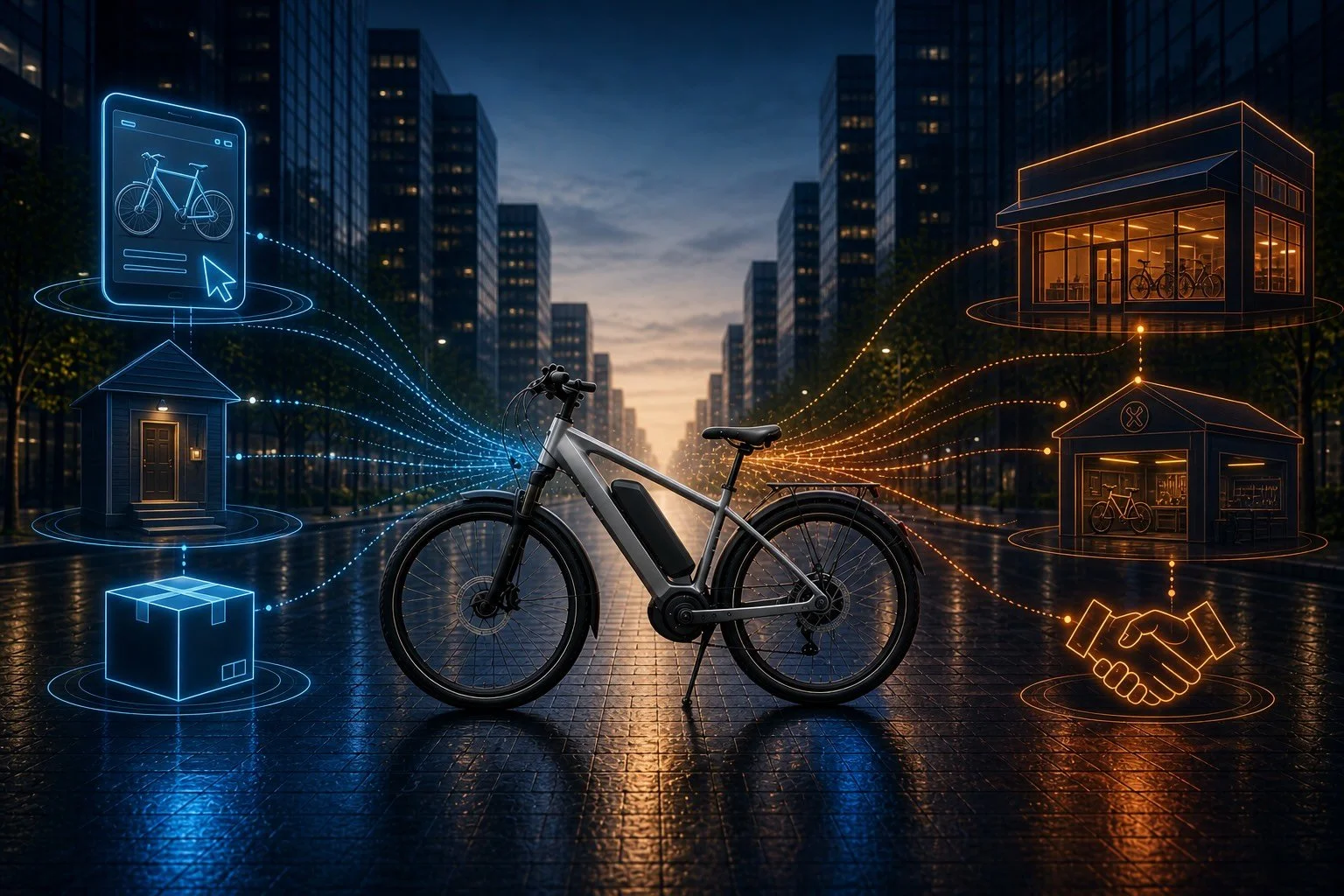
The winning channel model is the one that combines digital reach with physical reassurance, because customers ultimately buy confidence as much as convenience.
The fifth major failure pattern was assuming that direct-to-consumer distribution would permanently outperform local retail and service channels. DTC created real advantages: faster launch, cleaner brand storytelling, better first-party customer data, lower initial channel friction, and the ability to bypass legacy retailers that were slow to embrace e-bikes. But e-bikes are not apparel, cosmetics, or simple electronics. They are heavy, safety-sensitive, repairable mobility assets. A DTC model can sell the first bike efficiently; it may struggle to support the second and third years of ownership without local service density.
The customer journey reveals why. Before purchase, consumers need education on class type, range, fit, battery care, charging, cargo options, theft protection, insurance, and local rules. At delivery, they may need assembly, brake adjustment, accessory installation, firmware setup, and safety briefing. During ownership, they need maintenance, diagnostics, battery support, tires, brakes, drivetrain service, software help, and warranty escalation. After ownership, they may need trade-in, resale, refurbishment, or battery recycling. This journey is too complex to be handled only by a website and a support queue unless the product is unusually standardized and the customer is unusually self-sufficient.
Service data show where value may concentrate as the market matures. ZIV’s specialist-retailer data show workshop business remaining on a growth path after a 13.5% increase in sales in 2025, with 89% of surveyed specialist retailers viewing workshop development positively in 2025 and 78% expecting positive development in 2026. This is a mature-market signal. New-unit sales may fluctuate, but the installed base produces service demand. Brands that lack service infrastructure risk losing customer trust exactly when ownership economics should be improving.
Distribution should therefore be built around trust density, not simply sales reach. Trust density means consumers have accessible places to test, fit, repair, and resolve issues. It means technicians have parts, tools, training, diagnostic access, and economic incentives. It means dealers trust the manufacturer enough to recommend the product. It means customers view the e-bike not as a risky online purchase, but as a supported mobility relationship. In a category shaped by safety and uptime, distribution is not just a route to market. It is part of the product promise.
The post-shakeout market is already moving in this direction. Reuters reported that VanMoof’s new owner planned to shift from an in-house retail model toward third-party retailers for sales and service. Cowboy’s transaction with ReBirth emphasized more reliable deliveries, better parts availability, and a stronger service network. These moves are not accidental. They reflect a broader correction: e-bike brands need local infrastructure, but they may not be able to own all of it profitably. Partner-enabled distribution can improve customer access while converting some fixed costs into more flexible economics.
The best model is likely service-backed omnichannel. Digital channels should drive awareness, configuration, education, financing, and customer data. Local partners should support test rides, assembly, delivery, repair, warranty, accessories, and relationship management. The manufacturer should own quality standards, diagnostics, training, parts systems, certification documentation, and brand experience. The channel should own local execution. This model preserves many DTC benefits while reducing the burden of supporting a geographically dispersed installed base.
Channel economics must be designed before launch. Dealers require margin, labor recovery, parts availability, training, and confidence that the brand will support warranty claims. A manufacturer that views dealer margin as avoidable leakage may underinvest in the very infrastructure that reduces field friction. A better view is that dealer economics are a form of distributed risk management. Dealers localize trust, diagnose problems, absorb education needs, and maintain the relationship when things go wrong.
Leasing strengthens the importance of channel integration. In the German specialist-retail context, leasing represented 41.9% of bicycle sales in 2025. Leasing rewards brands that can maintain residual value, provide service documentation, support repairability, and manage returned bikes. It also strengthens dealer relationships because leasing often requires advice, fitting, servicing, and replacement planning. A bike that cannot be serviced locally is less attractive in a leasing ecosystem.
The first wave of e-bike startups often promised “beautiful electric bikes delivered to your door.” The next wave should promise “reliable mobility, locally supported, safely certified, financially accessible, and repairable over time.” That may sound less glamorous, but it is more powerful. Customers who depend on an e-bike for commuting, family logistics, or delivery work care about uptime. A bike without parts is not a mobility solution. A bike without a qualified technician is not premium. A bike without local trust is not resilient.
The e-bike channel is not merely a route to market; it is the physical infrastructure that converts a risky hardware purchase into a trusted mobility relationship.
Lessons learned from redesigning distribution around service density rather than website conversion alone: (i) Treat local service access as part of the product promise; (ii) use digital channels for demand generation while partnering for fitting, delivery, repair, and warranty; (iii) build dealer economics into pricing before launch; (iv) use leasing and refurbishment to create lifecycle revenue; (v) measure channel success by uptime, repeat purchase, attachment sales, service retention, and customer confidence rather than first-sale conversion alone.
Regulation and Safety Are Moving from Compliance Burden to Commercial Moat
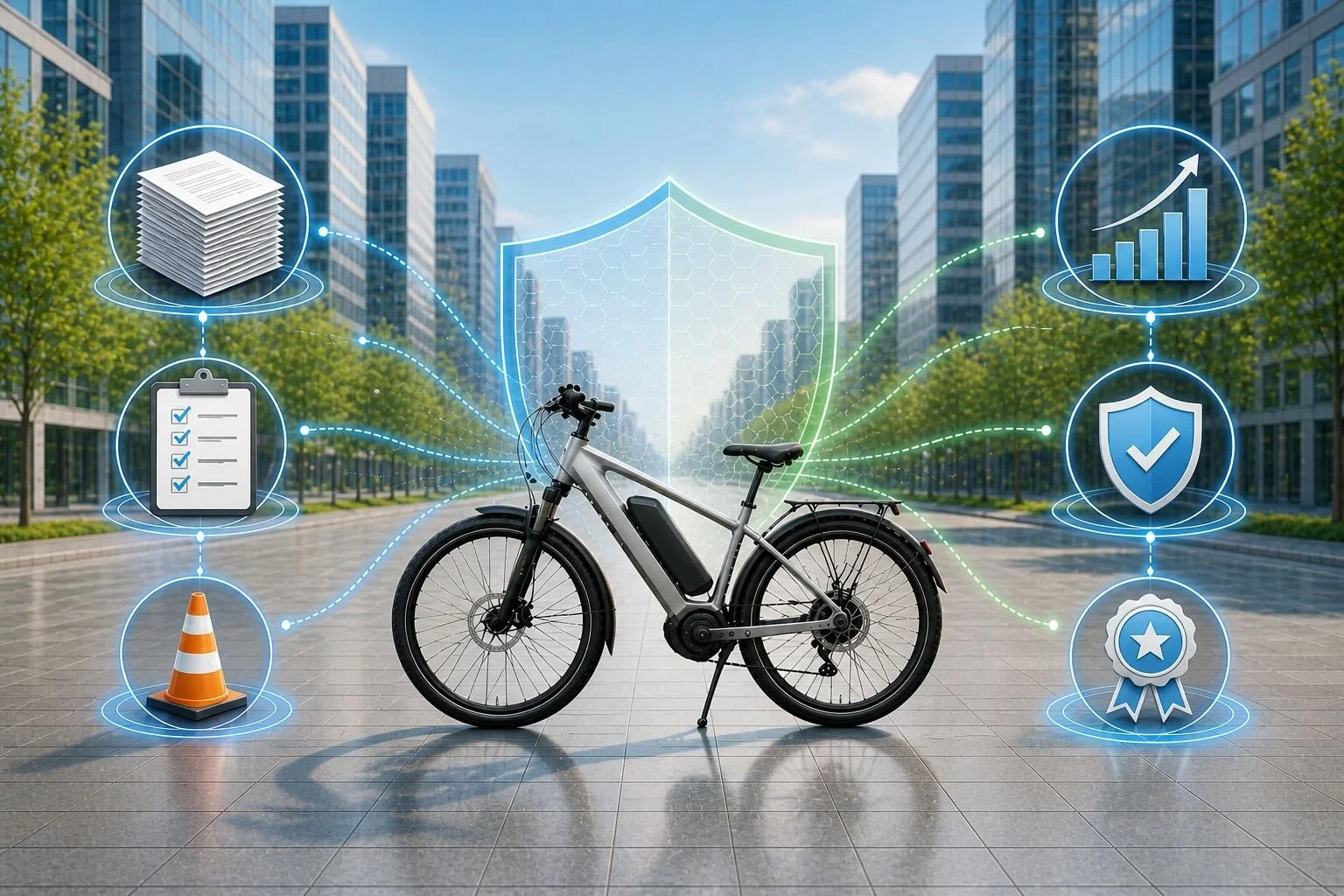
In a category powered by lithium batteries and used in public spaces, safety leadership is not defensive compliance but a foundation for trust and scale.
The sixth failure pattern was treating safety and regulation as late-stage compliance tasks rather than core elements of strategy. E-bikes occupy a sensitive space: they are consumer products, rechargeable battery systems, transportation devices, and in many jurisdictions regulated mobility assets. That means safety failures can damage not only a brand, but also the category’s public legitimacy. As adoption rises, regulators, insurers, landlords, transit agencies, schools, retailers, and city governments will all become more active in defining what qualifies as a legitimate e-bike and what standards are required.
The U.S. classification system shows the regulatory complexity. The National Conference of State Legislatures summarizes the common three-tier system: Class 1 e-bikes provide assistance only when the rider pedals and stop assistance at 20 mph; Class 2 e-bikes may be propelled by motor and stop assistance at 20 mph; and Class 3 e-bikes provide pedal assistance up to 28 mph and include a speedometer. This framework matters because products that blur the line between e-bikes and higher-powered electric motorcycles can trigger access restrictions, school bans, enforcement concerns, insurance issues, and public backlash. The industry must protect the legitimacy of low-speed e-bikes if it wants broad access to bike lanes, paths, campuses, and shared urban infrastructure.
Battery safety is more urgent. The CPSC warning involving certain Rad Power Bikes batteries stated that the batteries could unexpectedly ignite and explode, especially when exposed to water and debris. The agency cited 31 fire reports, including 12 property-damage reports totaling approximately $734,500, and stated that Rad had refused to agree to an acceptable recall while indicating it could not offer replacement batteries or refunds to all consumers given its financial situation. This should not be generalized to all e-bikes. But it demonstrates the strategic magnitude of safety obligations. If a company cannot financially support a safety remedy, the product issue becomes a corporate solvency issue.
Certification is becoming a market-access requirement. UL Solutions describes UL 2849 as examining the electrical drivetrain, battery, and charger system combinations of e-bikes. It also notes that New York City’s 2023 law required e-bikes, e-scooters, powered mobility devices, and light EV battery packs sold, leased, or distributed in the city to obtain third-party certification to standards including UL 2849, UL 2272, and UL 2271. That is a crucial shift. Safety certification is no longer an optional premium feature. In certain markets, it is a condition of sale.
The commercial implications are significant. Retailers may refuse uncertified products. Cities may restrict them. Landlords may impose charging rules. Insurers may price risk differently. Financing partners may require documentation. Dealers may avoid brands that expose them to liability. Parents may ask whether a teen’s e-bike is certified. Employers may demand proof before including bikes in benefit programs. Fleet operators may require battery traceability and maintenance documentation. Safety therefore becomes part of market access, pricing power, and customer trust.
A safety-led operating model has several components. First, the battery, charger, controller, wiring harness, motor, firmware, and diagnostics should be treated as one certified system. Second, supplier substitutions should trigger engineering review and documentation updates. Third, serial-number traceability should link bikes to battery batches, component revisions, firmware versions, and suppliers. Fourth, field incidents should be captured and escalated rapidly. Fifth, customer education on charging, storage, water damage, and inspection should be embedded in onboarding. Sixth, companies should maintain financial reserves and processes for recalls, warnings, or targeted replacements.
The behavioral dimension matters too. Products are used in homes, garages, apartment corridors, workplaces, delivery depots, schools, and dense urban environments. Batteries may be charged overnight, stored in heat, exposed to rain, dropped, repaired informally, or used with non-original chargers. A robust company designs for foreseeable misuse while educating customers clearly. Apps can support this through charge-state alerts, battery-health diagnostics, charger verification, and service reminders. Dealers can reinforce it through inspection and maintenance routines.
Regulation should not be treated as legal overhead. It should be converted into product and brand architecture. Clear class labeling, certified systems, controlled software locks, responsible marketing, dealer education, and market-specific configuration all reduce risk. The strongest companies will market safety without making the category feel frightening. They will make certification, traceability, charging discipline, and service training part of the value proposition. In a category where public confidence determines access, compliance is growth strategy.
Safety certification and regulatory clarity are no longer back-office obligations; they are becoming front-office differentiators that determine market access, customer trust, and enterprise resilience.
Lessons learned from turning safety, certification, and classification into strategic advantages: (i) Design the battery, charger, controller, harness, and firmware as one certifiable system; (ii) treat supplier substitutions as controlled engineering events; (iii) maintain traceability that enables targeted field action; (iv) educate customers on charging, storage, and inspection as part of onboarding; (v) position compliance as a trust-building feature rather than a reluctant cost.
Supply Chains, Tariffs, Inventory, and Forecasting Discipline Define the Next Profit Pool
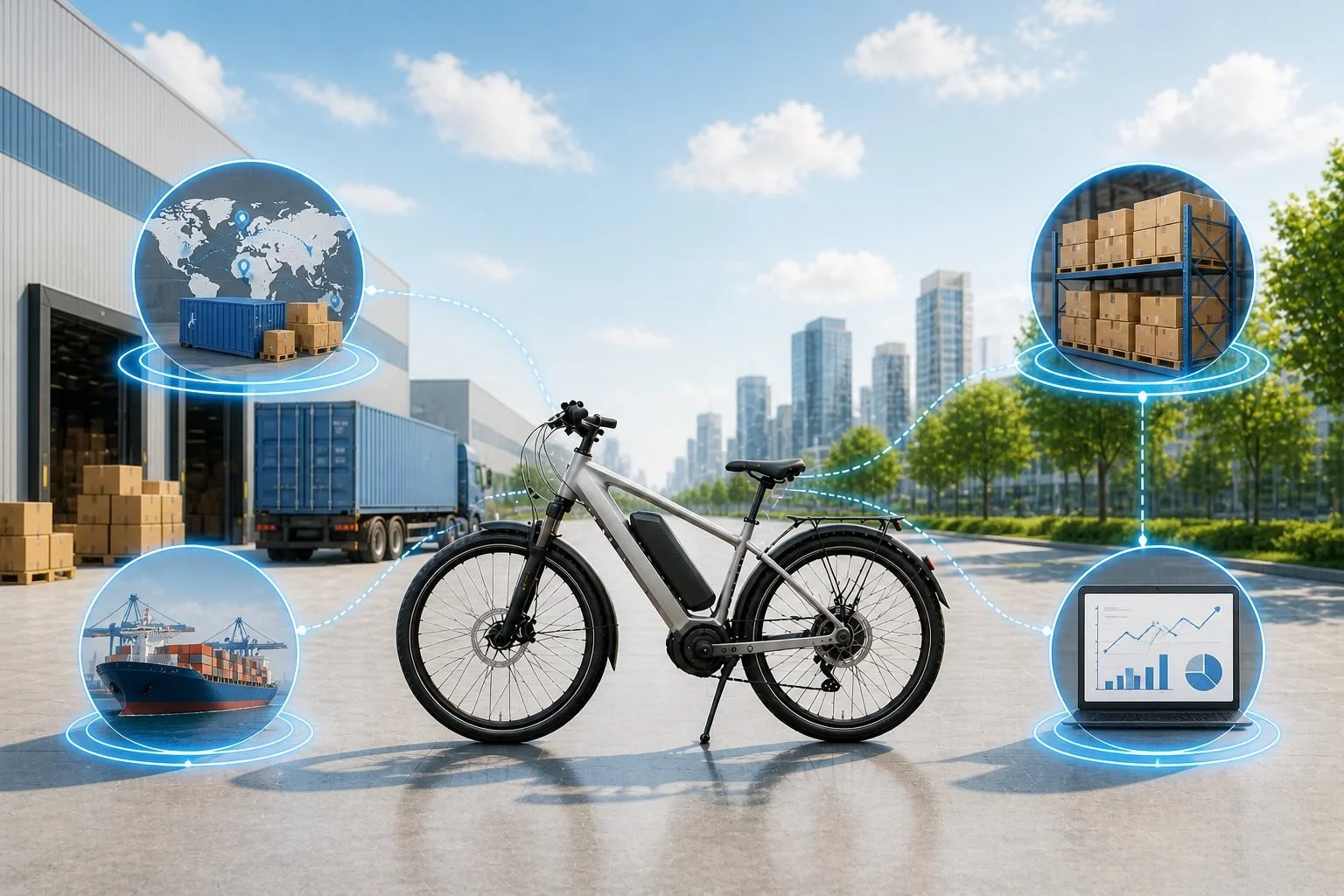
The strongest operators will convert supply-chain uncertainty into advantage by matching production, parts, tariffs, inventory, and cash commitments to real demand signals.
The seventh failure pattern was underestimating the combined impact of supply-chain volatility, tariffs, inventory aging, and weak sell-through visibility. E-bike companies do not simply respond to demand; they stage physical supply ahead of demand. Months before a customer buys a bike, the company must decide which frames, batteries, motors, colors, chargers, controllers, displays, tires, racks, and accessories to procure. When the forecast is wrong, the penalty is not theoretical. Cash becomes trapped in inventory, discounts accelerate, warehouses fill, batteries age, spare-parts mismatches appear, and dealer trust weakens.
The pandemic amplified this problem. Companies ordered aggressively when demand was high and supply chains were constrained. Long lead times encouraged over-ordering because under-ordering risked stockouts. But when demand normalized, product arrived into a softer market. CONEBI noted that 2024 trade patterns reflected a correction, with greater reliance on domestically produced units and existing inventory rather than fresh imports or exports. ZIV’s 2025 specialist-retailer data show that inventory normalization was still an ongoing issue: stock levels were returning to normal after a long adjustment period, but current stock turnover was 1.70, while annual stock turnover was listed at 2.7. This is the long tail of an overstock cycle.
Tariffs add another layer of volatility. Rad Power Bikes’ Chapter 11 filing listed a top unsecured claim of $8.36 million owed to U.S. Customs and Border Protection for tariffs. Regardless of one company’s specific circumstances, the broader lesson is clear: duties are not abstract policy variables. They affect landed cost, price architecture, cash timing, creditor risk, and inventory value. A company that prices aggressively without tariff headroom can find itself squeezed between consumers who resist price increases and obligations that require cash.
The Strait of Hormuz crisis further complicates supply-chain strategy. Higher oil prices can raise freight, marine fuel, insurance, and logistics costs. The World Bank warned that energy prices were projected to surge 24% in 2026 and that commodity prices would rise 16%, with ripple effects into metals, fertilizer, inflation, and global growth. E-bike companies may benefit from increased consumer interest in alternatives, but they also face cost inflation in the very systems used to manufacture and move product. That makes demand forecasting more dangerous. A fuel-price spike can create short-term interest, but over-ordering into that spike may recreate the pandemic inventory problem.
The next competitive advantage will be a demand-sensing operating model. Companies need weekly dashboards that combine orders, cancellations, dealer sell-through, inventory age, service tickets, returns, warranty claims, financing approvals, accessory attachment, and geographic demand shifts. They need a sales and operations planning process with authority to slow production, reallocate inventory, simplify model mix, and trigger corrective action before discounting becomes destructive. Many startups treat S&OP as bureaucracy. In hardware mobility, it is a survival system.
SKU discipline is equally important. Every color, size, battery variant, motor option, display configuration, and accessory bundle increases forecasting complexity. Variety can support brand expression, but it also fragments inventory, lowers part commonality, complicates dealer training, and increases obsolescence risk. A utility-bike company may be better served by fewer core platforms and modular accessories. Customers can still personalize racks, bags, child seats, lights, locks, and software services without forcing the core bike architecture into unmanageable complexity.
Supply chains must also be designed for service, not only production. A company can launch a bike successfully and still fail customers if spare parts are unavailable. Spare-parts forecasting requires a different logic from finished-goods forecasting. It depends on installed base, failure rates, accident rates, service intervals, seasonal use, and model age. Parts supply must remain viable after a bike is no longer sold. Otherwise, past revenue becomes future customer anger.
In e-bikes, supply-chain excellence is not about sourcing the cheapest bike; it is about synchronizing demand, duties, parts, inventory, and cash before volatility turns growth stock into stranded capital.
Lessons learned from making forecasting, tariff resilience, and inventory velocity central to e-bike strategy: (i) Build scenario plans for tariffs, freight, currency, energy, insurance, and supplier disruption; (ii) track sell-through rather than shipments as the primary demand signal; (iii) simplify SKUs to reduce forecasting error and parts complexity; (iv) manage spare parts as a strategic asset tied to installed-base trust; (v) classify inventory by growth, resilience, and liability so corrective action begins before discounting becomes destructive.
Consolidation, M&A, and the Future Industry Structure After the Shakeout

Consolidation will reward buyers that can transform stranded brands, unsupported customers, and fragmented service networks into disciplined platforms with recurring lifecycle value.
The next phase of the e-bike market will be shaped by consolidation. That does not mean the category is weak. It means the category is becoming more industrial. Early growth phases often produce too many brands, too many SKUs, too much duplicated marketing, too little service density, and too many unsupported proprietary systems. A shakeout forces the market to reallocate assets from undercapitalized operators to owners with stronger balance sheets, dealer networks, manufacturing discipline, or lifecycle-service capabilities.
The first consolidation wave is distressed brand rescue. This is where a company with valuable brand equity, installed base, software assets, or product design becomes financially unsustainable and is acquired out of bankruptcy or distress. VanMoof is the clearest example: after bankruptcy, it was acquired by Lavoie, the e-scooter unit of McLaren Applied, and Reuters reported that the new owner planned to shift away from the in-house retail-store model toward third-party retailers for sales and service. This type of deal can preserve customer relationships and product IP, but it also transfers hidden obligations: parts shortages, warranty claims, battery risk, software maintenance, and customer trust repair.
The second wave is industrial-backbone consolidation. In this model, the buyer does not only provide capital. It provides manufacturing discipline, supplier access, retail infrastructure, and service capability. Cowboy’s move into ReBirth Group is instructive because the announced logic centered on production restart, parts availability, and expanded retail and service reach. Cycling Industry News reported that ReBirth’s network included 95 Oxygen stores, 10 Ovelo outlets, and around 500 independent bike dealers. The strategic lesson is that e-bike assets are more valuable when attached to infrastructure capable of supporting them.
The third wave is channel consolidation. Dealers, workshops, mobile mechanics, leasing providers, and authorized service networks will become more important as e-bike installed bases age. New-unit sales are cyclical, but service demand compounds with installed base. German specialist-retailer data show why this matters: workshop business grew 13.5% in 2025, and most specialist retailers expected to expand service offerings in 2026. This creates a consolidation opportunity around service platforms, technician training, diagnostic tools, parts logistics, and refurbishment.
The fourth wave is leasing and lifecycle consolidation. As e-bikes become more expensive and more central to household mobility, financing models will matter more. Leasing platforms can aggregate demand, structure replacement cycles, influence brand selection, and create a supply of returned bikes for refurbishment. In Germany, leasing represented 41.9% of bicycle sales in the 2025 specialist-retailer survey context. That is strategically powerful because leasing platforms can become gatekeepers: they can favor brands with reliable residual values, serviceable components, certified batteries, and predictable maintenance cost.
The fifth wave is safety and component-system consolidation. Battery certification, charger compatibility, motor-controller integration, firmware safety, and traceability are becoming too important to remain loosely managed. As regulation tightens, brands may depend more heavily on certified component ecosystems and less on one-off proprietary systems. This favors companies with standardized architectures, robust supplier qualification, and documentation discipline.
For investors, the diligence agenda changes. Traditional consumer-brand diligence—revenue growth, gross margin, customer acquisition cost, brand awareness—is not enough. E-bike M&A requires diligence on installed-base liabilities, battery batches, open warranty claims, spare-parts availability, certification status, service manuals, firmware dependencies, supplier contracts, tooling ownership, inventory age, tariff exposure, and product-liability history. Rad Power Bikes’ Chapter 11 filing illustrates how these issues can converge: the company listed estimated assets of $32.1 million, estimated liabilities of $72.8 million, inventory of about $14.2 million, and an unsecured tariff claim of about $8.36 million from U.S. Customs and Border Protection.
The future industry structure will likely include fewer independent venture-backed pure plays and more hybrid models: established bicycle groups with stronger e-bike portfolios, industrial owners rescuing brands, service networks gaining bargaining power, leasing platforms shaping demand, and component suppliers setting safety baselines. The best acquisitions will not simply buy brands. They will buy installed bases that can be profitably serviced, upgraded, financed, and retained.
E-bike consolidation is not merely financial cleanup; it is the market’s way of moving valuable customer demand into operating systems capable of supporting it.
Lessons learned from viewing M&A as an operating-model reset rather than a brand-portfolio exercise: (i) Diligence the installed base as a liability and an opportunity; (ii) value service infrastructure as highly as brand awareness; (iii) examine battery, firmware, certification, and parts obligations before pricing any deal; (iv) use consolidation to simplify platforms and rebuild trust; (v) treat leasing, refurbishment, and service retention as core sources of post-acquisition value.
What E-Bikes Mean for Countries, Cities, and Destinations Building Energy-Resilient Mobility Systems

Public-sector success depends on treating e-bikes as part of a coordinated mobility ecosystem, where infrastructure, incentives, safety, tourism, and local repair reinforce adoption.
The e-bike conversation should not remain confined to manufacturers, dealers, investors, and consumers. The category now has strategic implications for countries, cities, tourism destinations, employers, infrastructure authorities, and economic-development agencies. In a world exposed to oil-market volatility, congestion, household transport inflation, and pressure to reduce emissions, e-bikes are not simply private consumer products. They are a form of distributed mobility infrastructure. The practical question for policymakers is no longer whether e-bikes are interesting; it is whether public systems can integrate them safely, affordably, and productively into everyday mobility.
For countries, e-bikes sit at the intersection of energy security, industrial policy, public health, household affordability, and transport decarbonization. The Strait of Hormuz crisis reinforces this point. The U.S. Energy Information Administration described the strait as one of the world’s most important oil chokepoints, with oil flows averaging about 20 million barrels per day in 2024, equal to roughly 20% of global petroleum liquids consumption; the International Energy Agency similarly describes the strait as one of the world’s most critical oil transit chokepoints, with limited bypass options. No national e-bike program can neutralize a global oil shock. But a national short-trip electrification strategy can reduce exposure at the margin by helping households, delivery workers, students, and commuters replace fuel-intensive local car trips with low-energy electric mobility.
The national policy case is strongest when e-bikes are embedded in a broader active-mobility and industrial-development plan. France offers a useful example. Its national cycling plan committed €2 billion by 2027, aimed to double the cycle-lane network from 50,000 km to 80,000 km by 2027 and 100,000 km by 2030, allocated €500 million for bicycle purchase subsidies, and set targets to assemble 1.4 million bicycles in France by 2027 and 2 million by 2030. The plan also explicitly linked cycling to tourism, domestic production, repair, and local trips as an alternative to cars and public transport. That is the right framing: countries should not treat e-bikes as isolated consumer subsidies. They should treat them as part of a national mobility, manufacturing, skills, safety, and tourism platform.
For cities, the implications are even more immediate. E-bikes change the radius of practical cycling. They make longer commutes more feasible, reduce the physical barrier of hills, help older riders and less athletic riders participate, and support cargo use cases that ordinary bicycles cannot always handle. That makes e-bikes especially relevant for replacing short car trips, but only where the city provides safe lanes, secure parking, charging norms, clear rules, and enforcement. RMI’s e-bike calculator was created to help policymakers quantify the environmental, health, and economic impact of replacing short vehicle trips with e-bike trips, including reductions in vehicle miles traveled, greenhouse gases, nitrogen oxides, fine particulates, and carbon monoxide. In consulting terms, the e-bike is not the strategy by itself; the strategy is mode shift enabled by infrastructure, incentives, and trust.
Shared micromobility data show that e-bikes can materially increase utilization when deployed well. NACTO reported that people took 82 million station-based bike-share trips in member cities in 2025, up 6% from 2024 and 30% from 2023. In September 2025, station-based e-bikes averaged 6.3 trips per bike per day, compared with 3.4 trips per day for pedal bikes. NACTO also reported 10 million dockless e-bike trips in member cities in 2025. This matters for public agencies because utilization is a proxy for asset productivity. A city does not only need more bicycles. It needs bicycles that are used often, placed equitably, priced affordably, maintained reliably, and integrated with transit.
The city playbook should therefore include six practical moves. First, cities should build protected cycle networks that connect homes, schools, employment centers, retail streets, parks, and transit hubs. Second, they should require secure parking in train stations, apartment buildings, campuses, hotels, and commercial districts. Third, they should establish battery-safety rules and approved charging practices, especially in dense housing. Fourth, they should use income-qualified incentives so e-bikes do not become only a middle-class climate benefit. RMI notes that Denver’s 2022 incentive program put more than 4,700 e-bikes on the streets, with more than 65% of funding going toward low-income residents, and purchasers riding an average of 26 miles per week. Fifth, cities should integrate e-bikes with buses, rail, and bike-share systems to solve first- and last-mile gaps. Sixth, they should set clear speed, parking, path-access, and enforcement rules so e-bikes strengthen public confidence rather than creating sidewalk conflict.
For destinations, the opportunity is different but equally strategic. E-bikes can extend tourism beyond dense city centers and distribute spending into rural towns, coastal routes, wine regions, heritage corridors, national parks, and second-tier destinations. They allow visitors to cover more distance than walking, with less dependency on rental cars, tour buses, or taxis. That is valuable for destinations trying to reduce congestion, improve visitor dispersion, lengthen stays, and create higher-value local experiences. ECF describes EuroVelo as both a cycling-tourism platform and a broader cycle-route network that can also support daily trips. It also notes that the European Declaration on Cycling includes cycling tourism and multimodality.
The economic evidence for cycling tourism is material. A EuroVelo summary of a French study reported €5.1 billion in annual economic benefits linked to cycling tourism in France, a 46% increase between 2010 and 2018, while broader direct cycling benefits were estimated at €8.2 billion annually and 80,000 jobs. Germany’s cycling-tourism market also remains substantial: EuroVelo reported that ADFC’s 2025 bicycle travel analysis found about €40 billion in economic impact, with cyclists on trips of three or more nights spending €133 per day on average and one- or two-night travelers spending €144 per day. E-bikes can expand this market by making cycling tourism more accessible to older travelers, families, casual riders, and visitors who want scenic mobility without the exertion of traditional touring.
For destinations, the operating model matters. A destination that wants e-bike tourism cannot simply add rental bikes and declare success. It needs safe routes, route signage, charging access, repair partners, luggage transfer, hotel storage, trained guides, emergency response, insurance clarity, and digital route information. Hotels need secure overnight storage and charging policies. Wineries, museums, restaurants, and attractions need bike parking. Train operators need capacity for bikes or clear rental options at arrival points. Local governments need to coordinate road safety, wayfinding, and maintenance. The destination proposition is strongest when e-bikes become part of a curated visitor journey rather than a fragmented rental transaction.
The public-sector implication is that e-bike policy should be governed as a portfolio of interventions, not a single subsidy line. Countries should set safety, certification, import, recycling, incentive, and industrial-policy frameworks. Cities should focus on infrastructure, parking, equity, enforcement, shared systems, and transit integration. Destinations should focus on route quality, tourism packaging, local-business participation, repair ecosystems, and visitor experience. Each layer reinforces the others. A national subsidy without safe city infrastructure underperforms. City lanes without secure parking underperform. Tourism routes without repair and hospitality services underperform.
The strategic prize is larger than bicycles. E-bikes can help countries reduce oil-price exposure, help cities reclaim short trips from cars, and help destinations build lower-impact visitor economies. But the public sector must avoid the same mistake many startups made: confusing demand with system readiness. The e-bike only scales when the surrounding ecosystem is ready to make riding safe, convenient, affordable, serviceable, and socially accepted.
Countries, cities, and destinations should treat e-bikes not as consumer gadgets to subsidize episodically, but as mobility infrastructure that requires coordinated policy, safety, service, and place-based design.
Lessons learned from translating e-bike adoption into national, urban, and destination strategy: (i) Countries should connect e-bikes to energy resilience, industrial policy, public health, and household transport affordability; (ii) cities should prioritize protected lanes, secure parking, charging safety, equity incentives, and transit integration; (iii) destinations should package e-bikes around routes, hotels, local businesses, repair access, and visitor experience; (iv) public agencies should measure success through replaced car trips, utilization, access, safety, and local economic impact rather than bike counts alone; (v) governments should avoid one-off incentives unless the infrastructure, safety rules, and service ecosystem are strong enough to convert purchases into sustained mobility behavior.
Close-Out: The Winning Playbook for Energy-Resilient E-Bike Platforms

The ultimate winners will be the companies and places that make e-bikes dependable enough to shift behavior, not merely attractive enough to generate interest.
The next e-bike cycle will not be won by companies that merely survive the shakeout. It will be won by companies that use the shakeout to redesign the business around resilience, reliability, and lifecycle economics. The market has now learned three lessons at once. First, pandemic demand was real but distorted. Second, venture capital cannot permanently subsidize hardware economics that lack service density, spare-parts planning, certification discipline, and working-capital control. Third, the Strait of Hormuz crisis has made short-distance electric mobility more strategically relevant, but also more operationally demanding.
The winning playbook starts with customer-mission clarity. Companies should stop treating e-bike buyers as one segment. A cargo-bike family, a delivery rider, a student, a senior rider, a suburban commuter, a premium urban professional, and a recreational trail rider do not have the same economics. Each segment has different tolerance for price, downtime, weight, range, risk, and service friction. The strongest brands will define where they create genuine substitution value. In a world of higher fuel volatility, the highest-value segments are likely to be those that replace high-frequency short car trips, reduce second-car dependence, support commercial utility, or help households manage mobility inflation.
The second pillar is lifecycle unit economics. A company should not celebrate a bike sold until it understands the cost to support that bike through warranty, service, parts, software, battery health, and eventual resale or retirement. A sale that creates an unfunded service liability is not profitable growth. The next generation of e-bike leaders will build dashboards around contribution margin after freight, duties, customer acquisition, dealer margin, warranty, returns, parts, battery reserves, and technical support. They will track installed-base profitability, not only launch-month sell-through.
The third pillar is certified safety. Battery risk is now a category-level issue, not a technical footnote. Brands must design the battery, charger, controller, harness, firmware, and diagnostics as a system. They must maintain traceability, control supplier substitutions, educate customers on charging, and reserve financially for field action. Safety certification should be marketed as trust infrastructure. In a category that lives in homes, schools, apartments, workplaces, and dense streets, safety is not only compliance. It is permission to scale.
The fourth pillar is service density. The DTC model has a role, especially for demand generation, customer data, and brand experience. But service cannot be optional. A reliable mobility product needs accessible diagnosis, parts, trained technicians, and escalation paths. Dealers and workshops should be treated as profit partners and risk absorbers, not margin leakage. The German specialist-retailer data showing workshop growth and strong expectations for service expansion point to a durable source of value as installed bases age.
The fifth pillar is supply-chain and inventory discipline. The Hormuz crisis reinforces the need for scenario planning. Freight, energy, insurance, duties, and component availability can change quickly. Companies must avoid making production commitments based on temporary demand spikes, whether caused by pandemic behavior or gasoline-price anxiety. The best operators will use real-time sell-through, service-ticket data, dealer inventory, financing approvals, and warranty signals to govern production. They will separate growth inventory from resilience inventory and liability inventory.
The sixth pillar is consolidation readiness. Every e-bike company should assume that the sector will continue to consolidate. That means management teams should make themselves acquirable even if they do not intend to sell. Clean documentation, certified systems, standard parts, accurate warranty reserves, service records, software continuity, and inventory transparency all increase strategic value. Companies that cannot be diligenced cannot be valued properly.
The final pillar is positioning. The strongest message is no longer “electric bikes are fun.” They are, but that is insufficient. The stronger message is: electric bikes are practical, energy-resilient, locally serviceable, lower-cost mobility assets for the short trips that dominate daily life. That message speaks to consumers, employers, cities, investors, dealers, and policymakers at the same time.
The e-bike category’s future belongs to companies that combine mobility substitution, oil-shock resilience, certified safety, service density, and capital discipline into one coherent operating model.
Lessons learned from converting the market correction and oil shock into a durable executive playbook: (i) Build around customer missions where e-bikes replace real transport costs; (ii) manage every sale as the beginning of a lifecycle obligation; (iii) make certified safety and charging discipline visible parts of the brand promise; (iv) use dealers, workshops, leasing, and refurbishment to deepen lifetime value; (v) treat geopolitical energy volatility as a reason to strengthen operations, not as an excuse to chase undisciplined growth.
The e-bike market is not moving from boom to irrelevance. It is moving from enthusiasm to evidence. The evidence now required is operational: safe batteries, reliable products, local service, disciplined inventory, funded warranty obligations, transparent customer economics, and resilience against oil, freight, tariff, and capital-market shocks. The Strait of Hormuz crisis strengthens the strategic case for e-bikes, but only for companies that can deliver them as dependable mobility systems. The winners will not be those that sell the most exciting bicycle. They will be those that build the most trusted, serviceable, financially durable, and energy-resilient alternative for the short trips that define daily life.
OHK has been active in Jordan and the wider region for more than two decades, supporting clients in understanding how venture capital, industrial development, mobility solutions, logistics, infrastructure, and regional resilience translate into real economic value. At OHK, we help clients look beyond market excitement around electric mobility, e-bikes, micromobility, manufacturing, logistics platforms, and urban transport to assess the commercial, institutional, financial, and operational conditions that determine long-term success. Our work links ambition to implementation by examining demand, unit economics, supply chains, safety, regulation, financing, localization potential, execution risk, and strategic competitiveness. Across venture-capital assessment, industrial feasibility, mobility strategy, and investment planning, our aim remains consistent: clearer judgment, stronger systems thinking, and more durable outcomes. To discuss how OHK can support your next phase of mobility, industrial, or investment strategy, please contact us.