

Why and How the World Still Runs Through the Strait of Hormuz: The Infrastructure It Never Built
Hormuz remains a strategic bottleneck because the infrastructure, coordination, and long-term capital needed for resilience rarely aligned

This illustration shows how the global energy system depends on a single narrow chokepoint—the Strait of Hormuz—where a vast flow of oil passes through a corridor barely wider than a thread. The artery-like passage conveys how geopolitical tension, maritime security, and infrastructure constraints converge in one fragile space, highlighting that global energy stability is shaped not by supply alone, but by the resilience of the narrow pathways that move energy through the world economy.
The 2026 U.S.-Iran war has turned a long-known strategic vulnerability into an immediate global economic threat. As shipping through the Strait of Hormuz slows sharply and energy markets react, the crisis is exposing how little the world did to reduce dependence on one narrow corridor that carries about a fifth of global oil and LNG trade. This article examines the structure of that risk, the cost of underinvestment, why alternatives proved difficult, and the categories of solutions that could have reduced exposure. The scale is stark:
• At a 25% disruption, Hormuz would lose about 5 million barrels per day of oil and 2.5 Bcf/d of LNG—enough to affect roughly 5% of global petroleum liquids consumption and about 5% of global LNG trade, sending an immediate shock through energy-importing economies and global shipping markets.
• At a 50% disruption, the loss rises to about 10 million barrels per day of oil and 5.0 Bcf/d of LNG—roughly 10% of global petroleum liquids consumption and about 10% of global LNG trade, a scale large enough to drive severe supply tightening, major price spikes, and broad inflationary pressure worldwide.
• At full stoppage, roughly 20 million barrels per day of oil and 10.0 Bcf/d of LNG would be affected—about 20% of global petroleum liquids consumption and around 20% of global LNG trade, making it one of the most consequential energy shocks the world economy could face.
Reading Time: 45 min.
All illustrations are copyrighted and may not be used, reproduced, or distributed without prior written permission.
Summary: This article examines why the Strait of Hormuz remains one of the world’s most dangerous energy chokepoints despite decades of awareness of the risk. It shows how roughly a fifth of global oil and LNG trade still depends on a narrow corridor for which no fully scaled substitute exists. The piece explores the cost of under-diversification through insurance, shipping disruption, price shocks, and inflation, then explains why alternatives proved so difficult to build. It compares direct bypasses, linked corridors, strategic storage, megaproject redesigns, and demand reduction, concluding that the world’s failure was not lack of ideas, but failure to build enough resilience. The overall arc is: the Hormuz bottleneck → global exposure by scale → the price of concentration → why solutions proved harder than they appeared → physical bypasses → corridor chains → resilience buffers → megaproject visions → demand reduction as strategic relief → why resilience required layers, not slogans → conclusion.
Defining the Hormuz Problem: Why One Narrow Strait Carries Global Energy Risk
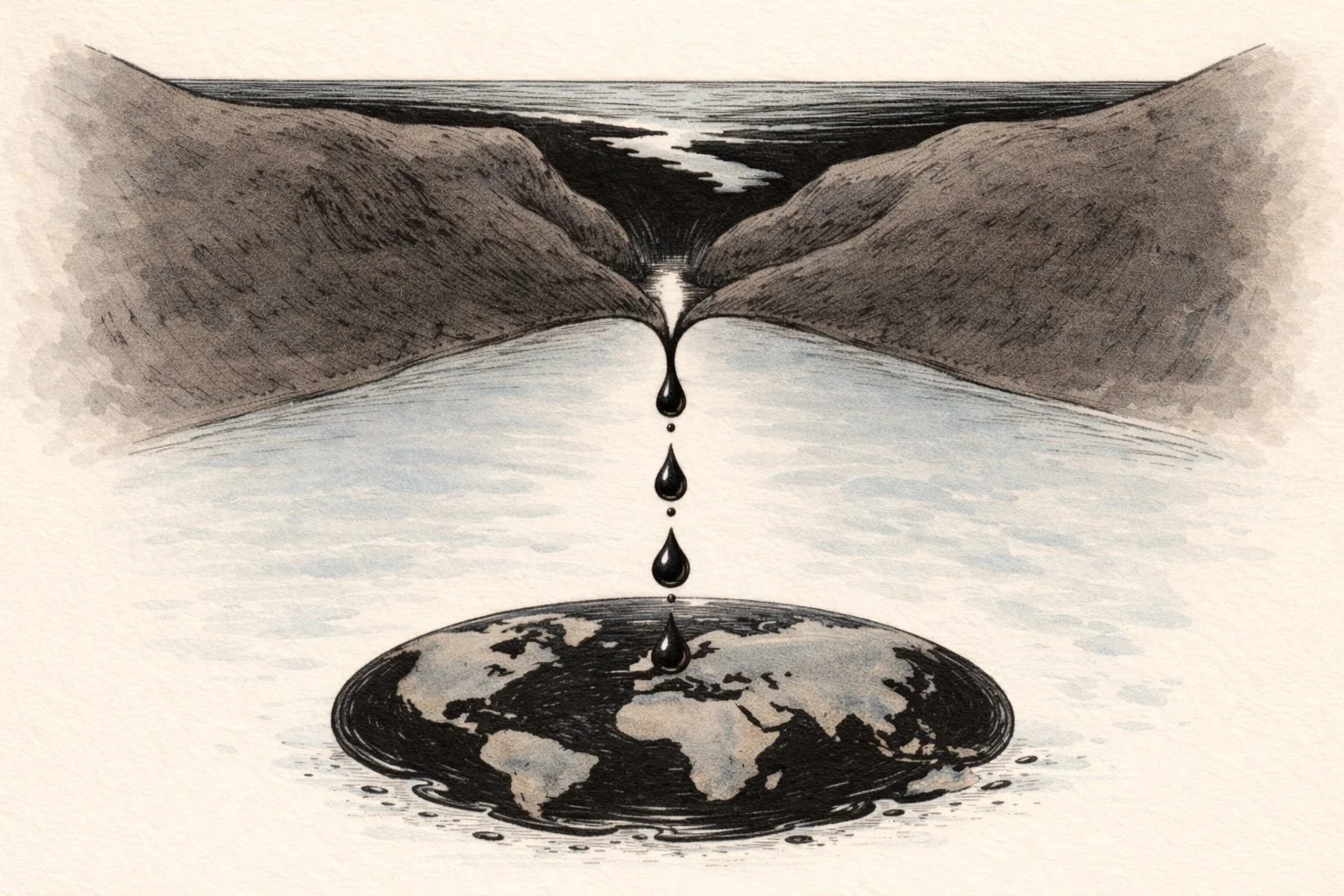
The Strait of Hormuz is not just a narrow waterway between the Arabian/Persian Gulf and the Gulf of Oman. It is one of the most consequential concentrations of energy risk in the world economy. In 2024, roughly 20 million barrels per day of oil moved through the strait, equivalent to about 20% of global petroleum liquids consumption and about 25% of world seaborne oil trade. The same chokepoint also handled about 20% of global LNG trade, with 83% of that LNG headed to Asia. Around 84% of crude and condensate passing through Hormuz also went to Asian markets, especially China, India, Japan, and South Korea. Any disruption would therefore hit not only Gulf producers, but the importing economies that anchor much of global manufacturing and trade.
What makes Hormuz uniquely dangerous is not only scale, but lack of substitute capacity. The US Energy Information Administration and the IEA both show that alternative export routes are small relative to the volumes normally flowing through the strait. The IEA estimates only 3.5 to 5.5 million barrels per day of available crude bypass capacity through Saudi Arabia’s Red Sea route and the UAE’s Fujairah route, versus nearly 20 million barrels per day of normal transit. In other words, even in a best-case diversion scenario, roughly 14.5 to 16.5 million barrels per day would still lack a direct substitute. Hormuz is therefore not simply a busy route; it is a chokepoint whose failure cannot currently be offset at scale.
A second way to define the Hormuz problem is to see it as a mismatch between globalized demand and concentrated transport geography. Energy demand is spread across continents, but a disproportionate share of oil and gas still depends on one narrow maritime corridor. That concentration magnifies the effect of every incident. A local attack, a mine threat, a drone strike, a crew-safety warning, or even insurer hesitation can become a macroeconomic event affecting refiners in Asia, fuel consumers in Europe and America, and central banks watching inflation expectations. In that sense, Hormuz is not merely a Middle Eastern security problem. It is part of the operating architecture of the world economy.
The scale of that dependence becomes clearer when translated into country exposure. China imported 11.1 million barrels per day of crude in 2024, and Columbia’s Center on Global Energy Policy notes that the Middle East still accounted for 44% of China’s crude imports. Japan relies on the Middle East for about 95% of its oil supplies, with around 70% of its oil coming via Hormuz. India, meanwhile, sourced about 55% of its crude imports from the Middle East as of January 2026, equal to about 2.74 million barrels per day. These numbers show why Hormuz matters even before any formal closure. It concentrates risk across the very countries whose energy demand helps set the tempo of the global economy.
It is also important to distinguish between closure risk and disruption risk. Total closure is the extreme scenario, but the market often reacts well before that point. Delayed sailings, reduced tanker availability, rerouting, insurer withdrawal, convoy requirements, and port congestion can all tighten supply and raise prices without a formal blockade. That is why Hormuz remains strategically potent even when traffic is still moving: the market prices insecurity, not just closure. A chokepoint of this size does not need to be fully shut to become globally disruptive.
Hormuz matters because it compresses an extraordinary share of the world’s oil and LNG trade into one narrow corridor for which no fully scaled substitute exists. Its danger lies not only in the volume it carries, but in the fact that local disruption can transmit instantly into global markets. This section shows why the Strait is not simply a regional flashpoint, but a structural weak point in the architecture of the world economy.
The Cost of Doing Little and The Price of Exposure: How Delay, Underinvestment, and Concentration Turn Risk into Cost

The Strait of Hormuz: a small crack through which the world’s energy economy leaks value.
The cost of leaving such a chokepoint structurally exposed is felt long before a full closure occurs. Markets do not wait for all cargoes to stop moving. Risk alone raises costs. The first transmission channel is insurance. In the current Gulf conflict, Reuters reported hull war-risk insurance rising from about 0.25% to as high as 3% of a vessel’s value. On a tanker worth $200 million, that implies a jump from roughly $500,000 to $6 million per voyage. On a $300 million vessel, the premium rises from about $750,000 to $9 million. These are direct additions to transport cost before counting delays, rerouting, crew bonuses, or tighter financing conditions.
The second channel is flow disruption. Even partial interruptions cause vessels to queue, pause loading, reduce speed, or divert. Reuters reported that at least 150 ships were stranded around Hormuz after attacks and insurer cancellations escalated the shipping risk. When that happens, the issue is not whether oil exists in the ground, but whether it can physically reach refiners on time and at tolerable cost. Delayed movement translates quickly into tighter prompt supply, higher spot prices, and more pressure on inventories.
The third channel is oil price response. History shows that supply shocks, or even feared supply shocks, can move oil prices violently. After the September 2019 attacks on Saudi facilities including Abqaiq, oil jumped by nearly 15% in one session after 5.7 million barrels per day of Saudi production was disrupted, roughly 6% of global supply at the time. Reuters has also noted that the 1973 Arab oil embargo led to a near quadrupling of oil prices, the 1979 Iranian Revolution roughly doubled spot prices, and Iraq’s invasion of Kuwait in 1990 pushed Brent to around $40, roughly a doubling from pre-crisis levels. More recently, during the current war, Reuters has reported Brent around the low-to-mid $90s, up sharply from pre-war assumptions, with some analysts warning that a prolonged conflict could test $120 or higher.
The fourth channel is inflation and downstream price pressure. Higher crude prices raise refinery input costs, which feed into gasoline, diesel, jet fuel, petrochemicals, fertilizer, and shipping. Reuters reported that U.S. average gasoline rose more than 10% in a week to $3.32 per gallon, while diesel rose about 15% to $4.33 after the war escalated. Those increases matter because diesel in particular transmits into freight, construction, food distribution, and industrial costs. A chokepoint crisis therefore does not stay at sea. It moves into household budgets and broader inflation.
Doing little also imposes a strategic premium on everyone else’s planning. Importing countries must hold larger emergency reserves, refiners must plan for feedstock substitution, governments must prepare inflation countermeasures, and shipowners must build geopolitical uncertainty into voyage economics. These are hidden costs of concentration. They may not sit in one line item, but they accumulate across reserve policy, working capital, hedging, and public finances. In effect, the world keeps paying for under-diversification even in periods that look calm on the surface.
This is where reserve arithmetic becomes especially revealing. Japan maintains petroleum stockpiles equal to roughly 235 days across national, private, and jointly held oil-producing-country stocks, while Reuters says that around 70% of Japan’s oil still comes via Hormuz. India says it has about 74 days of crude and fuel storage, but refining sources told Reuters that currently visible inventories may cover only 20–25 days. China’s combined strategic and commercial crude stocks provide at least 96 days of import cover at 2024 levels, and could reach 183 days if tanks were filled to capacity. These are large numbers in normal discussion, but they are small relative to a prolonged disruption. For example, replacing India’s current 2.74 million barrels per day of Middle East crude exposure for two years would require about 2.0 billion barrels of substitute supply. Replacing 1.69 million barrels per day of Japan’s Hormuz-linked imports for two years would require roughly 1.23 billion barrels. The lesson is not that reserves are unimportant, but that reserves are bridges, not permanent substitutes for missing corridors.
Past episodes confirm that energy systems do not need a full geopolitical rupture to feel major pain. The 2019 Saudi attacks, the 1973 embargo, the 1979 Iranian upheaval, and the 1990 Gulf crisis all show that even partial or temporary disruptions can produce outsized price effects. The current conflict adds a modern illustration: a market that, just before the war, had a Reuters poll consensus of only $63.85 Brent for the 2026 average can quickly flip into one trading near $90-plus, with insurance shocks, shipping paralysis, and growing downstream inflation. The cost of doing nothing is therefore cumulative. The world pays more not only when a chokepoint closes, but every time it leaves a known chokepoint under-diversified.
The cost of chokepoint dependence begins long before a full closure. Insurance premiums rise, shipping slows, inventories tighten, prices jump, and inflation spreads outward from the corridor into the wider economy. This section shows that leaving Hormuz under-diversified has imposed cumulative costs for years, and that the true price of inaction is measured not only in emergency scenarios, but in the recurring premium the world pays for concentrated risk.
Why Solving It Is So Difficult—More Than an Engineering Problem: How Scale, Coordination, Cost, and Politics Keep Alternatives Incomplete
If the vulnerability has been obvious for decades, why has it not been solved? The answer is that no single bypass can be delivered by engineering alone. The challenge is simultaneously technical, logistical, commercial, political, and geographic. The easy part is drawing a line on a map. The hard part is building an entire functioning system that can move enormous volumes safely, continuously, and competitively under real-world conditions.
From an engineering perspective, true alternatives require scale. A meaningful bypass is not just a pipeline. It also requires pumping stations, storage tanks, metering, blending systems, loading berths, dredging, terminal operations, security systems, maintenance regimes, and integration with upstream production infrastructure. For gas, the challenge is even harder. The IEA notes that there are effectively no meaningful alternative export routes for the vast bulk of Qatar’s LNG beyond limited pipeline gas to neighboring states. That means an oil bypass problem can at least be partially mitigated; an LNG disruption through Hormuz is much more rigid.
From a logistics standpoint, bypass systems must work as corridors, not isolated assets. Moving crude to another coast is only useful if there is enough storage, enough tanker handling, enough port draft, enough loading slots, enough insurance, and enough downstream market access at the far end. This is why even built alternatives often underperform expectations in practice. Saudi Arabia and the UAE have operational bypass routes, but the IEA still estimates that together they offer only 3.5 to 5.5 million barrels per day of available capacity against nearly 20 million barrels per day of normal Hormuz flows. In other words, even the world’s main existing solutions still leave about three quarters of normal transit volumes exposed.
Commercially, these projects are difficult because their value is most obvious during crises but much harder to monetize in quiet periods. Spare storage, secondary terminals, and partially idle pipelines can look inefficient next to concentrated, highly optimized routes that maximize peacetime returns. Investors often compare a certain upfront capital cost against a disruption cost that is probabilistic, even when the value-at-risk is enormous. If Hormuz carries about 20 million barrels per day, then at $70 oil the crude moving through it is worth roughly $1.4 billion per day; at $90 oil, roughly $1.8 billion per day. Over a year, that implies $511 billion to $657 billion in crude value passing through a single chokepoint, before counting LNG. The strategic logic for resilience is therefore strong, but private financing logic can still be weak if that resilience sits underused in normal years.
Another difficulty is that resilience assets often look inefficient in peacetime. Spare pipeline capacity, underused storage, secondary terminals, and redundant loading systems can all appear commercially inferior to concentrated, highly optimized routes. But strategic infrastructure should not be judged only by average utilization. Its value lies in what it prevents during shocks. That is exactly why many rational resilience projects struggle to get financed: they are most valuable in the states of the world that investors discount until crisis arrives.
This can be measured very directly. If a $250 million tanker faces a war-risk premium increase from 0.25% to 3%, the insurance bill rises from $625,000 to $7.5 million. If that ship carries 2 million barrels, the insurance component alone rises from about $0.31 per barrel to $3.75 per barrel before adding freight surcharges, delays, or financing costs on cargo. By contrast, a resilience asset such as spare pipeline capacity may appear “underused” for years while preventing exactly this kind of transport-cost shock. Markets often see the idle asset; they do not price the crisis it helps avoid until too late.
There is also a sequencing challenge. A corridor only works if upstream production systems, midstream transport, port handling, shipping availability, legal permissions, and destination market access all line up together. If even one link is weak, the whole alternative underperforms. That is why many bypass ideas sound compelling in principle but disappoint in practice: they solve one segment of the problem while leaving the rest of the chain constrained. For oil, the weakness is usually insufficient end-to-end capacity; for LNG, it is often the near-total dependence on fixed liquefaction and shipping chains. The challenge, then, is not the absence of ideas. It is the difficulty of converting strategic logic into financed, coordinated, built infrastructure.
The challenge of Hormuz was never just to build a pipeline or dig a canal. It was to create a fully functioning system of routes, terminals, storage, security, finance, and coordination capable of replacing one of the world’s busiest energy corridors. This section explains why many solutions that looked convincing on a map proved far harder in practice, and why the real barrier was not imagination, but delivery at the necessary scale.
Types of Solutions—Main Categories: Comparing Scale, Physics, Practicality, Cost, and Strategic Value
The alternatives to Hormuz dependence were never confined to one grand project. They fall into a few broad categories. But to judge them seriously, each category should be tested against the same question: could it realistically carry 25%, 50%, or even 100% of normal Hormuz daily flow? In practice, that means asking whether a given solution could handle roughly 5 million barrels per day, 10 million barrels per day, or 20 million barrels per day, what physical infrastructure that would require, how practical it would be, what it would likely cost, and whether that cost is reasonable relative to the scale of the risk being insured against. Since Hormuz carries nearly 20 million barrels per day, or well over $500 billion a year in crude value at ordinary oil prices, this is not a theoretical exercise. It is a way of testing whether the world ever invested at the level required to match the magnitude of the vulnerability. Below each category is analyzed and has five lenses: capacity threshold, physics, practicality, cost, and verdict.
The world did not lack options; it lacked enough commitment to any one of them. Direct bypasses, linked corridors, storage buffers, megaproject redesigns, and structural demand reduction all offered different forms of relief, but none was pursued at the scale required to materially transform the map. This section compares the main categories of response and shows that resilience was always going to require layers of solutions, not a single grand fix.
1- Direct Physical Bypasses: The Most Credible Solution, but Not at the Scale the Risk Required
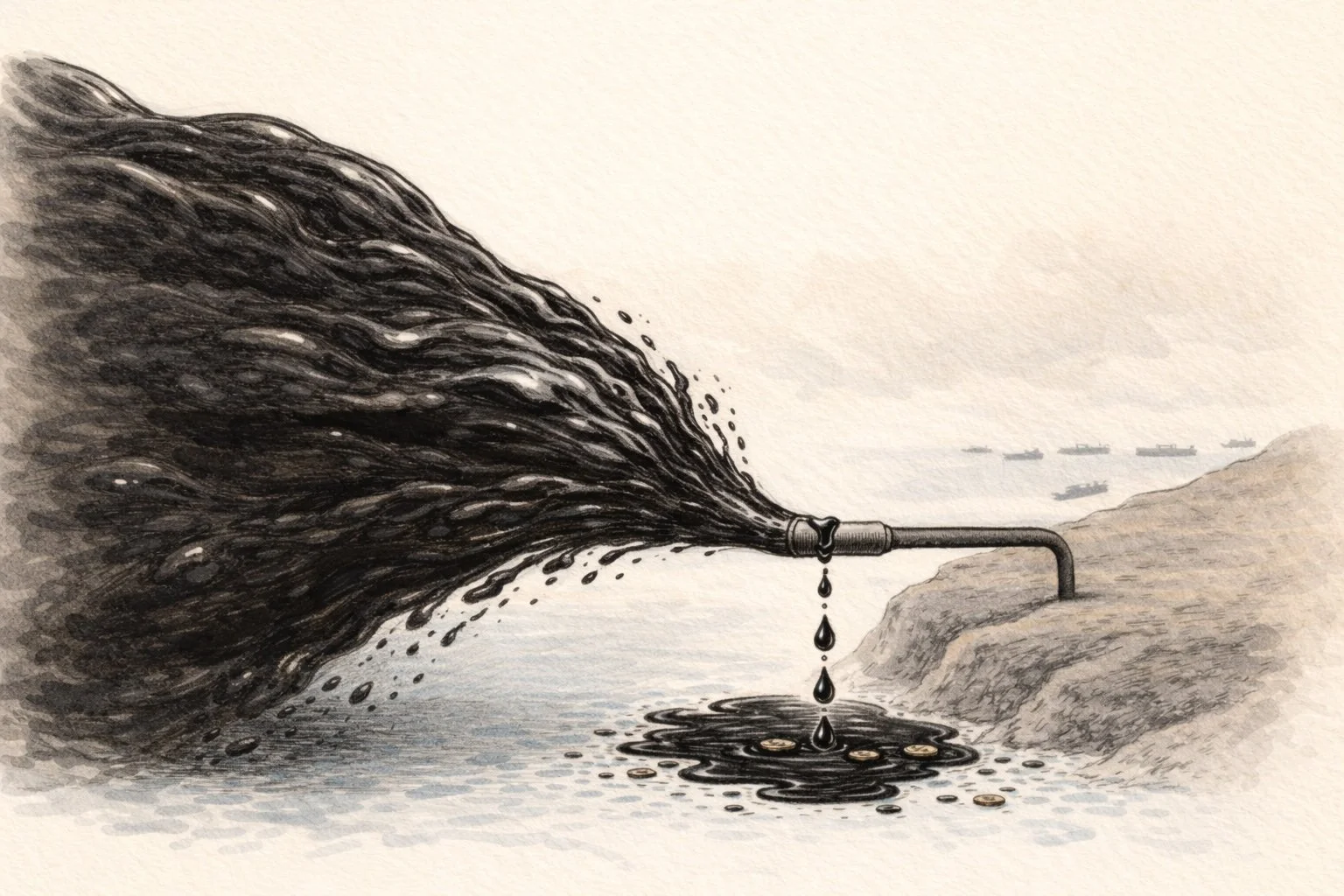
Existing bypass pipelines offer a path around Hormuz, but their capacity remains far smaller than the volume of oil the strait normally carries.
The first category is direct physical bypasses. These are the clearest solutions because they move oil to export points outside the strait. The two main real examples are Saudi Arabia’s East–West Pipeline to Yanbu and the UAE’s Habshan–Fujairah pipeline. In pure physics terms, this is the most efficient category because pipelines can move very large continuous volumes if the upstream gathering system, pumping stations, storage, and marine terminal capacity exist at both ends. But current scale is the problem. The UAE’s line carries about 1.5 million barrels per day and reportedly cost about $4.2 billion. Saudi Arabia’s East–West route can in theory reroute about 5 million barrels per day in current conditions, though Saudi pipeline system design capacity is higher than what is clearly available today. Together, these two routes roughly match the 25% benchmark, but they do not come close to the 50% benchmark and are far short of full replacement of Hormuz.
If one uses the UAE line as a rough capital benchmark, a 1.5 million barrels per day bypass costing $4.2 billion implies something like $2.8 billion per million barrels per day of pipeline capacity, before major new storage, additional marine berths, dredging, security systems, and associated terminal works. On that rough order of magnitude, a 5 million barrels per day new bypass system could easily imply $14 billion or more for the line alone, while 10 million barrels per day could push toward $28 billion-plus, and 20 million barrels per day toward $50–60 billion or more before counting the full export corridor around it. That is a large number, but it is still modest relative to the annual crude value moving through Hormuz. At $70 oil, 20 million barrels per day equals roughly $1.4 billion per day, or about $511 billion per year. So in strategic terms, direct physical bypasses are expensive but still look economically reasonable if they materially cut chokepoint exposure. Their real limitation is not that they are irrational, but that they require long planning horizons, coastal terminal buildout, and political commitment at a scale the region rarely sustained.
• Capacity threshold: This is the strongest existing category. Saudi Arabia’s East–West system and the UAE’s Habshan–Fujairah line are the only operational crude routes that can materially bypass Hormuz. But even together, the IEA estimates only about 3.5–5.5 mb/d of available bypass capacity, which means this category can roughly approach the 25% threshold, but not the 50% or 100% thresholds. The UAE line itself is about 1.5 mb/d.
• Physics: Pipelines are the most efficient way to move large oil volumes on land. Once built, they provide steady, continuous flow and avoid repeated ship-to-ship or ship-to-terminal transfers. But the pipe alone is not enough: to sustain multi-million-barrel-per-day throughput, you also need feeder lines, pumping stations, storage, marine export terminals, berths, metering, blending, and security. The physics are favorable, but only when the whole corridor is built end-to-end.
• Practicality: This is the most practical category because it already exists and can be expanded incrementally. The challenge is scale, not concept. Moving from today’s roughly 3.5–5.5 mb/d toward 10 mb/d would require major terminal and storage upgrades in addition to new line capacity. Reaching anything close to 20 mb/d by pipelines alone would be a generational build-out, not a marginal expansion.
• Cost: The UAE’s Habshan–Fujairah project is a useful benchmark: reliable industry references put it at around $4.2 billion for 1.5 mb/d, or roughly $2.8 billion per mb/d of line capacity before counting major additional downstream works. On that rough order, 5 mb/d of fresh bypass capacity could imply something like $14 billion-plus, 10 mb/d perhaps $25–30 billion-plus, and 20 mb/d very likely well above $50 billion, especially once export terminals, tankage, and security hardening are included.
• Verdict: This is the most credible hard-infrastructure answer. It is expensive, but reasonable relative to the scale of the risk. At $70 oil, 20 mb/d moving through Hormuz represents about $1.4 billion per day of crude value, or over $500 billion per year. The problem is not that direct bypasses are irrational; it is that the world never built enough of them.
If the goal was simply to move oil outside Hormuz, direct bypass pipelines were the clearest and most technically convincing answer. Their weakness was not logic, but scale. They were built, but not built enough. Direct physical bypasses remain the strongest hard-infrastructure solution, while also revealing how far short they still fall of replacing more than a fraction of normal Strait transit.
2- Linked Corridor Chains: More Achievable Than Megaprojects, but Still Only Partial Solutions
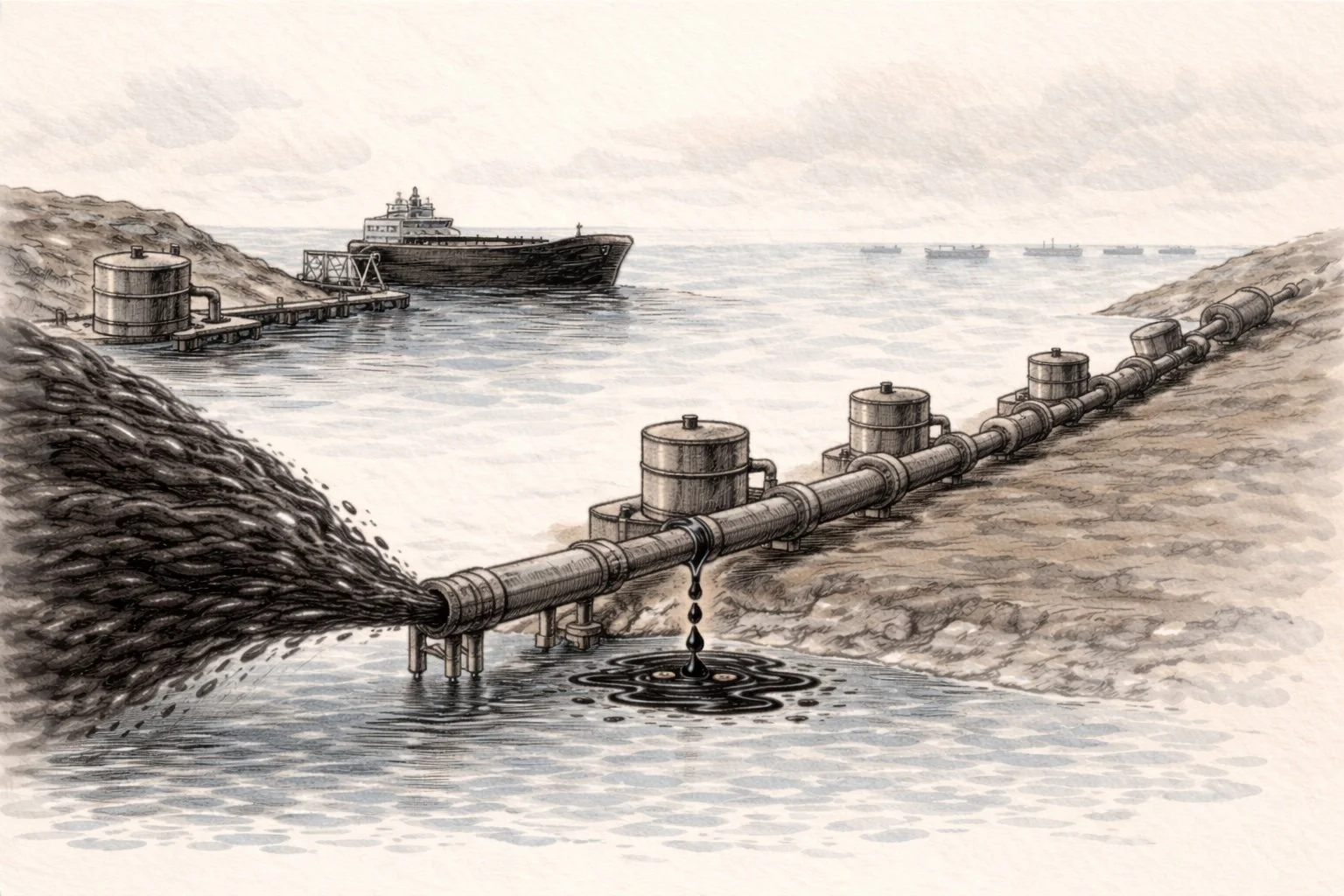
Linked corridors combine pipelines, ports, and tanker transfers into an alternative route—but every additional link introduces new constraints and vulnerabilities.
The second category is linked corridor chains. Here, no single asset solves the problem, but several systems together create an alternative route. The clearest example is the Saudi westward corridor feeding the Red Sea, combined with Egypt’s SUMED pipeline, which can move about 2.5 million barrels per day from the Red Sea to the Mediterranean. In physics terms, this is a chain rather than a line: production must first move across Saudi Arabia, then be loaded on the Red Sea, then cross to Egypt or arrive there by tanker, then pass through SUMED, then reload to the Mediterranean. It is therefore much more operationally complex than a direct bypass. Every transfer point adds tankage, scheduling, marine exposure, insurance cost, and bottleneck risk.
In terms of scale, a corridor chain can be strategically powerful, but it struggles to hit the larger thresholds cleanly. SUMED at 2.5 million barrels per day is only half of the 25% benchmark, and even when paired with Saudi westward export capacity, the system depends on multiple infrastructures all functioning at once. Reaching 5 million barrels per day through such a chain is plausible with major optimization and spare terminal capacity. Reaching 10 million barrels per day would likely require substantial expansion at several points: more Red Sea tankage, more berths, more pumping, more scheduling flexibility, and possibly additional Egyptian transfer capacity. Reaching 20 million barrels per day by corridor chains alone is not realistic. Cost-wise, the advantage is that parts already exist, so upgrading a chain is cheaper than building a totally new mega-route from scratch. That may put the likely cost in the low tens of billions, not the hundreds of billions, for a meaningful enhancement. Against the scale of the risk, that looks reasonable. Against the complexity of cross-border coordination, it is much harder. So linked corridors are attractive because they are more achievable than canal megaprojects, but they are still partial answers rather than full substitutes.
• Capacity threshold: This category links existing assets into a workaround rather than relying on one mega-asset. The best example is Saudi westward exports to the Red Sea combined with Egypt’s SUMED pipeline, which can move about 2.5 mb/d from the Red Sea to the Mediterranean. That means SUMED alone covers only about half of the 25% threshold, and far less of the 50% or 100% thresholds.
• Physics: The physics here are more complex than with a direct bypass. A corridor chain requires multiple handoffs: production moves west, reaches a Red Sea terminal, crosses by tanker, enters Egypt’s system, transits SUMED, and is re-exported in the Mediterranean. Every transfer point adds delay risk, scheduling friction, storage needs, and marine exposure. So this category can work, but it is operationally less elegant than a single direct route.
• Practicality: This is more practical than a giant new canal because key pieces already exist. It is also politically more feasible than building an entirely new transnational megaproject. But it is only as strong as its weakest link. If one terminal, berth, pipeline segment, or tanker rotation is constrained, the whole chain underperforms. It is a good “system optimization” option, but not a clean one-shot solution.
• Cost: Because much of the hardware already exists, the cost is more likely in the single-digit to low tens of billions of dollars for meaningful upgrades, rather than the tens to hundreds of billions needed for a wholly new route. That makes it comparatively attractive. But the tradeoff is that spending $10–20 billion on a linked chain still may not deliver anything close to 10 mb/d of dependable bypass performance.
• Verdict: Linked corridors are one of the most sensible medium-term answers because they can be improved faster than brand-new megaprojects. But they are partial answers. They are best for moving the system from “almost no flexibility” toward “some flexibility,” not for replacing Hormuz at full scale.
Linked corridors offer a more achievable path because they build on infrastructure that already exists, combining multiple routes into a functional workaround. Yet every additional transfer adds complexity, friction, and new bottlenecks. Corridor chains are among the most realistic medium-term answers to Hormuz dependence, but also explains why they remain partial solutions—useful for flexibility, not decisive enough to replace the Strait at full scale.
3- Buffer and Resilience Measures: Essential for Buying Time, but Not for Replacing the Route
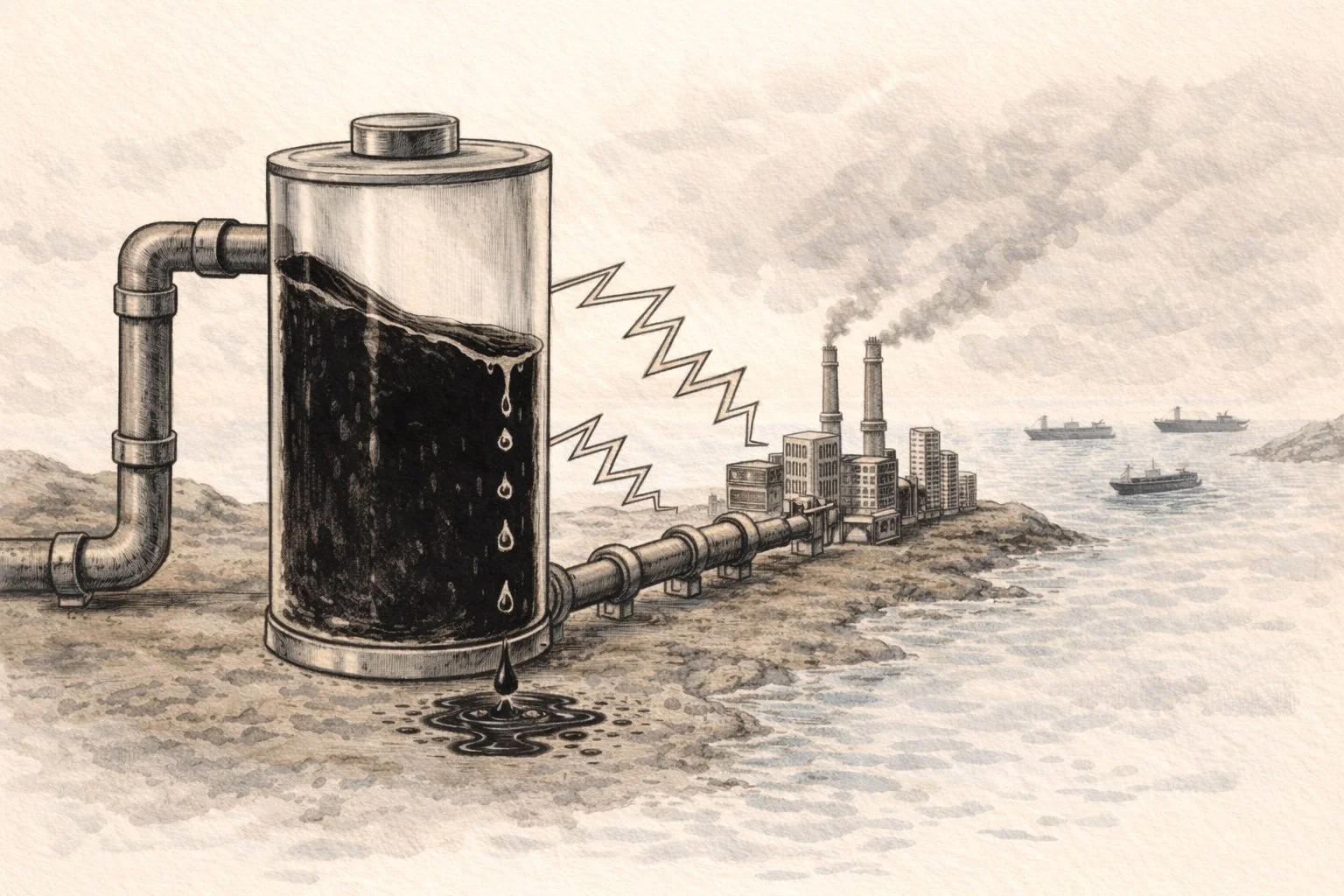
Strategic oil reserves function like a battery: they can power the system during disruptions, but only for a limited time.
The third category is buffer and resilience measures. These include strategic storage, inland tank farms, export hubs such as Fujairah, and emergency stockpiles. These do not “carry” Hormuz flow in the same way a pipeline does, so their physics must be measured differently. Instead of barrels per day of transport capacity, the relevant metric is barrels of time — how many days or months of import loss they can absorb. This category is operationally very practical because storage is proven, modular, and often easier to finance than giant new corridors. But it cannot solve a long disruption by itself.
The arithmetic makes the limitation obvious. To buffer the loss of 25% of Hormuz flow for 90 days, the system would need 450 million barrels of usable stocks. To buffer 50% of Hormuz flow for 90 days, it would need 900 million barrels. To buffer 100% of Hormuz flow for 90 days, it would need 1.8 billion barrels. At $90 oil, the inventory alone would cost about $40.5 billion, $81 billion, and $162 billion respectively, before paying for tanks, caverns, land, security, financing, and stock rotation. Country examples show why this is finite rather than permanent. Japan’s official stockpiling system totals about 235 days. India officially says it has about 74 days of crude and product storage, though Reuters reported refiners seeing only 20–25 days in visible inventories during the current crisis. China’s crude stocks are estimated by Reuters to total as much as 1.3 billion barrels, or more than four months of imports. Those are very large buffers, but not enough to replace multi-year exposure to Hormuz-linked flows without rerouting or demand destruction. So storage is highly reasonable as short-crisis insurance, but not as a complete substitute for transport infrastructure.
• Capacity threshold: These do not carry barrels per day in the transport sense. Instead, they provide days of cover. So the right threshold is time, not throughput. To offset the loss of 25% of Hormuz flow (5 mb/d) for 90 days, the world would need 450 million barrels of usable stocks. To offset 50% (10 mb/d) for 90 days, it would need 900 million barrels. To offset 100% (20 mb/d) for 90 days, it would need 1.8 billion barrels.
• Physics: Storage is straightforward in engineering terms: tanks, caverns, pumps, rotation, and inventory management. It is modular and proven. That makes it easier to deploy than giant corridors. But storage does not create a new route; it only delays the consequences of losing one. It solves a timing problem, not a geography problem.
• Practicality: This is highly practical and politically easier than new cross-border export corridors. Japan, China, and India all maintain strategic or broader stock systems. Japan’s stockpiles are roughly 235–254 days, China’s combined strategic and commercial stocks are at least 96 days and around 104 days by some 2026 estimates, and India officially cites about 74 days, though Reuters reported visible inventories nearer 20–25 days in the current crisis.
• Cost: At $90 oil, inventory alone for a 90-day buffer would cost about $40.5 billion for 5 mb/d, $81 billion for 10 mb/d, and $162 billion for 20 mb/d, before counting the tanks, caverns, land, financing, maintenance, and stock rotation. So buffering is not cheap. But as short-crisis insurance, it is often more achievable than building a transport corridor that can carry the same daily volume.
• Verdict: Buffering is essential, but finite. It is a bridge, not a substitute. It is highly reasonable for shocks lasting weeks or a few months, but it becomes extremely expensive and ultimately insufficient if the disruption is prolonged.
Storage, reserves, and export hubs are among the most practical ways to absorb immediate shocks, calm markets, and buy governments time. But they do not solve the underlying geography of dependence. They substitute time for flow, not one corridor for another. Buffer measures are indispensable in any serious resilience strategy, while making clear that even large stockpiles become inadequate when disruptions stretch from weeks into months or years.
4- Mega-Concepts and Corridor Redesigns: Where the Scale Matched the Risk, but the Practicality Collapsed

Mega-concepts such as artificial canals or corridor redesigns could theoretically replace Hormuz-scale flows, but their cost, complexity, and political barriers have kept them on the drawing board.
The fourth category is mega-concepts and corridor redesigns. These include proposals for an artificial canal through Gulf territory, multi-utility land bridges such as a Saudi–Sinai fixed link, and wider cross-border pipeline systems intended to redraw the map itself. In pure physics terms, these are the only concepts that might aspire to 50% or even 100% replacement scale without relying entirely on repeated ship-to-pipe transfers. A sea-level canal, for example, could in principle preserve the maritime model instead of replacing it with a pipeline model. But that is also why such projects are so difficult. To carry anything like a significant share of Hormuz tanker traffic, a canal would need not just a trench, but full navigation engineering, dredging, protection, environmental management, approaches, turning basins, and wartime hardening.
The cost and practicality are where these ideas usually collapse. The UAE bypass-canal proposal reported in 2008 was priced at around $200 billion for roughly 112 miles. That gives a sense of the order of magnitude. A canal-sized solution capable of handling very large tanker volumes is no longer a “midstream project”; it is a civilizational-scale megaproject. Relative to annual value-at-risk, $200 billion is not mathematically absurd if it truly solved most of the problem. But the practical obstacles are immense: sovereignty, terrain, security, environmental impact, military vulnerability, construction time, and the fact that a fixed canal is itself another chokepoint. That is why these schemes are intellectually important but operationally weak. They prove the vulnerability was recognized, yet they rarely moved beyond the drawing board because cheaper, smaller, politically easier partial solutions always won.
• Capacity threshold: This category includes ideas like a canal bypassing Hormuz, major new cross-border trunk routes, or a Saudi–Sinai multi-utility land bridge. In theory, these are the only concepts that could aspire to the 50% or even 100% thresholds without relying entirely on fragmented corridor chains. In practice, almost none reached build stage.
• Physics: The physics are daunting. A canal capable of handling large tanker traffic is not just a trench: it requires dredging, navigational control, turning basins, bank stabilization, environmental management, security hardening, and marine approaches. A land bridge carrying pipelines beneath or alongside it requires a fully integrated right-of-way, plus all the energy and logistics infrastructure on either end. These are not ordinary infrastructure projects. They are system-redesign projects.
• Practicality: This is where the category usually fails. The projects are politically exposed, slow to deliver, difficult to secure, and vulnerable to becoming new chokepoints themselves. Even if technically feasible, they are hard to finance because they require an unusual combination of long-term state coordination, security guarantees, and tolerance for enormous upfront capital.
• Cost: The reported UAE bypass-canal concept from 2008 was priced around $200 billion. That is not necessarily irrational if it truly solved a strategic risk affecting hundreds of billions of dollars of annual trade, but it is large enough to place the project in the category of historic megaprojects rather than normal energy infrastructure. Put differently, it is completely different class even from modern canal megaprojects. Egypt’s 2015 New Suez Canal expansion cost about $8.2 billion, and the Panama Canal Expansion capitalized about $5.68 billion in total program costs. The proposed Hormuz bypass, then, was roughly 25 times the cost of the New Suez Canal expansion and more than 35 times the Panama expansion, which underlines that it belonged not to the category of normal energy infrastructure, but to the realm of exceptional geopolitical megaprojects. That does not automatically make it irrational given the scale of the risk it aimed to solve, but it does explain why it never advanced beyond the conceptual stage.
• Verdict: These concepts are useful as evidence of how seriously the vulnerability was understood. But as practical solutions, they are weak. They are too costly, too slow, and too politically difficult to have been the main answer unless the region had made a once-in-a-century strategic decision to redraw the map.
OHK perspective: It is important to look at this proposal more closely, because OHK undertook work specifically to examine corridor alternatives, bypass options, and the strategic logic behind them. At first glance, the reported $200 billion price tag for a UAE bypass canal can sound so large that it is dismissed almost automatically. But that would be too superficial a reading. The better question is not simply whether the number was high, but what kind of project this actually was, what scale of risk it was trying to address, and whether the cost should be judged against ordinary infrastructure benchmarks or against the value of the strategic vulnerability itself. That is precisely why OHK’s analysis matters: it moves the discussion away from headlines and toward a more serious evaluation of feasibility, scale, and strategic trade-offs. To put that in perspective, the UAE’s 2026 federal budget is AED 92.4 billion, about $25.2 billion, so the canal would equal roughly 7.9 times one year of the entire federal budget. Even against the UAE’s larger economy, it would still amount to about one-third of national GDP: the IMF’s current-price estimate for UAE GDP is about $601 billion for 2026, which means a $200 billion project would equal roughly 33% of GDP.
If a project of that size were financed conventionally, it would almost certainly require either very large sovereign borrowing, major state-backed issuance, heavy use of sovereign wealth or national oil balance sheets, or some combination of all three. For comparison, the IMF puts UAE general government gross debt at 31.9% of GDP, while one official debt profile for Abu Dhabi shows AED 112.4 billion outstanding as of end-2025. Adding a $200 billion canal all at once would therefore represent a massive financing event even for a wealthy state. Spread over 10 years, the project would still require about $20 billion per year, equal to roughly 79% of the 2026 federal budget; spread over 20 years, it would still average about $10 billion per year, or roughly 40% of the annual federal budget. So the issue was not simply whether the canal was strategically interesting. It was whether any government would realistically commit a budgetary effort of that scale to a single transport-security project when cheaper, smaller, and politically easier partial alternatives existed.
This may answer the reader’s instinctive question: “Could the UAE realistically afford this as a normal public works project?” The answer is essentially no, not without extraordinary financing or a very long construction horizon.
Disclaimer: The UAE’s federal budget does not capture all public spending across Abu Dhabi, Dubai, and the other emirates, and a project of this kind would not necessarily have been paid from the federal budget alone; it could also have drawn on emirate-level resources, state-owned companies, sovereign wealth, or debt markets. The comparison is therefore illustrative: it shows order of magnitude, not a literal claim that the entire cost would have come directly from one annual budget.
The boldest ideas were also the least deliverable. Artificial canals, land bridges, and corridor redesigns were among the few concepts large enough to match the scale of the Hormuz problem itself, yet they demanded extraordinary financing, coordination, and political will. These proposals remain analytically important—even when unbuilt—because they reveal how seriously the vulnerability was understood, and how difficult true geographic transformation would have been.
5- Structural Demand Reduction: The Only Response That Shrinks the Exposure Rather Than Just Redirecting It
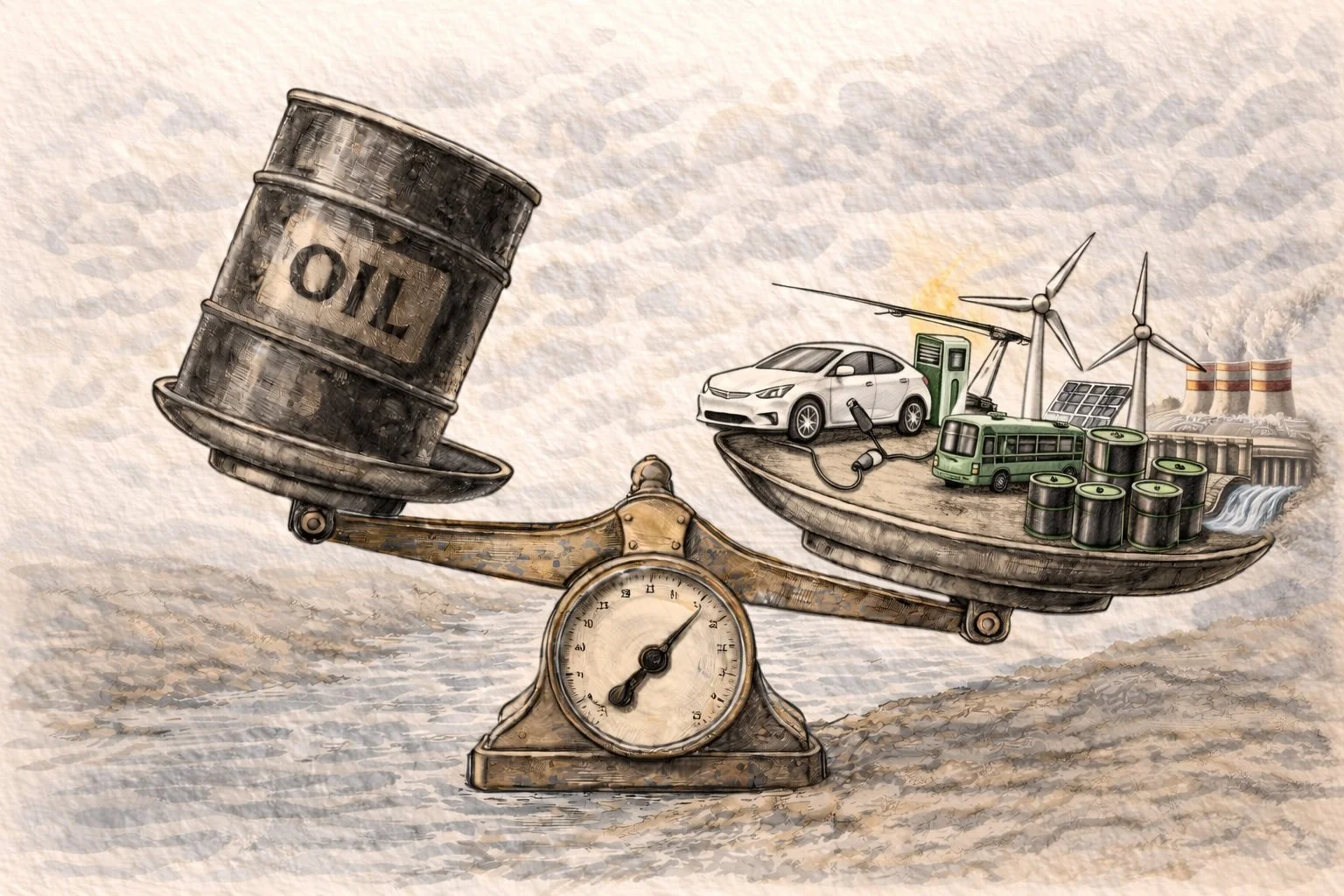
Demand reduction lightens the system: efficiency, electrification, and renewables reduce the volume of oil that must pass through global chokepoints.
The fifth category is structural demand reduction. This includes efficiency, electrification, domestic energy diversification, more renewables, nuclear in some markets, and reduced oil intensity in transport and industry. This does not bypass Hormuz physically, but it reduces how much the global economy depends on cargoes moving through it. The physics here are different again: the question is not whether a project can transport 5, 10, or 20 million barrels per day, but whether it can remove that much demand over time. In strategic terms, a sustained 1 million barrels per day reduction in demand has the same effect on exposure as creating a new 1 million barrels per day bypass route.
That is why this category deserves to be treated as real infrastructure relief, not just as a climate side note. If a large importer cuts oil demand by 10%, the exposure reduction is enormous. For China, against 11.1 million barrels per day of crude imports in 2024, that would mean about 1.11 million barrels per day less import dependence, or around 405 million barrels per year less exposure. For India, using the current 2.74 million barrels per day Middle East import figure, a 10% cut would trim vulnerability by about 274,000 barrels per day, or almost 100 million barrels per year. The practicality of this path is higher politically in some countries than building giant new export corridors across sovereign borders, but it is slower and more diffuse. Cost-wise, it is hard to compress into one number because it sits across vehicles, grids, efficiency upgrades, fuel switching, and industrial policy. Still, against a chokepoint that moves over $500 billion of crude a year, even expensive demand-reduction programs can be reasonable if they permanently lower import dependence by material amounts. This is why, over the long run, demand reduction may be the only category capable of matching the scale of the risk without trying to replicate Hormuz barrel-for-barrel in steel and concrete.
• Capacity threshold: Here the threshold is not transport capacity but demand displaced. A permanent 1 mb/d reduction in oil demand has the same strategic effect as creating a 1 mb/d bypass route. A 5 mb/d reduction would match the 25% threshold. A 10 mb/d reduction would match the 50% threshold. The scale is enormous, but so is the payoff.
• Physics: This category works by reducing the number of barrels that need to be imported, shipped, insured, stored, and routed through chokepoints. It comes from EVs, public transport, industrial efficiency, fuel switching, renewables, nuclear, and broader electrification. It does not solve an acute shipping disruption tomorrow morning, but over time it reduces the size of the problem itself.
• Practicality: Politically and institutionally, this is often easier than building giant new cross-border export routes, because countries can pursue it domestically. For large importers, the numbers are meaningful. China imported 11.1 mb/d in 2024; a 10% reduction in crude import dependence would reduce exposure by about 1.11 mb/d, or about 405 million barrels per year. India’s current Middle East exposure is about 2.74 mb/d; a 10% reduction in that exposure would cut about 0.274 mb/d, or nearly 100 million barrels per year.
• Cost: There is no single project cost because this category is spread across vehicles, grids, industrial upgrades, efficiency retrofits, and power systems. Some components are expensive, but unlike a bypass canal they also deliver benefits beyond resilience: cleaner air, lower domestic fuel bills, industrial modernization, and lower import dependence. That makes the economics broader and, in many cases, more attractive.
• Verdict: This is the slowest category, but probably the only one that can reduce exposure at very large scale without trying to recreate Hormuz in steel and concrete somewhere else. It is not a substitute for short-term security measures, but it may be the most durable long-term answer.
Unlike every other category, demand reduction does not try to reroute the same barrels through different infrastructure. It reduces the number of barrels that need to move at all. That makes it slower, but potentially more transformative. Efficiency, electrification, and diversification are not just climate or industrial policy tools; they are also strategic responses to chokepoint dependence, and perhaps the only ones capable of shrinking the problem at its root.
Bottom-Line Comparisons: What Each Category Could Really Do, What It Could Not, and Why the World Still Remained Exposed
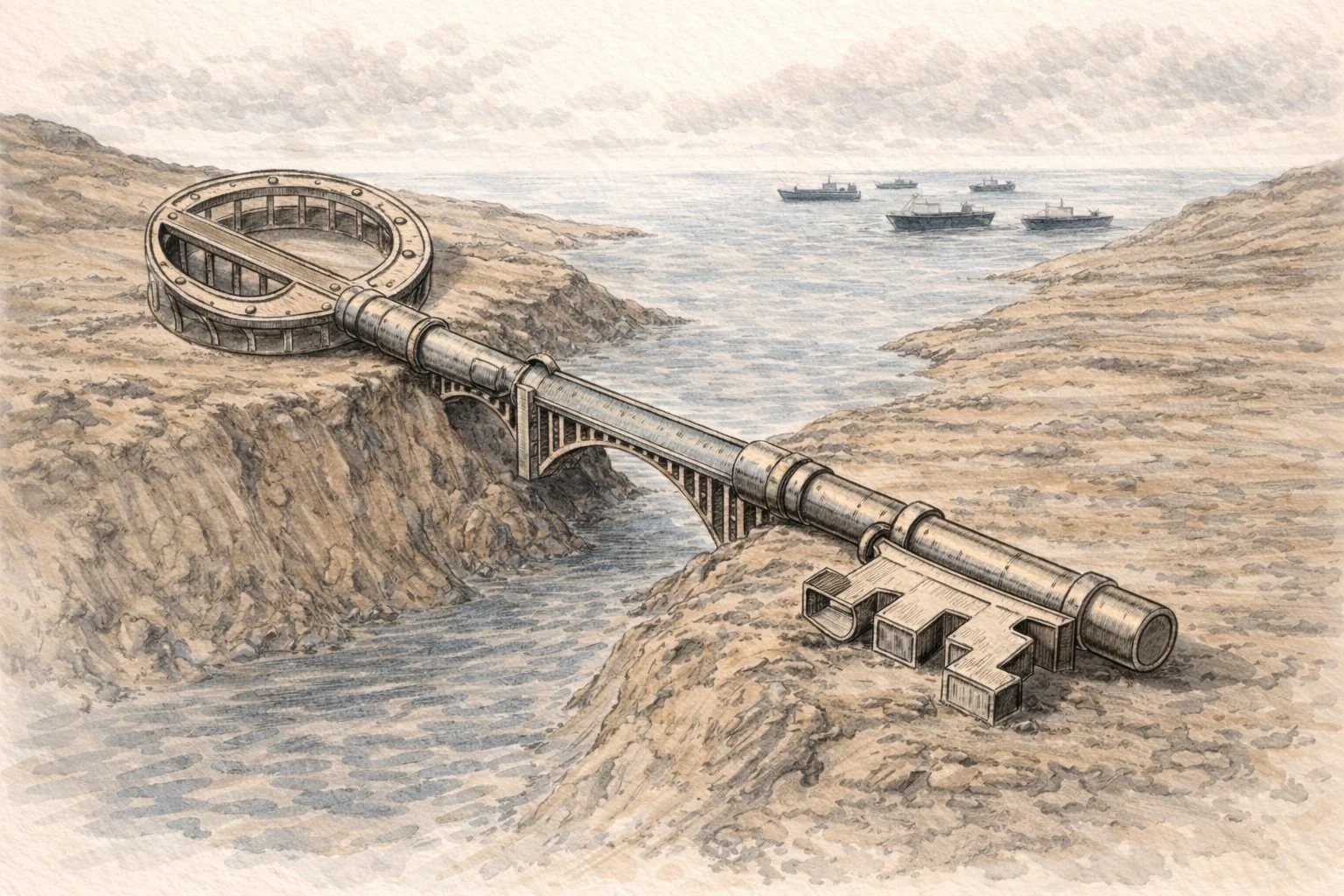
Many keys were proposed to unlock the Hormuz problem, but none proved large, practical, and coordinated enough to fully open the system.
Set side by side, the five categories reveal something important: the world did not fail because no alternatives existed. It failed because each category solved only part of the problem, and no category was pursued at the scale required to offset the sheer concentration of flow through Hormuz.
Direct physical bypasses were the strongest hard-infrastructure answer. They offered the cleanest physics, the lowest operational complexity once built, and the clearest strategic payoff because they physically moved oil outside the Strait. If the world had wanted the most straightforward insurance against Hormuz, this was the category that should have been expanded most aggressively. Yet even here, real capacity remains limited. Saudi Arabia’s East–West system and the UAE’s Habshan–Fujairah route together can only approach the lower end of the 25% disruption benchmark, not the 50% or 100% scenarios. In other words, the category that made the most sense physically was never built in sufficient size. The lesson is not that direct bypasses were flawed. It is that they were underbuilt relative to the risk.
Linked corridor chains offered a different kind of logic. They were less elegant, but more politically and financially achievable because they could build on infrastructure that already existed. The Saudi westward corridor linked with Egypt’s SUMED system is the clearest example. These chains are attractive precisely because they do not require inventing a whole new geography from scratch. But their weakness is cumulative complexity. Every additional handoff introduces friction: extra tankage, more scheduling, more marine exposure, more insurance, more chances for congestion. They can improve flexibility, and they are probably among the most realistic medium-term options, but they do not produce a decisive strategic break from chokepoint dependence. They move the system from near-total concentration toward partial diversification, not toward full resilience.
Buffer and resilience measures are, in many ways, the most immediately practical category. Strategic reserves, inland storage, export hubs, and emergency stockpiles are easier to build than giant transnational corridors and easier to justify politically than speculative megaprojects. They buy time, calm markets, and reduce the immediate pressure of disruption. But that strength is also their limitation. They are not substitutes for flow; they are substitutes for time. They help absorb a shock, but they do not remove the underlying dependency. Once measured against a disruption lasting many months rather than many weeks, their limits become obvious. The stockpile arithmetic in China, Japan, and India shows that even very large reserve systems are ultimately bridges, not alternate geographies. Buffering is therefore indispensable — but it is not transformative.
Mega-concepts and corridor redesigns were the only category bold enough to imagine solving the problem at something like full scale. Artificial canals, land bridges, cross-peninsula utility corridors, and other geographic redesigns were attempts to think at the level of the vulnerability itself. In that sense, they are important because they show that the scale of the problem was understood. Yet they were also the least practical solutions. They demanded exceptional capital, cross-border coordination, long construction horizons, and unusual tolerance for political and military risk. The UAE bypass-canal concept is the clearest illustration. It was not absurd in relation to the value-at-risk moving through Hormuz, but it was so large relative to ordinary public works, sovereign financing, and implementation capacity that it never escaped the conceptual stage. These ideas mattered analytically, but they were rarely plausible as actual delivery vehicles.
Structural demand reduction stands apart from the others because it does not try to reroute the risk — it tries to shrink it. This is why it may prove the most important category in the long run. Every barrel of oil no longer needed by a major importer is a barrel that no longer needs to be shipped, insured, stored, or routed through a strategic chokepoint. In pure strategic terms, a permanent reduction in demand is functionally equivalent to creating new bypass capacity. But demand reduction is also the slowest category. It depends on industrial transition, technology adoption, grid investment, public transport, efficiency gains, fuel switching, and changes in the structure of national economies. It cannot solve a war tomorrow. Yet over time, it may be the only category capable of matching the scale of the problem without trying to recreate Hormuz somewhere else in steel, dredging, and concrete.
This comparison leads to a more sobering conclusion. The categories are not alternatives in the sense of choosing one instead of another. They are layers. A genuinely resilient strategy would have required all five: more direct bypasses, more optimized linked corridors, deeper storage buffers, serious evaluation of larger redesign concepts where appropriate, and long-term reduction in demand exposure. The reason the world remained so vulnerable is that it never built enough strength in any one layer, and never assembled the layers into a coherent system.
Another way to see this is to compare what each category was actually good for:
Direct bypasses were best for replacing flow
Linked corridors were best for improving flexibility
Storage and buffers were best for buying time
Mega-concepts were best for reimagining scale, even if rarely buildable
Demand reduction was best for shrinking the problem permanently
The difficulty is that the world tended to treat these categories as separate conversations rather than parts of one strategic architecture. Energy security planners looked at reserves. Pipeline planners looked at line capacity. Governments looked at budgets. Markets looked at short-term returns. Climate planners looked at demand transition. But the chokepoint problem required all of those conversations to converge. They rarely did.
That is the deeper infrastructure lesson of Hormuz. Resilience was never going to come from one silver bullet. It required a portfolio approach: one part engineering, one part logistics, one part statecraft, one part finance, and one part structural transformation in energy demand. Because those pieces were rarely aligned, the world defaulted to a familiar pattern: limited incremental improvements around the edges of the system, while the underlying concentration remained intact.
The result is the world visible today. The most dangerous energy chokepoint on earth is still carrying volumes for which no fully scaled substitute exists. The categories of response are all intelligible. The logic behind them is all clear. The tools were not absent. What was missing was follow-through at the level of the risk. In the end, the bottom-line comparison is stark. Direct bypasses were too small. Linked corridors were too partial. Storage was too finite. Megaprojects were too difficult. Demand reduction was too slow. Each category had merit. None was enough alone. And because no combination was pursued with sufficient seriousness, the global energy system remained concentrated in the very place where decades of analysis had warned it was most vulnerable.
Each category solved part of the problem, but none solved enough of it alone. Direct bypasses were too small, linked corridors too partial, storage too finite, megaprojects too difficult, and demand reduction too slow. The alternatives together show that the true failure was not conceptual but systemic: the world never assembled enough strength across multiple layers to match the concentration of risk passing daily through Hormuz.
Close-Out: The Geography of Risk Was Known. The Infrastructure Response Never Matched It.

The geography of the risk was long understood, but the infrastructure response never matched its scale: Too much of the global economy still rests on a single narrow passage.
The world did not arrive at this vulnerability by surprise. The Strait of Hormuz has been recognized as a strategic danger for decades. Policymakers knew it. Energy markets knew it. Importing countries knew it. Producers knew it. The risk was never hidden. What remained unresolved was the harder question of whether that knowledge would be converted into infrastructure, redundancy, and long-term strategic adaptation. It largely was not.
That is the core lesson of Hormuz. The problem was not a lack of imagination. Over the years, governments and planners considered direct bypass pipelines, linked export corridors, strategic storage systems, artificial canals, land bridges, and a broad range of ideas for reducing dependence on narrow maritime passages. The menu of options existed. Some were built in part. Some were expanded incrementally. Some never moved beyond concept. But taken together, they were never pursued with the scale, coordination, and continuity needed to change the global map of exposure in a decisive way.
The result is that the world still confronts Hormuz with an infrastructure profile that does not match the concentration of risk. A single narrow passage continues to carry around one-fifth of global oil and LNG trade, while the practical substitutes remain fragmented, incomplete, or too small. That mismatch is not just a technical failure. It is also a planning failure, a financing failure, and in some ways a political failure. It reflects what happens when short-term commercial rationality repeatedly overrides long-term systemic resilience.
The current war has made that failure visible again. Insurance spikes, delayed shipping, stranded vessels, price shocks, and downstream inflation are not simply symptoms of conflict. They are symptoms of a world economy that left too much strategic weight resting on too little infrastructure diversity. Markets may react in real time, but the underlying cause was years—indeed decades—in the making.
From OHK’s perspective, this is precisely why corridor analysis matters. The value of studying alternatives is not only to identify a perfect replacement route, because in many cases such a route does not exist. The deeper value is to understand how layers of resilience might have been assembled, where they remain inadequate, and what trade-offs prevented them from maturing into real systems. That is a more serious way of thinking about infrastructure than merely asking what is technically possible. It asks what was strategically necessary, what was institutionally feasible, and what was never funded or coordinated despite being repeatedly recognized as important.
The implication is larger than Hormuz itself. The same logic applies to energy corridors, food routes, data cables, shipping lanes, rare-mineral supply chains, and many of the other systems on which the modern world depends. Vulnerability often persists not because it is unknown, but because solving it requires investment before crisis, coordination before panic, and patience beyond electoral and market cycles. Those are exactly the things the modern world often struggles to sustain.
In that sense, Hormuz is not only a chokepoint. It is a warning about how global systems are built. It reminds us that resilience is not an abstract virtue. It is a physical condition created by storage, corridors, terminals, redundancy, spare capacity, diversified demand, and institutions capable of treating long-term exposure as seriously as short-term return.
That is also why the question is not whether the world should have built one alternative to Hormuz. The better question is why it never built enough across multiple categories to materially change the risk profile. Why were direct bypasses not expanded further? Why were linked corridor systems not more systematically strengthened? Why were buffers treated as emergency tools rather than part of an integrated resilience architecture? Why were larger redesign concepts left conceptually interesting but practically abandoned? And why was demand reduction so rarely discussed as a serious energy-security measure rather than only a climate or industrial policy issue?
Those are the questions this crisis should reopen.
Because once the immediate headlines pass, the temptation will again be to treat Hormuz as a recurring regional drama rather than as a structural weakness in the world economy. That would be a mistake. The broader lesson is not only about war. It is about what decades of underbuilt resilience look like when stress finally tests the system.
The geography of the risk was known. The infrastructure response never matched it.
And until it does, the world will continue to discover—in every new crisis—that a great deal of global economic stability still depends on a very narrow stretch of water.
The world knew the danger of Hormuz for decades, yet its response remained fragmented, partial, and consistently below the scale of the exposure. What failed was not awareness, but follow-through. This conclusion argues that the Strait is ultimately a lesson in how global systems remain fragile when resilience is deferred, underfunded, or treated as secondary to short-term efficiency—and why every new crisis keeps rediscovering the same underlying weakness.
OHK’s work in strategic infrastructure, corridor analysis, and resilience planning is grounded in precisely these kinds of questions: how governments and institutions can identify chokepoints early, evaluate alternatives seriously, and build layered systems before crisis forces the issue. If your organization is evaluating corridor alternatives, strategic logistics investments, or infrastructure pathways to reduce geopolitical and supply-chain risk, contact us to explore how we can help design and implement durable resilience strategies.