

Resort Morphology Decoded Through Spatial Logic, Design Patterns, and Development Intelligence
A structured taxonomy of resort forms revealing how layout, land use, experience, efficiency, and environmental logic shape tourism development outcomes.
Resorts are often discussed in terms of atmosphere, luxury, architecture, or branding, yet their deeper logic lies in morphology: the spatial structure through which buildings, amenities, infrastructure, and landscape are arranged. Once these recurring forms are named and compared, resort design becomes more legible, measurable, and useful for planners, developers, environmentalists, and investors alike. This article proposes a practical taxonomy of resort morphologies and explains why understanding them matters not only for design culture, but also for governance, performance, sustainability, and long-term territorial intelligence. This is Part 1 of a two-part series. Part 1 establishes the conceptual foundation by defining resort morphology, explaining why recurring spatial patterns matter, and proposing a clear taxonomy of resort forms. Part 2 builds on this foundation by exploring how AI, GIS, and geospatial analysis can identify these morphologies from satellite imagery, measure their consequences, test alternatives on specific sites, and generate insights for environmental, planning, and economic decision-making.
Reading Time: 50 min.
The illustrations presented here are drawn from OHK’s design archive and represent real client-facing design work developed for actual projects and proposals. They reflect concepts prepared as part of professional engagements, illustrating design thinking, spatial vision, and OHK’s approach to translating project briefs into compelling architectural and planning narratives across a range of morphologies. All illustrations are copyrighted and may not be used, reproduced, or distributed without prior written permission.
Summary: This article argues that resort design follows recurring spatial patterns that can be classified into a clear morphology-based taxonomy. Rather than treating each resort as unique, the article identifies repeatable types such as single-block, winged, courtyard, linear, terraced, clustered, and hybrid formats. It explains how these patterns influence land consumption, guest experience, infrastructure efficiency, environmental footprint, and market positioning. The article also suggests that formalizing resort morphology creates a bridge between design thinking and analytical systems, making resort development easier to assess, compare, regulate, and eventually analyze through AI. The overall arc is: resort discourse framed through aesthetics, hospitality language, and isolated design narratives versus the underlying spatial patterns that actually shape outcomes → morphology as the breakdown of image-led reading → the taxonomy as the methodological reset that makes resort form legible and comparable → comparative testing of each type through guest experience, operational logic, land efficiency, infrastructure burden, and ecological consequence → real-world examples as proof that the patterns are visible despite hybrid complexity → broader implications for how resort thinking must shift from stylistic interpretation toward structured spatial intelligence.
Seeing the Resort as a System: Why Morphology Reveals What Design Language Alone Usually Leaves Unmeasured and Uncompared
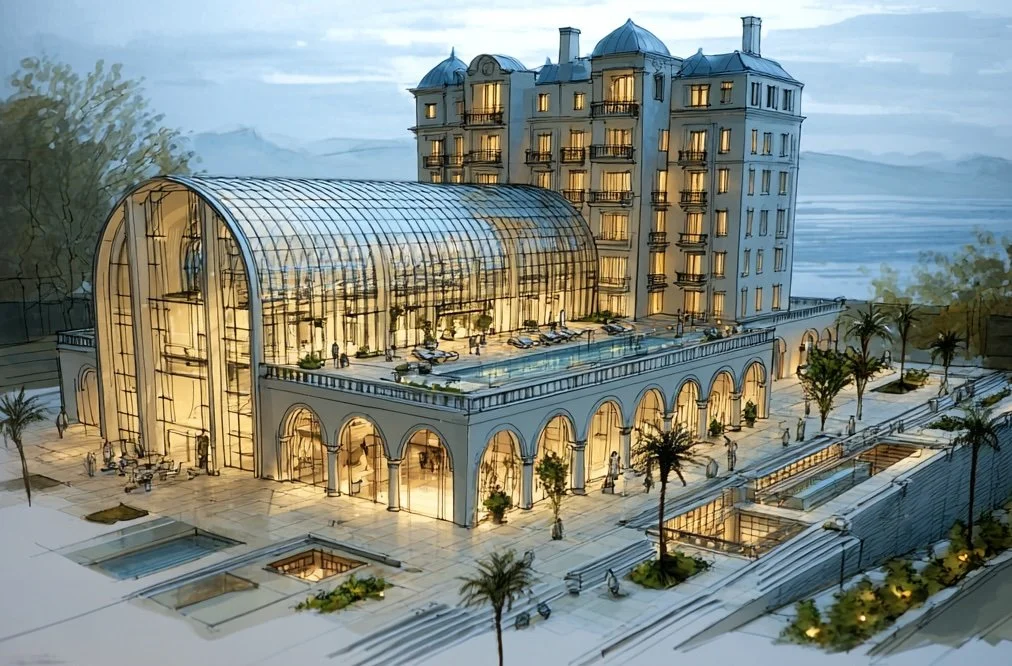
This illustration from OHK’s design archives presents a client-facing concept for a single-building resort, defined by one primary architectural mass that consolidates the resort’s main guest, public, and operational functions within a unified structure. What characterizes this morphology is its clarity, compactness, and strong visual identity: rather than dispersing accommodation into multiple clusters or wings, the project is read as one dominant building, with terraces, water features, and open space acting as extensions of the main hospitality core.
Most discussions of resorts remain trapped in the language of image. We hear about luxury, authenticity, placemaking, wellness, or experience, and these are not meaningless terms. They matter, especially to branding, architecture, and hospitality operations. Yet they often obscure the deeper structure of what a resort actually is on the ground. A resort is not just a collection of rooms and amenities. It is a spatial system made of relationships: between buildings and landscape, between guest privacy and operational efficiency, between frontage and density, between roads and ecosystems, between form and financial performance. Morphology is the language that allows us to make these relationships visible.
When we use the word morphology, we are talking about the recurring physical organization of a resort. This includes the arrangement of accommodation units, the concentration or dispersion of public amenities, the logic of movement, the relationship to topography, and the way the resort occupies land. In this sense, morphology is not decoration and not style. A white modernist villa resort and a vernacular stone lodge may look different architecturally, yet both may belong to the same morphological family if they share the same spatial logic. Conversely, two resorts with similar aesthetics may operate very differently if one is compact and centralized while the other is dispersed and cluster-based.
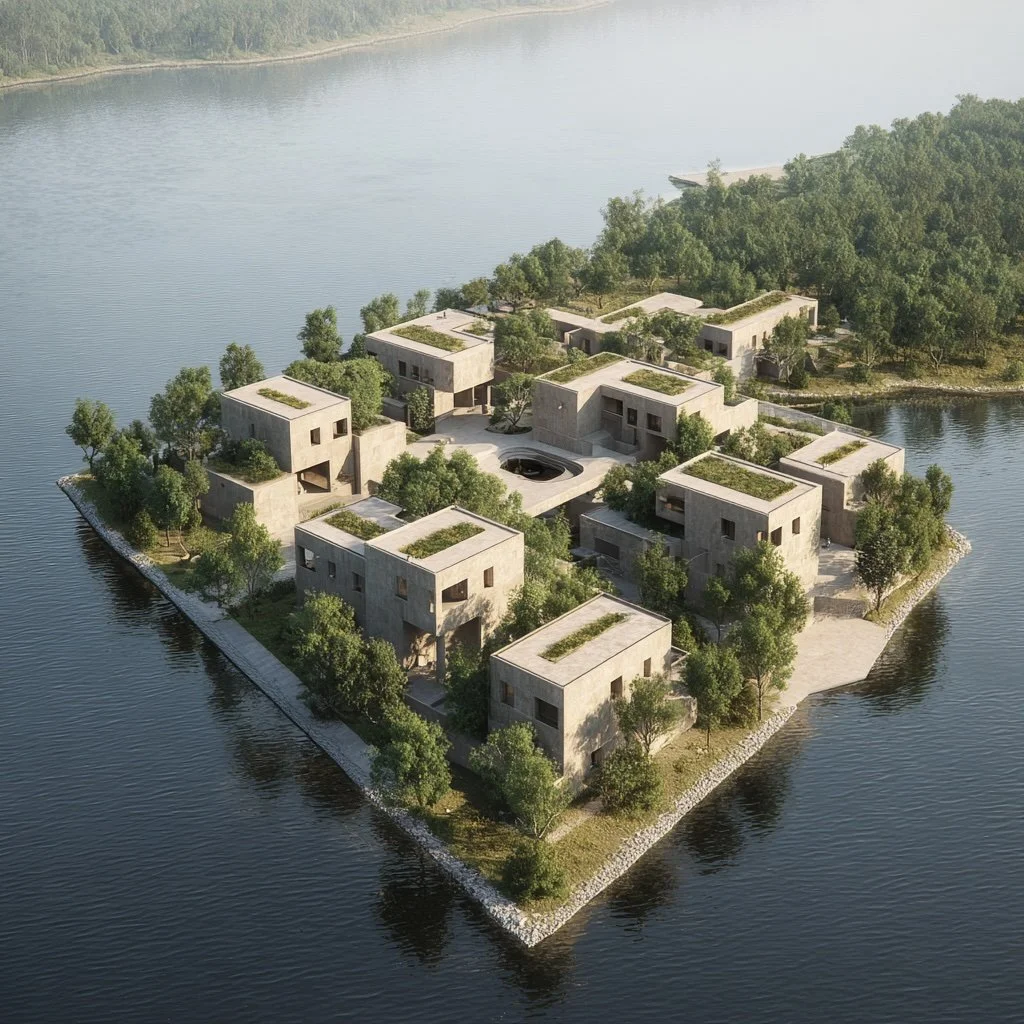
OHK concept for Al-Warraq Island in the Nile, showing a clustered low-rise hospitality morphology designed to support regeneration, community involvement, and a more diffused pattern of development across the island rather than concentrated, high-impact construction. The vision distributes accommodation in small-scale built clusters set within an expansive landscape, reducing visual mass, softening the footprint of hospitality, and preserving the island’s character and relationship with the Nile. Central service villages form the social and operational heart of the scheme, hosting shared amenities, local enterprise, cultural activity, and guest services. With a high landscape-to-key ratio, the concept prioritizes Nile greenery, open space, and the river setting over dense construction. The result is a community-rooted hospitality model that blends local participation, environmental sensitivity, and a calm, place-based visitor experience.
This is important because too much of the design world still confuses appearance with structure. Architects are often excellent at discussing formal expression, materiality, and atmosphere. Planners are often strong in discussing zoning, policy, and territorial context. But what often remains underdeveloped is a rigorous, operational understanding of pattern. We need a way to say not merely that a resort is “village-like” or “integrated into nature,” but that it is a clustered low-rise morphology with distributed accommodation, a central service spine, moderate frontage efficiency, and a high landscape-to-key ratio. That shift in language matters because it transforms intuition into analysis.
A clear morphological reading immediately opens new questions. How much shoreline does each room consume? How many meters of internal road are required per guest key? Does the morphology create wind-protected microclimates or expose open spaces harshly? Does it preserve contiguous ecological corridors or fragment them? Does it support walkability or depend on buggies? Does it produce a strong sense of arrival and centrality, or a diffuse and low-intensity guest experience? These are not aesthetic side questions. They are central questions of performance.
The benefit of morphology is that it turns resort design into something comparable. Once patterns are named, we can compare a compact winged resort against a dispersed villa resort. We can compare a linear beachfront strip to a terraced hillside typology. We can begin to understand why some resorts feel efficient but institutional, while others feel immersive but costly. We can also begin to see the territorial consequences of repeating certain forms across an entire coastline. A single resort may seem harmless in isolation, but the repeated use of ribbon-like linear resorts can gradually privatize shoreline access, fragment dune systems, and impose hidden infrastructure burdens on public authorities.
This is why morphology matters beyond design criticism. It matters for investment strategy, because different morphologies imply different capital expenditures, operational costs, market segments, and revenue models. It matters for environmental governance, because different forms consume land differently and create different pressures on water, vegetation, and habitat continuity. It matters for planning, because authorities often regulate setbacks and heights but fail to regulate the deeper spatial logic that determines whether a destination becomes coherent, sprawled, accessible, exclusive, resilient, or ecologically destructive.
Morphology also matters culturally. Many destinations fall into imitation: a developer sees a successful resort elsewhere and reproduces its visual image without understanding its spatial logic or contextual fit. This is how one ends up with forms that are badly matched to site width, slope, climate, or local carrying capacity. A terraced hillside logic transplanted thoughtlessly onto flat land may create needless complexity. A linear beachfront strip copied onto a fragile dune system may destroy what gives the place value in the first place. A courtyard logic suited to hot arid climates may perform poorly if reproduced mechanically in a humid tropical environment without reconsideration. Morphological literacy protects against superficial imitation by forcing attention onto structure.
Another reason to treat resorts morphologically is that hospitality is one of the clearest cases where space becomes economics. A resort’s layout directly shapes how value is created. The number of view rooms, the distribution of premium villas, the concentration of food and beverage, the length of service routes, the reach of utilities, and the amount of landscaped open space all affect both cost and market appeal. Yet developers often discuss these through fragmented departmental lenses rather than as a unified spatial logic. Morphology brings them back together.
At a deeper level, what morphology offers is a language of pattern intelligence. It says that resort design is not just art, and not just regulation, and not just engineering. It is a repeatable field of spatial decisions with consequences. Once that is accepted, the resort stops being an isolated project and becomes part of a broader body of comparable knowledge. That knowledge can then be codified, measured, taught, regulated, and eventually digitized.
Once a resort is understood as a spatial system rather than a stylistic object, its hidden logic becomes visible, comparable, and actionable.
What this section makes unmistakably clear: (i) morphology is about spatial structure, not surface image (ii) naming patterns improves comparison and evaluation (iii) resort form affects performance, not just appearance (iv) territorial impacts emerge from repeated typologies (v) morphology creates the bridge from design intuition to operational intelligence
A Practical Taxonomy of Resort Forms: From Single Blocks and Bilateral Wings to Clusters, Spines, Terraces, and Hybrids
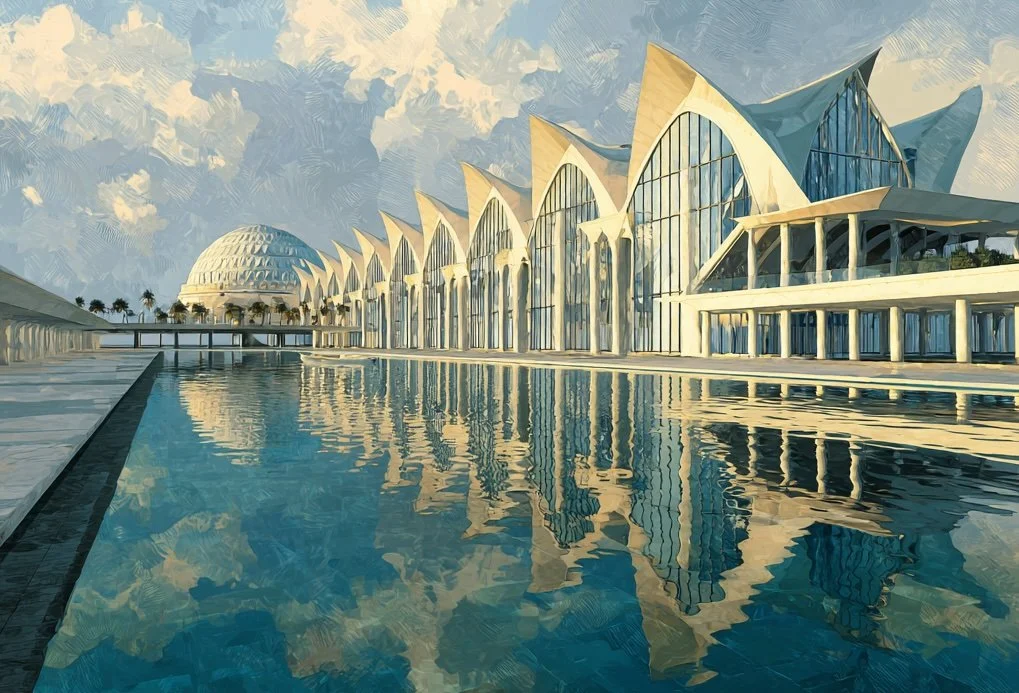
This concept illustration from OHK’s design archives presents a client-facing resort proposal organized around a central core with bilateral wings. The composition is defined by a dominant central block that anchors the project architecturally and symbolically, while long lateral wings extend outward as direct horizontal continuations of the same building line. What defines this morphology is its combination of clear hierarchy, strong frontage, and broad openness: the center acts as the visual and functional focus, while the wings widen the resort’s reach without enclosing a court.
If resort morphology is to become useful, it must move beyond abstract discussion and become a taxonomy. A taxonomy does not deny uniqueness; rather, it provides a structured way to recognize recurring forms beneath local variation. The purpose is not to claim that every resort fits perfectly into one box, but to identify the dominant spatial logic of each project so that comparisons become possible. In practice, most resorts fall into a finite set of recurring morphological families, even if many projects combine more than one.
The first family is the single-block or monolithic resort. Here, the majority of rooms, public areas, and back-of-house functions are concentrated within one primary building mass. This is the classic grand hotel logic. It can be elegant, highly efficient, easy to service, and relatively economical in land use. It often works well on constrained sites, urban edges, mountain sites, or where centralized operations are essential. Yet it can also feel institutional, less immersive, and visually dominant if poorly handled. Its great strength is efficiency; its weakness is often limited experiential diversity.
The second family is the central core with bilateral wings. In this arrangement, a main arrival and public core anchors the center while accommodation extends left and right in two arms. This morphology is common in formal beachfront resorts because it creates symmetry, clear orientation, and a strong center. It allows many rooms to capture views while preserving a central social heart. It also frames pools, gardens, or a sea-facing forecourt effectively. Its advantage lies in balance and legibility. Its risk is over-formality or overextension if wings become too long.
The third family is the U-shaped resort. This type encloses an open side, often facing the sea, landscape, or major leisure zone. It creates a strong internal outdoor room: a pool court, garden terrace, or arrival-to-view sequence. It is excellent for creating enclosure, climate moderation, and social focus. In desert or windy coastal environments, it can also provide shelter. Yet if overused, it can become repetitive and inward-looking, especially if the open side is not carefully aligned with the main attraction.
The fourth family is the courtyard resort. Unlike the U-shaped type, the courtyard form is often more inward, using one or multiple courts to structure privacy, microclimate, and circulation. This morphology is particularly strong in hot climates, heritage contexts, and wellness settings. It can be highly atmospheric and climate-responsive, but its success depends on the quality of voids, shading, and edge treatment. A poor courtyard becomes empty leftover space; a good one becomes the heart of the resort.
The fifth family is the linear beachfront resort. This is perhaps the most common mass-tourism morphology on narrow coastal sites. Rooms and amenities stretch parallel to the shoreline, maximizing direct frontage and sea views. Financially, it can be compelling because beachfront access is monetized efficiently. But it can also be problematic. Linear resorts tend to consume large lengths of shoreline, create repetitive circulation, and sometimes generate a ribbon effect that limits permeability and public access. At territorial scale, this morphology can have major planning implications.
The sixth family is the terraced hillside resort. Here, accommodation steps with topography, often using the slope to maximize views and privacy while reducing visible bulk. Terraced resorts can be spectacular when done well. They respond to section rather than plan alone. They often create layered guest experiences and superior view equity. Yet they are technically demanding, expensive, and highly sensitive to grading, drainage, and access logistics. Their elegance often hides substantial engineering complexity.
The seventh family is the clustered village resort. This type breaks accommodation into small buildings or groups distributed across the site, often with a main social center and supporting open spaces. Its key strength is human scale. It can feel informal, authentic, and socially rich, especially when modeled on local settlement logic without becoming fake pastiche. Operationally, however, clustering introduces complexities in servicing, maintenance, and circulation. Its success depends on balancing intimacy with legibility.
The eighth family is the dispersed pavilion or villa resort. This is common in luxury, eco, or wellness hospitality. Units are separated and embedded in landscape, prioritizing privacy, exclusivity, and immersion. The land take per key is usually high, as is infrastructure distribution. Such resorts can produce extraordinary guest experiences, but they often carry hidden environmental and servicing burdens unless planned with care. Their appeal is emotional and marketable, but their efficiency is usually lower than compact models.
The ninth family is the spine-and-pods resort. A central organizing circulation spine—whether a road, shaded walkway, buggy route, or landscape promenade—connects a sequence of room clusters, villas, and amenities. This morphology is especially useful on large, irregular, or phased sites. It is both structured and flexible. It allows growth over time and can adapt to terrain or ecological constraints. However, its success depends on the quality of the spine itself. A vibrant spine becomes identity; a purely technical spine becomes just an internal road.
The tenth family is the hybrid core-and-villas resort. This increasingly common type combines a compact central hotel or public core with separate premium villas, pavilions, or bungalow districts. It allows a developer to mix operational efficiency with differentiated price points. Standard rooms and shared amenities remain centralized while high-end privacy products occupy more distributed land. This morphology is commercially intelligent because it supports segmentation. It is also analytically important because it shows that modern resorts rarely belong to one pure type.
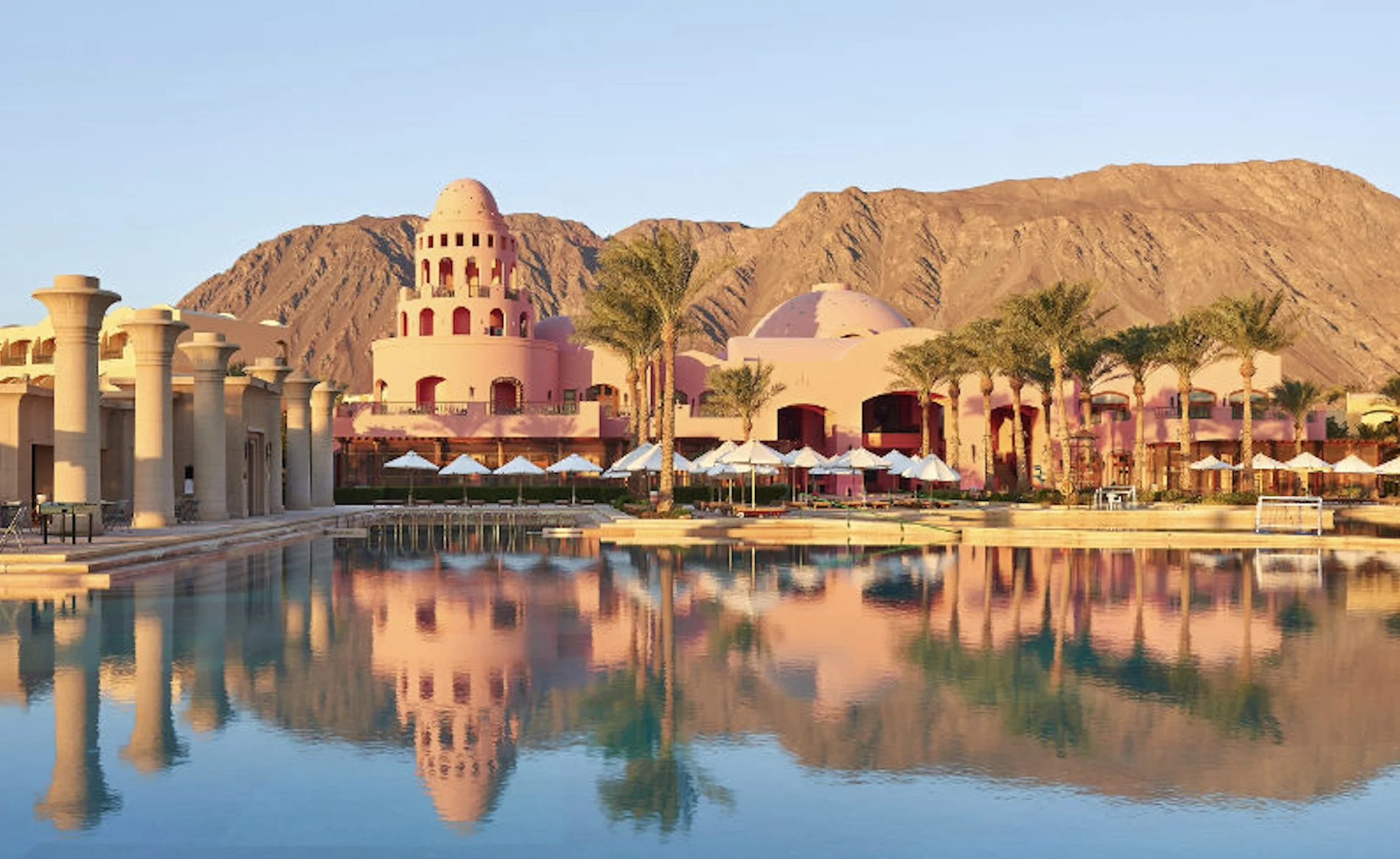
In Egypt, ring or loop morphology has become one of the most influential spatial patterns in both resort planning and compound-based real estate. It began as a resort device, especially around lagoons, golf courses, and internal landscapes, where looping development maximized frontage, organized circulation, and created a strong internal world. Over time, that same logic migrated into residential compounds, because it allowed developers to multiply premium edge conditions around amenities rather than rely on one beachfront. The result is a powerful Egyptian planning model in which resort morphology evolved into real estate morphology, shaping not only tourism projects but wider patterns of gated urban development. Taba Heights is a strong Egyptian example of how loop or ring-based resort morphology can organize large-scale tourism development around internal amenities, structured circulation, and repeated premium edges, anticipating the same spatial logic later seen in many residential compounds and mixed-use real estate enclaves. It is also significant because its planning and architectural language drew on OHK’s vernacular guidelines developed for Red Sea and Sinai contexts, showing how regional design principles could be translated into a large-scale resort framework rather than applied only at the level of individual buildings.
Other subtypes also exist, including ring or loop formats around lagoons, golf courses, or internal landscapes; finger plans that extend wings to increase frontage; and bungalow field morphologies where repeated low-rise units are laid across flat landscaped ground. These can be treated either as separate classes or as variants depending on the analytical purpose.
In practice, many resorts are hybrids rather than pure types. A project may combine a central hotel block with bilateral wings, add a dispersed villa district, incorporate a marina edge, or evolve over time from one dominant morphology into another. For that reason, morphology should be read as a matter of prevailing spatial logic rather than absolute purity. The value of the taxonomy lies not in forcing every resort into a perfect box, but in identifying the dominant organizational structure and the secondary elements that modify it.
A strong taxonomy therefore needs two levels: primary morphology and secondary attributes. The primary morphology identifies the dominant organizational logic. The secondary attributes capture conditions such as beachfront, hillside, island, low-rise, high-rise, compact, dispersed, regular, irregular, marina-linked, golf-linked, or mixed-use. This two-level structure avoids oversimplification while preserving analytical clarity.
The real value of taxonomy is that it creates a disciplined vocabulary. Instead of loose adjectives, we can describe a resort precisely. Instead of saying a project is “spread out,” we can ask whether it is a clustered village, a dispersed villa system, or a spine-and-pods scheme. Instead of saying a hotel is “compact,” we can ask whether it is monolithic, bilateral, or courtyard-based. These distinctions matter because they shape experience, land use, infrastructure, ecology, and financial performance in different ways.
A usable taxonomy does not erase uniqueness; it reveals the repeatable structural families beneath the stylistic diversity of resort design.
What the taxonomy ultimately teaches us: (i) most resorts belong to recurring spatial families (ii) each family has distinct strengths and liabilities (iii) hybrids are common and should be acknowledged (iv) primary and secondary classifications work best together (v) precise language improves design, planning, and analysis simultaneously
Where Taxonomy Meets Reality: Why Context, Climate, History, and Phasing Make Pure Morphological Classification Harder Than It First Appears
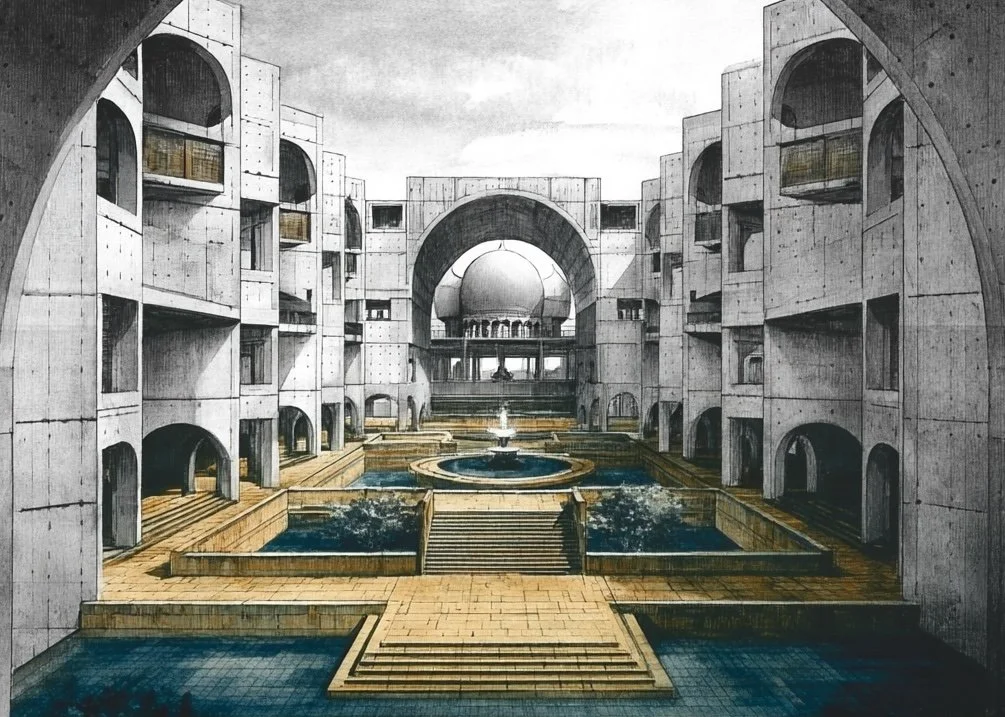
This illustration from OHK’s design archives presents a U-shaped resort concept prepared for a client, defined by three primary built edges that frame a strong central open space. What characterizes this morphology is the balance between enclosure and directed openness: the resort creates a protected internal court for water, arrival, and social life, while the open end establishes orientation toward a focal landscape, view, or ceremonial center. The result is a composition that is formal, legible, and spatially cohesive.
A taxonomy is only useful if it clarifies reality without pretending that reality is cleaner than it truly is. That is especially important in resort morphology, because while recurring spatial patterns are real and highly legible, actual resorts do not emerge under laboratory conditions. They are shaped by land constraints, climate, ownership structures, financing cycles, changing tourism markets, infrastructure limitations, brand repositioning, political pressure, and the simple fact that most developments evolve over time. For that reason, resort morphology should never be treated as a rigid doctrine of purity. It should be treated as a disciplined way of reading dominant spatial logic within a field of real-world complexity.
The first source of complexity is context. The same basic morphology can behave very differently depending on whether it is placed on a narrow beachfront parcel, a desert plateau, an island lagoon edge, a mountain slope, or an urban waterfront. A linear morphology on a narrow coast may be the almost inevitable outcome of site geometry, while a linear organization on a broad inland parcel may reflect a highly specific development choice. A courtyard morphology in a hot arid environment may be climatically rational, while a similar arrangement in a humid tropical setting may require significant adaptation to avoid becoming stagnant or uncomfortable. In other words, morphology cannot be understood only as shape in plan. It must also be understood as a relationship between form and setting.
The second source of complexity is climate. Resorts are unusually exposed to climatic forces because so many of them rely on outdoor movement, open-air amenities, strong view corridors, and direct landscape experience. Wind, heat, humidity, solar exposure, storm patterns, and topographic ventilation all influence how morphology performs. A compact shaded form may produce comfort and operational efficiency in desert environments. A dispersed pavilion system may work beautifully in a lush tropical landscape where privacy and cross-ventilation are desired. A terraced hillside model may maximize views while increasing exposure to drainage, slope stability, and heat-gain challenges. This means that a morphology is never just a visual type. It is also a climatic strategy, whether intentionally or unintentionally. Any classification system that ignores this will remain too abstract to be fully useful.
The third complication is history. Many resorts are not built all at once. They begin with one logic and are then modified, extended, densified, repositioned, or partially reprogrammed. A project that starts as a compact core hotel may later acquire villas. A clustered village resort may receive a new conference wing. A linear beachfront property may deepen inland through additional room blocks or branded residences. A heritage hotel may accumulate resort amenities long after its original morphology was established. Once one begins to look carefully, it becomes clear that many resorts are less like finished objects and more like spatial biographies. Their current form is the result of phases, accretions, market shifts, and strategic corrections. This is why dominant morphology matters more than formal purity. Classification must identify the leading organizational logic of the present condition while acknowledging the layered path by which that condition emerged.
A fourth complication is phasing, which is related to history but deserves separate attention. Resort development is often structured financially in stages. Infrastructure may be delivered first, keys later, premium products after that, and destination amenities only when market demand strengthens. As a result, morphology may be intentionally provisional. A spine-and-pods scheme, for example, may begin with a central cluster and later extend along a circulation arm. A hybrid core-and-villas model may initially appear monolithic, only becoming hybrid when later villa districts are added. A low-density layout may be designed from the beginning for future densification. This matters because a taxonomy that looks only at first impressions may misread projects that are in transition. Morphology, in practice, must often be understood as both current state and development trajectory.
There is also the problem of programmatic layering. Many contemporary resorts are no longer simple hospitality compounds. They may include branded residences, marinas, golf courses, conference centers, retail promenades, staff accommodation, wellness precincts, serviced apartments, or adjacent mixed-use districts. At that point, the edge of the “resort” becomes difficult to define. Is the marina part of the morphology or an adjacent system? Do branded residences belong to the same resort logic if they share infrastructure but not guest access patterns? Does the golf course count as part of the morphological footprint or as a landscape condition around it? These questions do not undermine taxonomy, but they do show why classification needs rules, not just intuition. A strong methodology must define what is being classified: the accommodation system, the guest-experience footprint, or the total development envelope.
Another reason pure classification becomes difficult is that different scales reveal different truths. A resort may look monolithic at the building scale, hybrid at the site scale, and nodal at the territorial scale. A central hotel block may dominate the immediate plan, but when viewed across the wider development, that same project may form only one anchor in a larger spine, loop, or cluster system. This means morphology is partly a matter of analytical resolution. The classification is not necessarily wrong at one scale and right at another; rather, different scales capture different spatial realities. Good analysis must therefore be explicit about what scale is being read.
There is also a professional danger worth naming. Once a taxonomy is proposed, readers may be tempted to use it too mechanically. They may start treating the categories as boxes into which every resort must fit, rather than as tools for disciplined interpretation. That would be a mistake. The purpose of taxonomy is not to flatten complexity but to organize it. The goal is not to deny ambiguity but to make ambiguity more manageable. In that sense, the taxonomy is strongest when it supports clear identification of dominant forms while also allowing secondary attributes, hybrid labels, contextual notes, and developmental history to remain visible.
This is precisely why the idea of primary morphology and secondary attributes is so important. Primary morphology captures the main organizing structure: single-block, bilateral, courtyard, linear, terraced, clustered, dispersed, spine-and-pods, or hybrid core-and-villas. Secondary attributes capture what modifies that structure: beachfront, hillside, desert, island, low-rise, high-rise, marina-linked, golf-linked, phased, mixed-use, or historically accreted. Once this distinction is accepted, classification becomes much more powerful and much less brittle. The taxonomy stops behaving like a rigid typological chart and starts behaving like an analytical framework.
In fact, the presence of ambiguity is not a weakness of the system. It is proof that the system is engaging reality rather than caricaturing it. If every resort fit perfectly into a single pure class, the field would be simpler but much less interesting. The real value lies in being able to identify recurring spatial logics within complex development conditions. That is what makes the taxonomy useful for planners, designers, investors, environmentalists, and, eventually, for AI systems that must learn not only ideal types but messy real cases.
Seen this way, taxonomy does not compete with judgment. It sharpens it. It gives experts a shared language for discussing what is dominant, what is secondary, what is inherited, what is adaptive, and what remains unresolved. That is exactly the level of precision the field needs if morphology is to become not just descriptive vocabulary, but a serious basis for comparison, governance, and intelligent analysis.
The usefulness of resort taxonomy lies not in pretending real projects are pure, but in reading dominant spatial logic clearly within the complexity of context, climate, history, and change.
What this section helps keep firmly in view: (i) morphology always interacts with site and climate rather than existing in abstraction (ii) many resorts are evolutionary products rather than single-moment designs (iii) phasing and programmatic layering often blur pure typological boundaries (iv) classification becomes stronger when primary forms and secondary attributes are separated (v) a good taxonomy organizes complexity without denying it
How the Main Morphologies Differ in Their Advantages, Liabilities, and Best-Use Conditions
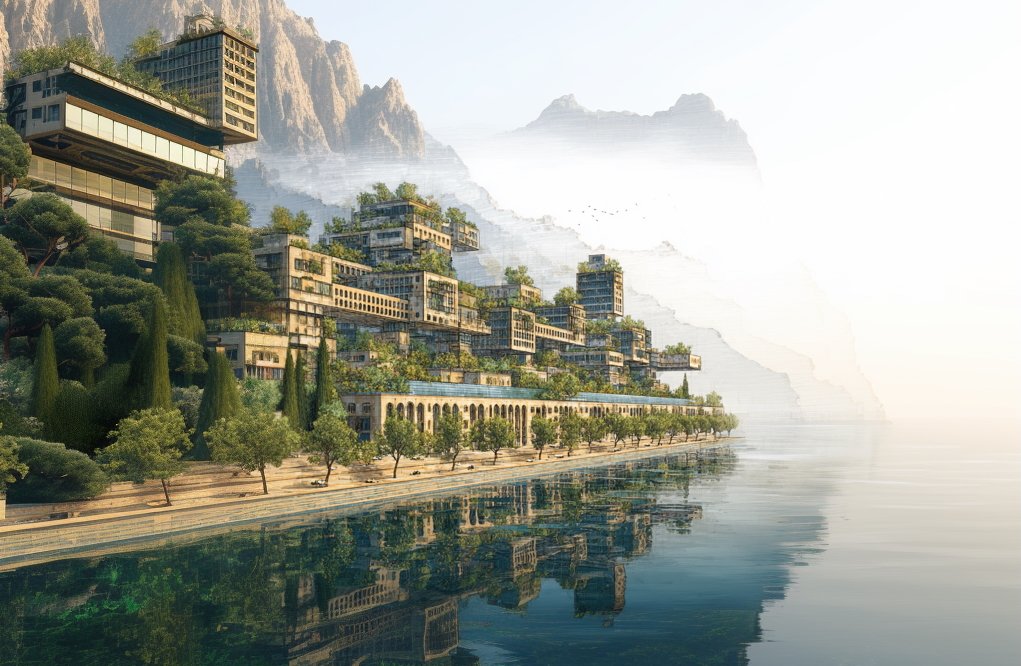
This illustration from OHK’s design archives presents a client-facing concept for a terraced hillside resort in Eastern Sinai, where the mountains of the Gulf of Aqaba descend closely toward the sea. It is best read as a terraced hillside morphology, defined by accommodation and public spaces stepping with the slope to maximize views, reduce apparent bulk, and respond directly to dramatic topography. The composition reflects a condition found in Taba and south toward Nuweiba, where the narrow meeting of mountain and shoreline strongly shapes resort form.
A taxonomy becomes far more useful once it is treated not merely as a naming system, but as a comparative framework. Knowing that a resort is single-block, courtyard-based, linear, terraced, clustered, dispersed, or hybrid is only the beginning. The deeper question is what each morphology tends to do well, where each tends to struggle, and under what conditions each becomes most appropriate. This is where morphology moves from classification to judgment. It allows designers, planners, developers, and public authorities to compare not just shapes, but the consequences embedded in those shapes. Resort forms are never neutral. Each one privileges certain values while compromising others.
The single-block morphology is often strongest in operational clarity, construction efficiency, and infrastructural economy. By concentrating rooms, services, and public functions in one primary mass, it reduces utility runs, shortens service routes, centralizes staffing, and often lowers the complexity of maintenance. It can also work well on constrained sites, urban edges, mountain sites, and destinations where a strong architectural presence is part of the market proposition. Yet these same advantages can become liabilities. A single-block resort may feel institutional, less immersive, and less varied experientially. If handled poorly, it can dominate the landscape rather than belong to it. It also tends to offer less privacy differentiation unless internal zoning is highly sophisticated. In short, it is strongest where efficiency, clarity, and concentrated identity matter most, and weaker where landscape integration and distributed experience are central to the concept.
The central core with bilateral wings morphology offers a different balance. It retains much of the operational coherence of the single-block type, but introduces more frontage, symmetry, and view distribution. This makes it especially useful on beachfront or view-oriented sites where many rooms need direct orientation toward a primary asset without dissolving the social center of the resort. Its strengths lie in legibility, balanced planning, and the ability to combine centralized operations with relatively broad exposure to scenery. However, this morphology can become over-formal, repetitive, or overly elongated if pushed too far. Long wings can reduce intimacy, increase walking distances, and create a hospitality experience that feels orderly but not particularly distinctive. It is therefore best suited to sites where geometry, outlook, and a strong central axis are advantageous, but it needs careful handling to avoid monotony.
The U-shaped morphology is particularly effective at creating a strong outdoor room. It frames a court, pool, terrace, or landscaped forecourt while directing openness toward a sea, garden, or major attraction. This creates enclosure and focus at once. Its advantages include microclimatic shelter, social coherence, and a strong sense of arrival-to-view sequence. In windy or hot environments, this can be especially beneficial. Yet the U-shaped form also has limitations. It may become inward-looking, overly self-contained, or too dependent on the quality of the open side. If the framed exterior space is weak, the morphology loses much of its value. It is best suited to projects where enclosure and outward focus need to coexist, but it requires careful calibration of void, orientation, and landscape edge.
The courtyard morphology is often one of the most climatically and socially intelligent forms, especially in hot, dry, or heritage-sensitive environments. It creates interiority, shade, microclimate, and layered movement. Courtyards can support intimacy, transitional thresholds, and a strong sense of place. They are particularly powerful in wellness, desert, boutique, and culturally rooted resort settings. Their liabilities are also clear. They can become introverted to the point of detachment from wider landscape assets. Poorly scaled courtyards become dead space rather than social heart. In humid climates, they may perform poorly if ventilation and shading are mishandled. This morphology is therefore strongest where environmental control, atmosphere, and inward spatial richness matter, and weaker where expansive outward orientation is the primary value.
The linear beachfront morphology is perhaps the clearest example of how a strong commercial logic can produce both advantages and risks. Its main strength is obvious: it maximizes direct access to shoreline frontage and often increases the number of rooms with premium views. On narrow coastal parcels, it may seem almost inevitable. It can be financially powerful because beachfront exposure is one of the most monetizable conditions in tourism real estate. Yet its drawbacks are equally serious. Linear resorts often consume disproportionate amounts of shoreline, create repetitive circulation, reduce permeability, and contribute to the territorial problem of ribbon development. At destination scale, they can lead to coastal privatization and fragmented public access. They are best suited to narrow waterfront sites where frontage is the primary asset, but they are also among the forms most in need of strong planning control.
The terraced hillside morphology excels where topography itself is the main design generator. By stepping with the slope, it can preserve view equity, reduce apparent bulk, and create an unusually dramatic hospitality experience. This form is often among the most visually compelling because it engages section as much as plan. It is especially strong on steep sites where flat-land logic would either fail or require excessive brute-force engineering. At the same time, terraced schemes are often technically demanding, costly, and highly exposed to drainage, grading, and access complexity. Their elegance can conceal substantial infrastructure and geotechnical burdens. They are best suited to sites where topographic response and view layering justify that complexity, but they can become inefficient if the terrain is being forced rather than respected.
The clustered village morphology offers one of the richest balances between human scale, social variety, and landscape integration. By distributing accommodation into smaller groups, it often avoids the institutional feel of large hotel blocks and creates a sense of settlement rather than enclosure. This can make the guest experience feel more authentic, varied, and pedestrian-friendly, especially when public spaces and pathways are carefully designed. Its liabilities are primarily operational. Services become more distributed, maintenance more complex, and orientation sometimes less obvious for guests. If handled poorly, it can slip into fake picturesque pastiche or lose coherence altogether. It works best on larger sites where human scale and experiential diversity matter, but it requires discipline to remain legible and efficient.
The dispersed pavilion or villa morphology is often the most desirable from the standpoint of privacy, exclusivity, and immersion in landscape. It is highly attractive in luxury, eco, and wellness markets because it gives each unit a stronger sense of autonomy and often a more intimate relationship with terrain, vegetation, or water. It can produce extraordinary guest experiences and premium room rates. Yet it is also one of the most demanding forms in terms of land take, infrastructure spread, staffing complexity, and environmental disturbance. A visually light-touch villa field may in fact require extensive underground networks, service routes, and landscape management. It is best suited to premium markets and sensitive experiential concepts where privacy and immersion justify the cost, but it can be environmentally and operationally burdensome if used carelessly or at scale.
The spine-and-pods morphology is one of the most flexible forms, especially on large, irregular, or phased sites. Its great advantage is that it combines order with adaptability. A central spine—whether road, shaded path, or landscape promenade—creates a readable organizing structure, while clusters or pods can be added, differentiated, or expanded over time. This makes it well suited to long-term growth, difficult site geometry, and projects where phasing matters. Its weakness is that everything depends on the quality of the spine. If the spine is spatially rich, shaded, active, and legible, the resort gains identity and coherence. If it is merely technical infrastructure, the whole project risks feeling stretched and mechanical. This morphology is strongest where flexibility and phased growth matter, but it must be designed as experience, not just circulation.
The hybrid core-and-villas morphology has become especially important in contemporary resort development because it allows a project to combine operational efficiency with product segmentation. A central hotel block or public core supports shared amenities, back-of-house efficiency, and market legibility, while more distributed villas or premium precincts capture higher-end demand, privacy, and differentiation. In commercial terms, it is often one of the smartest models because it creates multiple revenue ladders within one destination. Its challenge lies in integration. If the core and distributed elements feel disconnected, the resort becomes socially fragmented and logistically awkward. If they are balanced well, the morphology can offer both efficiency and richness. It is best suited to upscale and mixed-segment developments where one hospitality product alone would underserve the market.
The overwater or pier-based morphology, whether treated as a subtype or full class, is perhaps the most iconic but also among the most site-specific. Its advantage lies in direct immersion into lagoon or shallow-water environments, offering a spectacular guest experience and highly differentiated premium product. Yet it is also technically constrained, environmentally sensitive, and limited to certain coastal and marine conditions. Construction, maintenance, and ecosystem impact are all major considerations. This form can be powerful where the marine setting truly supports it, but it should never be treated as universally transferable or casually imitable.
When these morphologies are compared side by side, a larger pattern becomes visible. Compact forms usually perform better in operational efficiency and infrastructure economy, but often offer less privacy and immersive landscape experience. Dispersed forms often perform better in exclusivity, differentiation, and emotional appeal, but can be heavier in land, service, and ecological burden. Linear forms maximize frontage but risk territorial damage. Terraced forms unlock topographic value but introduce engineering intensity. Clustered and hybrid forms often offer the richest middle ground, but also require the greatest design intelligence to hold together.
This is why there is no universally superior resort morphology. Each type is a strategic response to a particular combination of site, climate, market, infrastructure logic, and development ambition. The value of morphology lies precisely in helping decision-makers understand that trade-offs are structural, not accidental. A form does not merely look a certain way; it commits a project to a certain set of advantages and vulnerabilities. Once that is understood, resort planning becomes less a matter of style preference and more a matter of choosing which spatial consequences are worth embracing.
A second reason this comparative view matters is that it gives public authorities a better basis for regulation. Instead of relying on generic standards, they can ask more intelligent questions. Which morphologies preserve public access better? Which ones are more infrastructure-intensive? Which ones are appropriate for fragile dune systems, steep slopes, lagoon environments, or golf-led developments? Which ones should be encouraged in one zone and discouraged in another? Taxonomy becomes far more useful once it supports comparative governance rather than mere descriptive labeling.
For designers and developers, the comparative logic is equally important. It makes clear that innovation does not lie in ignoring typology, but in selecting, adapting, or hybridizing it intentionally. A good designer does not simply reject categories; a good designer understands them deeply enough to know when to follow them, when to bend them, and when to combine them. The same applies to resort strategy. The question is never only what the project should look like. It is also what kind of spatial system it should become.
The real value of morphology emerges when resort types are compared not as visual categories, but as different bundles of performance, risk, and strategic fit.
What this comparative section makes much easier to see: (i) every resort morphology embeds both strengths and liabilities (ii) compactness, dispersion, frontage, and clustering each carry different operational and territorial consequences (iii) no single type is universally superior outside its context (iv) hybrid models often succeed because they combine offsetting advantages (v) morphology becomes most powerful when it informs judgment, not just classification
How Designers Modernize Resort Types: Why Older Morphologies Persist Through Fragmentation, Hybridization, and Landscape-Responsive Reinterpretation
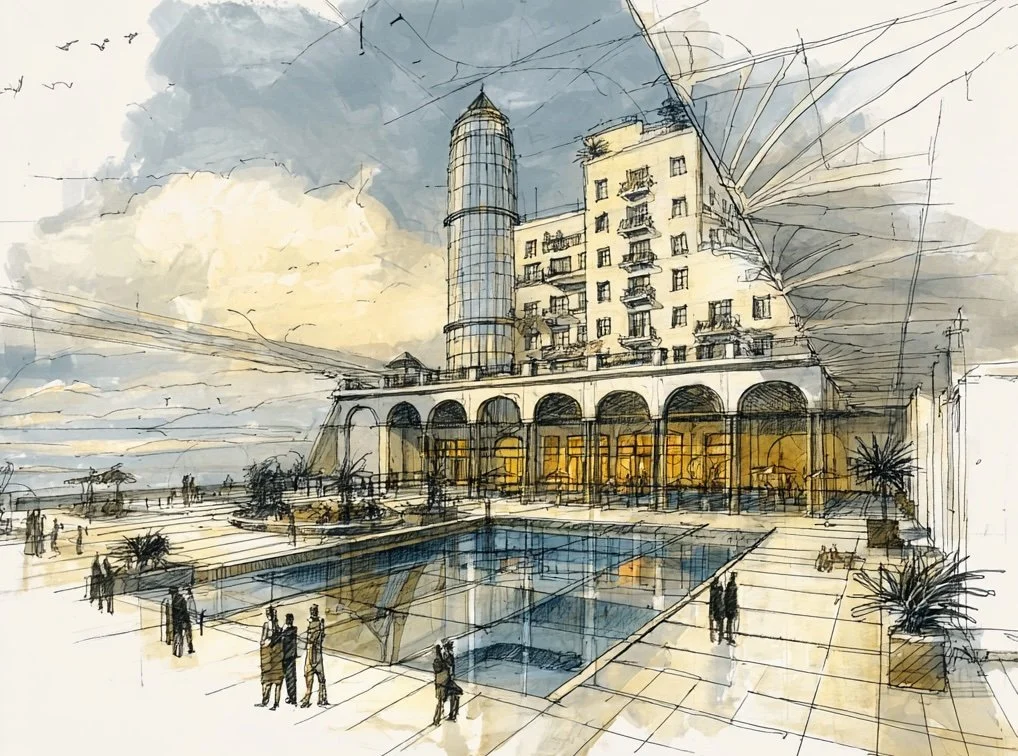
This illustration from OHK’s design archives presents a client-facing courtyard resort concept, organized around a strongly defined internal open space that acts as the social, spatial, and climatic heart of the project. What characterizes this morphology is the way built edges, arcades, water, and circulation are arranged to frame an inward-facing court, creating a sense of enclosure, shade, and layered movement. The courtyard becomes not leftover space, but the central device through which the resort’s atmosphere, orientation, and identity are formed.
A resort taxonomy becomes much more useful once it is understood not as a catalog of frozen historical forms, but as a map of spatial logics that continue to evolve. This is especially important because not all resort morphologies age in the same way. Some remain highly current in both structure and expression. Others persist in underlying logic but appear dated when repeated too literally. The classic U-shaped hotel is an obvious example. In its pure, symmetrical, frontally composed form, it often belongs to an older generation of resort planning. Yet the fundamental logic behind it—enclosure combined with directed openness—remains very much alive. Contemporary designers have not abandoned such morphologies altogether; rather, they have learned to fragment, loosen, hybridize, and re-situate them so they respond more convincingly to landscape, privacy, climate, and contemporary hospitality expectations.
This distinction between typological logic and formal expression is crucial. What often ages is not the deep structure of a morphology, but the way it is drawn, composed, and repeated. Older resort planning traditions often favored symmetry, axiality, singular gestures, repetitive room bars, and highly centralized social hearts. These approaches made sense in their own time. They offered clarity, operational control, and easy legibility, and they aligned well with earlier mass-tourism models and conventional hotel planning. But contemporary hospitality increasingly values informality, distributed experience, landscape immersion, privacy, and a sense that the resort emerges from its site rather than being imposed upon it. As a result, many of the old types survive only after being transformed.
The U-shaped morphology is perhaps the clearest case. In older resorts, it often appeared as a formal horseshoe block framing a pool terrace and opening toward the sea. That arrangement could be effective, but it also tended to feel static, centralized, and somewhat institutional. Contemporary designers often retain the underlying logic of framed enclosure, but they no longer express it as one rigid gesture. Instead, they may use offset wings, staggered bars, broken arms, or multiple smaller courts that create a family resemblance to the U-shape without reproducing it literally. The goal is the same—shelter, focus, directed openness—but the formal result feels more relaxed, more site-responsive, and less diagrammatic. In other words, the U survives by losing its old rigidity.
A similar process affects the single-block morphology. The classic consolidated hotel remains operationally powerful, and there are many contexts where a compact primary mass still makes excellent sense. Yet in contemporary design, the monolithic block is often softened, broken down, or supplemented. Designers may articulate the mass into smaller volumes, split the public base from the guestroom accommodation, attach pavilions, or combine a central core with detached premium units. This reflects a broader shift in hospitality away from the image of one dominant institutional building and toward a more layered hierarchy of spaces. The single block does not disappear, but it often becomes the anchor of a more differentiated composition.
The linear beachfront morphology also undergoes modernization. In its older form, it often appeared as a repetitive bar or sequence of bars marching parallel to the shoreline. This logic was financially rational because it maximized frontage, but it could feel monotonous, territorially aggressive, and environmentally blunt. Contemporary designers often rework this by staggering room clusters, breaking the bar into articulated segments, introducing landscape notches, or combining the linear edge with inward clusters or villa fields behind it. The frontage logic remains, but it is softened and made more porous. The ambition is no longer only to monetize the sea edge as efficiently as possible, but to create a more varied relationship between rooms, landscape, movement, and public access.
The courtyard morphology offers another illuminating example. In older or more traditional expressions, the courtyard might appear as a highly regular enclosure with strong perimeter definition. That still works in many environments, especially hot and arid ones, but contemporary design often makes the courtyard more porous and more multiple. Instead of one dominant inward court, designers may create a sequence of interlocking courts, partial enclosures, planted voids, water courts, and social pockets that retain the climatic and atmospheric strengths of courtyard logic while reducing the sense of introverted formalism. The modernized courtyard is often less about strict symmetry and more about calibrated thresholds, filtered openness, and environmental modulation.
Even the clustered village type, which can feel more timeless than the U-shape, often requires modernization. Older versions sometimes relied too heavily on picturesque imitation, producing faux villages that borrowed the appearance of local settlement without the deeper logic. Contemporary reinterpretations tend to be more abstract and more topographically responsive. Designers may still use clusters, lanes, courts, and distributed buildings, but they often avoid literal historic mimicry. The village becomes less a stage set and more a landscape-driven organizational system. The same is true of the dispersed pavilion morphology. While it remains highly current in luxury and eco-resort design, contemporary versions often integrate stronger environmental intelligence, more careful service concealment, and more deliberate relationships between privacy and collective experience than earlier villa fields did.
The larger pattern is that contemporary designers increasingly favor hybridization over purity. Rather than committing to one classical type in its strict form, they borrow the strengths of several. A project may use the clear service logic of a compact core, the privacy advantages of distributed villas, the climatic intelligence of courtyards, and the social focus of semi-enclosed outdoor rooms. What emerges is not typological confusion, but a more sophisticated spatial synthesis. This is especially common because modern hospitality programs are themselves more complex. Resorts now often include branded residences, wellness precincts, destination dining, private clubs, and differentiated guest products that require more varied spatial responses than older single-format resorts did.

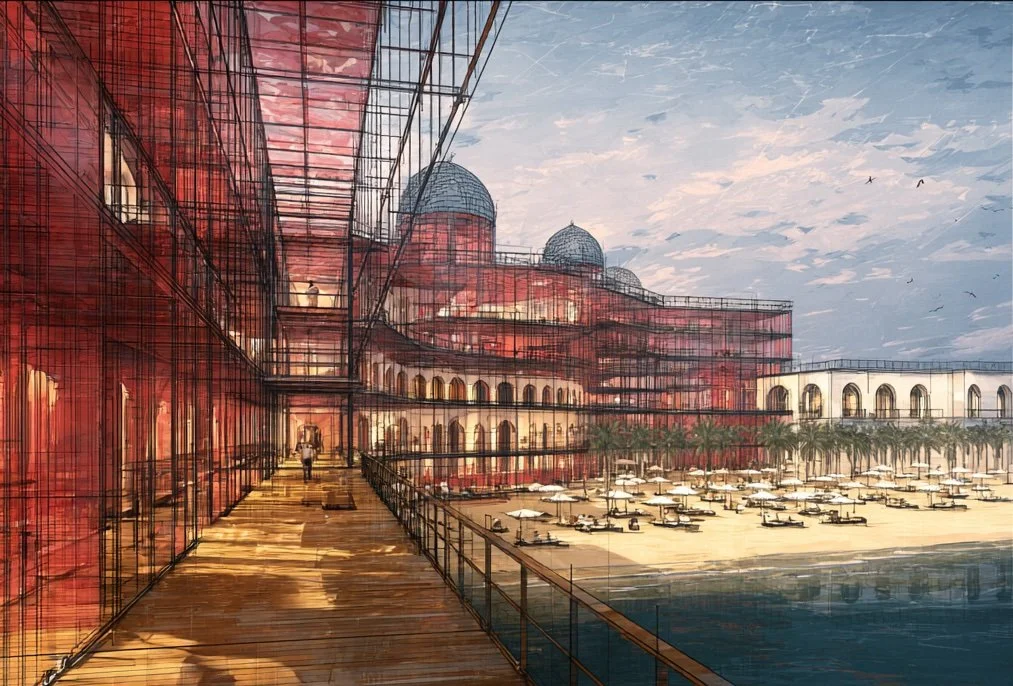
A modernized interpretation of the U-shaped resort morphology, this OHK concept for NEOM is situated on Ras Sheikh Humaid and was conceived as part of the original master plan developed by OHK and presented to Saudi leadership. Designed for one of the smaller islands off the coastline, the resort was intentionally planned with a boutique footprint and a compact land take, allowing it to sit lightly within its island setting while still creating a strong architectural presence. The illustration shows how the classic U-shaped logic has been reworked into a more contemporary composition. Rather than a rigid or heavy monumental form, the massing is staggered and layered, opening the project more gracefully toward the pool, landscape, and sea while preserving the sense of enclosure, focus, and ceremony that makes this morphology so effective. The result is a resort that combines intimacy with grandeur, creating a central outdoor room that becomes the heart of the guest experience. Architecturally, the project fuses a clean modernist language with references drawn from Islamic architecture. Its arcades, domes, rhythmic colonnades, symmetry, and shaded transitional spaces give the composition a character that feels both regionally rooted and contemporary. The staggered treatment softens the form, reduces its apparent bulk, and gives the resort a more relaxed and site-responsive expression, while the fusion of modernism and Islamic architectural vocabulary reinforces a distinct identity suited to its Saudi coastal setting.
This shift is also tied to changes in taste and market expectation. Earlier resort models often assumed that grandeur, symmetry, and visible order communicated quality. Today, many luxury and design-led markets value the opposite: informality, intimacy, looseness, landscape immersion, and the appearance of effortlessness. Ironically, this often requires more—not less—design discipline. A fragmented and natural-feeling resort usually demands careful choreography if it is to remain coherent, operable, and memorable. The contemporary move away from literal older types is therefore not simply stylistic fashion. It reflects a deeper recalibration of what hospitality is supposed to feel like.
Climate and ecology also drive this modernization. Pure older forms were often repeated too mechanically across very different environments. Today, there is greater pressure to respond to sun, wind, slope, drainage, habitat continuity, and water scarcity more carefully. This encourages more broken, terraced, porous, and adaptive configurations. A rigid block or perfect U may still be possible, but it is often less persuasive than a form that can bend to terrain, create multiple microclimates, preserve vegetation corridors, or reduce apparent bulk. The modernization of morphology is therefore also the modernization of environmental intelligence.
For the purposes of this article, the key point is that resort taxonomy should not be read as a museum of obsolete diagrams. It should be read as a framework for understanding how older spatial logics persist through transformation. A modern resort may no longer look like a textbook U-shape, single block, or linear strip, yet traces of those logics may still organize its performance. This is why morphology must be interpreted with both historical awareness and contemporary sensitivity. Pure types are useful analytically, but real design culture evolves through adaptation, mutation, and hybrid recomposition.
This insight is particularly important for later AI-based analysis. A machine-learning system that expects literal textbook forms will fail in the contemporary built environment, where morphologies are often broken, layered, and recombined. But a system trained to detect underlying organizational logic rather than surface purity can become much more powerful. In that sense, the modernization of resort types is not only a design issue. It is also a methodological one. It reminds us that classification must remain dynamic enough to capture both inheritance and innovation.
Ultimately, what contemporary designers are doing is not rejecting morphology, but making it more supple. They are preserving the structural intelligence of older models where it still serves the project, while discarding the rigid formal habits that no longer fit current landscapes, markets, or ecological conditions. That is why an apparently old type may still survive at the heart of a very contemporary resort. The type is not repeated; it is reworked.
The most enduring resort morphologies do not survive by being copied literally, but by having their underlying spatial logic reinterpreted for contemporary expectations, sites, and climates.
What this section helps bring into sharper focus: (i) many older resort types remain relevant at the level of logic even when their literal form has aged (ii) contemporary designers often modernize morphology through fragmentation, porosity, and hybridization (iii) changing hospitality taste favors looser and more landscape-responsive reinterpretations (iv) environmental and climatic intelligence now push typologies away from rigid repetition (v) morphology is most useful when understood as evolving structure rather than frozen diagram
From Taxonomy to Recognition: Three Illustrative Built Examples for Each Morphology Showing How Real Resorts Express Dominant Spatial Types in Practice
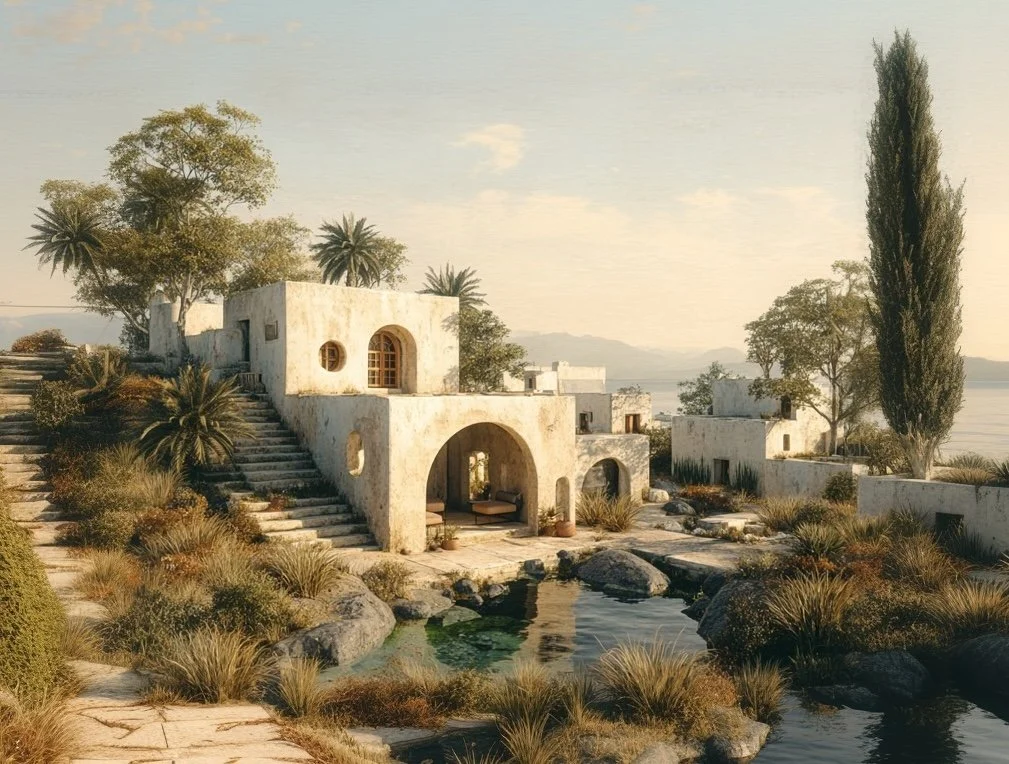
This illustration from OHK’s design archives presents a client-facing concept for a clustered village resort in the Ajloun Hills, developed through the rehabilitation of an existing village and its extension into a larger hillside settlement. It is best understood as a hybrid between terraced hillside and clustered village morphology, with multiple small hospitality clusters woven into the slope rather than imposed as one dominant building. The concept was later expanded into a broader vision involving five villages to be redeveloped and extended, making the project not only a resort design, but a larger territorial model of village-based regeneration and hillside tourism development.
A taxonomy becomes far more persuasive when readers can connect abstract categories to real projects. That said, any serious treatment of resort morphology must begin with a caution: real resorts are often hybrids. They expand over time, add villa districts, bolt on branded residences, or evolve from one dominant form into another. For that reason, the examples below should be read as illustrative dominant-type references rather than rigid or absolute assignments. Their value lies in sharpening recognition. Once readers can associate each morphology with recurring real-world cases, the taxonomy becomes more usable for designers, planners, analysts, and eventually for AI-based classification.
For the single-block morphology, useful examples include Burj Al Arab Jumeirah in Dubai, which is dominated by a singular monumental accommodation mass; The Breakers Palm Beach in Florida, where a principal hotel block concentrates the resort identity and room inventory; and Marina Bay Sands in Singapore, which, although urban and mixed-use, demonstrates the logic of a highly consolidated hospitality megastructure. In all three cases, the guest experience is centered on a primary built mass rather than a distributed accommodation field.
For the central core with bilateral wings morphology, one can look at The Phoenicia Malta, where the central arrival and public spaces anchor flanking room wings; Rixos Sharm El Sheikh, where a central hospitality core organizes lateral accommodation spreads; and Mövenpick Resort El Quseir, which expresses a recognizable balanced resort logic even within a lower-rise coastal setting. In each case, the legibility comes from a central organizing focus with accommodation extending in relatively readable arms.
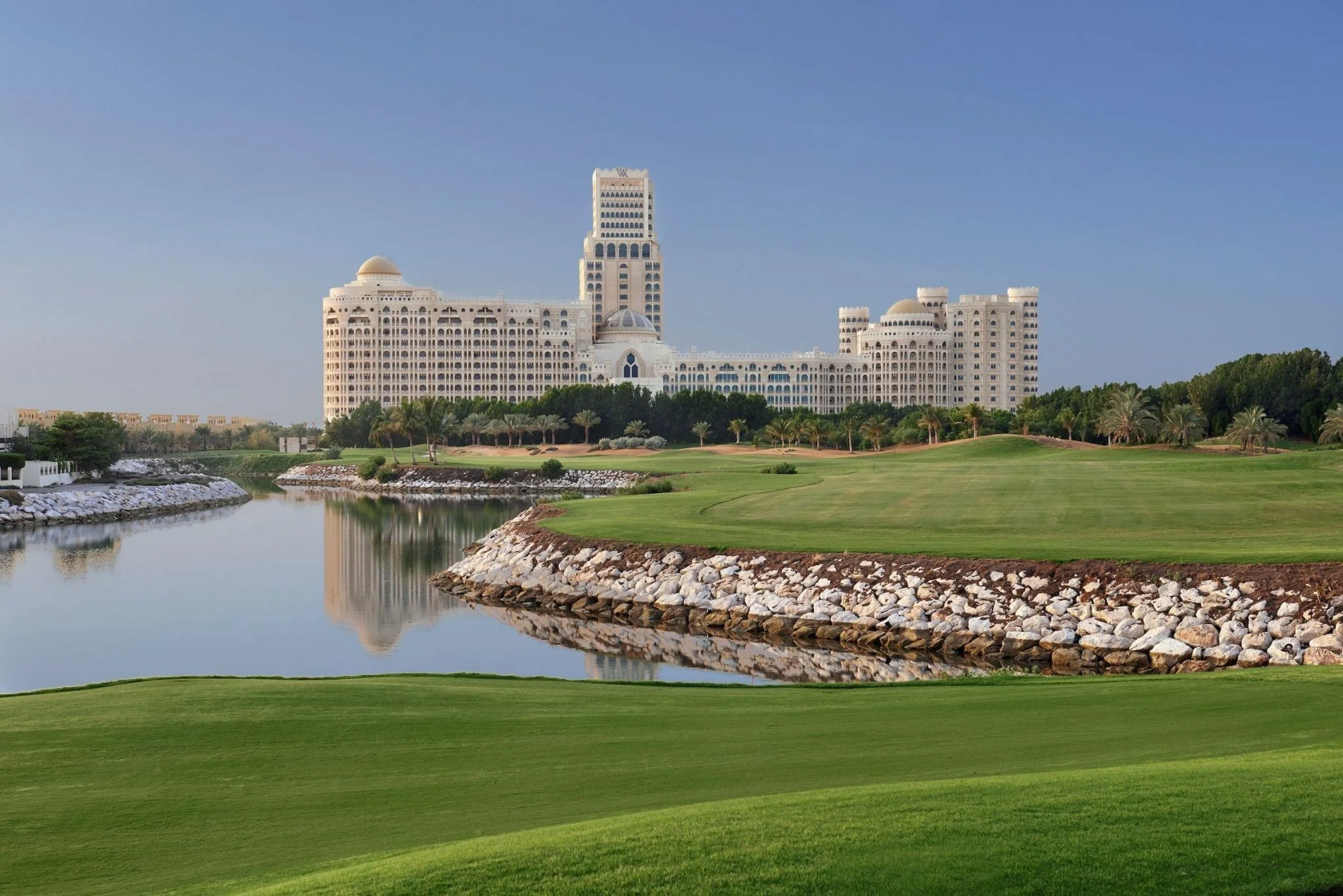
The Waldorf Astoria Ras Al Khaimah is not a pure U-shaped resort in the strict sense. It is better understood as a centralized main structure with flanking wings, combined with a shallow or softened U-shaped tendency. The composition has a strong central mass and clear bilateral extensions, but those wings also help frame space in a way that pushes the building toward a partial U rather than a simple linear or purely winged format.
For the U-shaped morphology, examples include Hilton Hurghada Plaza, where a framed open side engages water-facing leisure space; Hotel Excelsior Dubrovnik, where built form and orientation create an open-fronted enclosure toward the sea; and Waldorf Astoria Ras Al Khaimah, which uses a formal massing structure to frame major open recreational space. These examples help readers see how U-shaped logic creates both enclosure and directed openness.
For the courtyard morphology, strong references include Amanjena in Morocco, where pavilions and maisons radiate around a central bassin and courtyard-garden system; Bab Al Shams in Dubai, where inward-looking courts and enclosed outdoor rooms shape the desert resort experience; and Kasbah Tamadot in Morocco, where court-based organization and enclosed landscape pockets structure movement and atmosphere. These examples make clear that courtyard logic is not only aesthetic; it is climatic and social.
For the linear beachfront morphology, one can point to Hyatt Ziva Cancun, where accommodation and amenities align strongly with shoreline exposure; Riu Palace Bavaro in Punta Cana, where the site is largely organized as a deep but clearly sea-oriented coastal strip; and Barceló Tiran Sharm, which also demonstrates the repeated logic of maximizing direct coastal frontage. These are classic examples of the financial and experiential appeal of ribbon-like beachfront organization.
For the terraced hillside morphology, useful examples include Canaves Oia Suites in Santorini, where built form steps dramatically with topography; Katikies Santorini, which also exemplifies section-driven hospitality on a steep volcanic slope; and Belmond Hotel Caruso on the Amalfi Coast, where topographic layering shapes access, views, and the resort’s dramatic experiential sequence. These projects show that terraced resorts are best understood in section as much as in plan.
For the clustered village morphology, strong examples include Forte Village in Sardinia, where accommodations and amenities are distributed in a village-like arrangement across a large landscaped site; Mazagan Beach & Golf Resort in Morocco, which mixes centrality with distributed precincts in a destination-style layout; and Pueblo Bonito Sunset Beach in Los Cabos, where repeated accommodation groupings and internal organization evoke a clustered settlement pattern. These examples reveal why village logic often feels more human in scale than large singular blocks.
For the dispersed pavilion or villa morphology, one can look at Soneva Fushi in the Maldives, where villas are intentionally spread through dense landscape and along beachfront edges; Amanpulo in the Philippines, where detached pavilions and casitas privilege privacy and immersion; and Six Senses Zighy Bay in Oman, where villa dispersion across a dramatic natural setting is central to the guest proposition. In these cases, the land is experienced as a field of discrete hospitality units rather than a single built object.
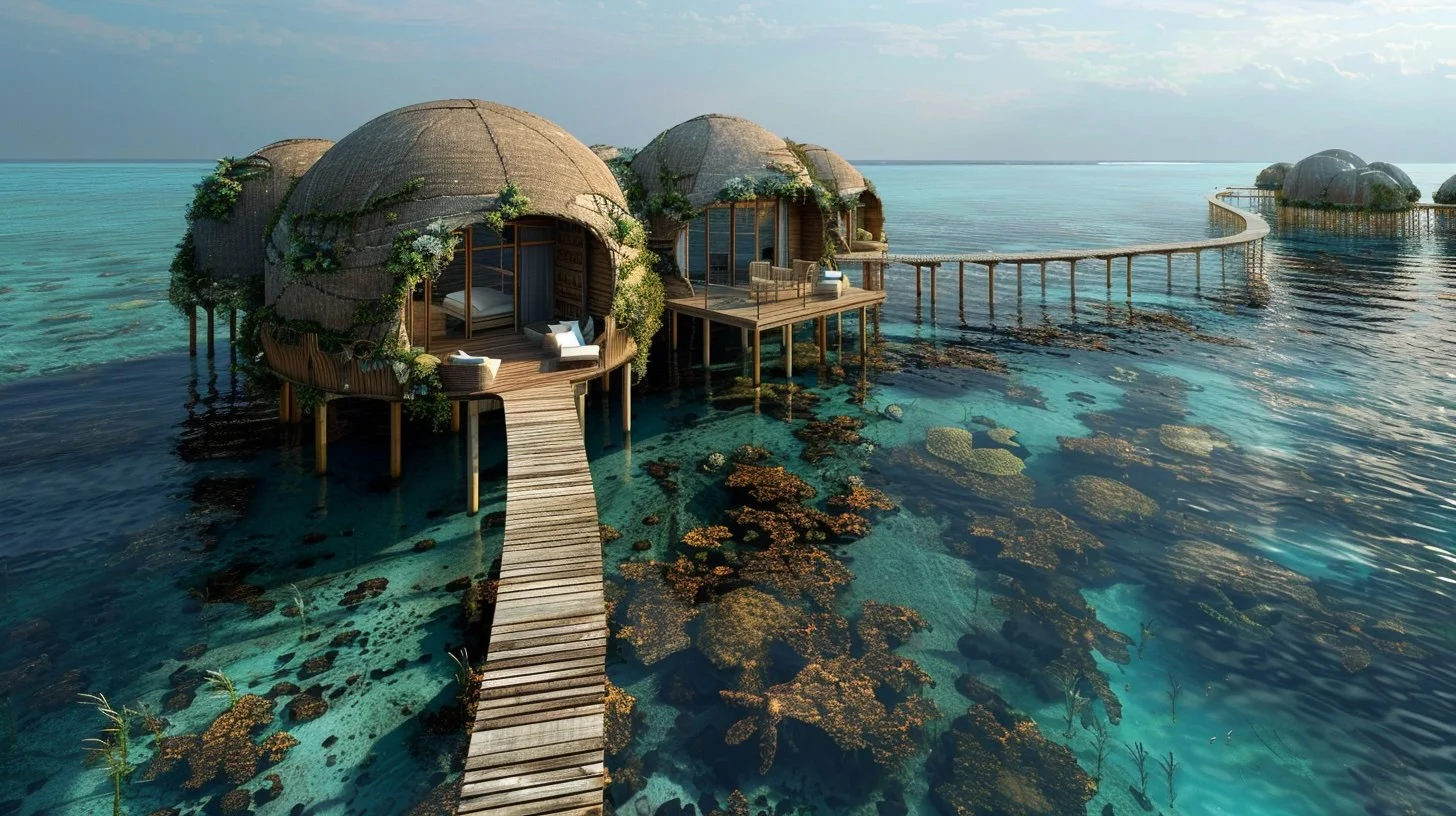
In the early 2000s, overwater or pier-based morphology was being discussed as a potential resort model for the Red Sea in Egypt. OHK responded by developing a concept specifically designed to ensure that environmental conditions would not be jeopardized, and alongside it prepared a full set of guidelines for over-reef construction. The aim was to move beyond image-driven imitation and establish a more disciplined approach in which reef ecology, marine sensitivity, structural systems, and long-term environmental performance were treated as core design parameters. The composition avoids the image of a massive offshore hotel and instead reads as a carefully sequenced chain of low-rise units, each with its own deck, privacy, and close relationship to the sea. OHK made clear environmental, material, and architectural choices in this concept. By using slender piers, narrow elevated walkways, and separated pods, the scheme suggests a lighter footprint over the visible reef shelf, helping reduce continuous shading, preserve water movement, and limit disruption to coral habitat. The pods are also wrapped in kheish-like fabric, recalling the traditional Egyptian coarse woven material and giving the architecture a softer, more vernacular character. In the spirit of Hassan Fathy, the design relies on small, human-scale domed pavilions, rounded forms, handcrafted texture, and climate-responsive logic, avoiding large buildings in favor of intimacy, restraint, and cultural rootedness. The guidelines developed by OHK were later adopted as part of the approval framework for jetties and piers proposed along the Red Sea, and they remain in use to this day.
For the spine-and-pods morphology, useful references include Atlantis The Palm in Dubai when read not only as a singular hotel but as part of a broader master-planned hospitality spine; Nusa Dua Beach Hotel & Spa in Bali, where movement and sequencing along strong internal axes connect major precincts; and Club Med La Plantation d’Albion in Mauritius, where a clear organizing route ties together distributed accommodation and activity zones. These examples help explain how a powerful internal spine can structure large or irregular hospitality grounds.
For the hybrid core-and-villas morphology, good examples include One&Only Reethi Rah in the Maldives, which combines a strong public core with distributed villa products; Four Seasons Resort Sharm El Sheikh, where central hotel logic is combined with more distributed room and villa zones; and Jumeirah Al Naseem within Madinat Jumeirah, where a more centralized hospitality core is linked to a broader field of differentiated accommodation and amenities. These cases show why hybrid morphology has become so commercially attractive: it allows operational concentration and market segmentation at once.
For the overwater or pier-based morphology, which can be treated as a subtype or stand-alone class depending on the framework, clear examples include Soneva Jani in the Maldives, Four Seasons Resort Bora Bora, and Gili Lankanfushi Maldives. In each case, jetty-based accommodation geometries project hospitality into the lagoon itself, making the resort legible through water-based linear or branching structures rather than land-based clustering alone.
What matters most is not whether every expert would classify every example identically. What matters is that these cases make the taxonomy operational. They help readers see dominant patterns, recognize hybrids, and understand why classification should always be done with both discipline and flexibility. A good taxonomy is not weakened by real-world complexity; it becomes more useful when that complexity is acknowledged openly.
Real-world examples do not make the taxonomy messier; they make it teachable, recognizable, and ready for analytical use.
What these examples allow the reader to grasp much faster: (i) resort morphologies are visible in practice, not just in theory (ii) dominant types can still be identified even when hybrids exist (iii) examples sharpen pattern recognition across disciplines (iv) the taxonomy becomes more credible when grounded in known cases (v) visual recognition is the bridge from conceptual classification to AI-based detection
A Resort Town as Morphological Laboratory: How El Gouna Reveals the Coexistence, Layering, and Evolution of Multiple Resort Types Within One Destination
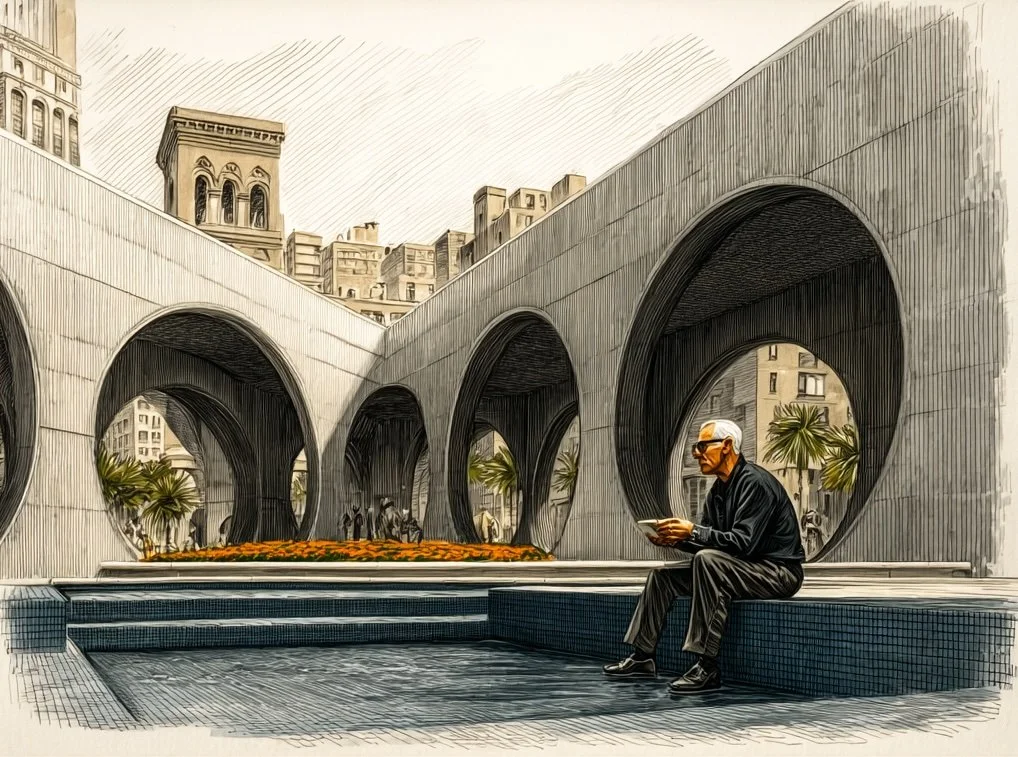
This illustration from OHK’s design archives presents a client-facing hybrid resort concept, combining a sequence of courtyard-like spatial chambers in the foreground with the presence of a larger consolidated hospitality mass beyond. What defines this morphology is the layering of multiple organizing logics: a series of enclosed and semi-enclosed courts shape movement, shade, water, and atmosphere at the pedestrian level, while the larger building behind provides the clarity, hierarchy, and operational focus of a more centralized resort core.
If individual resorts help us understand morphology at the project scale, a mature resort town helps us understand it at the level of a living system. That is what makes El Gouna, a large Red Sea resort town that OHK helped design, such a valuable case. Rather than presenting a single purified resort typology, El Gouna can be read as a morphological laboratory in which many major hospitality and tourism spatial logics coexist, overlap, and evolve within one destination. This makes it unusually useful for the argument of this article. It allows morphology to be understood not only as a way of classifying isolated projects, but as a way of reading how an entire resort town is composed, diversified, and managed over time.
El Gouna is especially important because it occupies a middle ground between the singular resort and the conventional town. It is not simply one hotel compound with one guest logic, nor is it a traditional city whose tourism functions are only incidental. It is a purposefully developed environment in which accommodation, marinas, lagoons, public spaces, golf, retail, neighborhoods, mobility systems, and hospitality clusters interact. In such a context, morphology becomes legible across multiple scales. One can read the form of individual resorts, the organization of districts, the relationship between waterfronts and internal lagoons, the contrast between concentrated and dispersed development, and the way hospitality typologies interweave with broader urbanism. This is precisely why a place like El Gouna adds something unique to the taxonomy: it demonstrates that resort morphology is not only about the form of a hotel, but about the structure of a destination.
A town like El Gouna also makes clear that morphology is rarely static. Over time, resort destinations accumulate layers. They expand, diversify, reposition, and adapt. New hospitality products are inserted into older spatial frameworks. More intimate, boutique, or villa-based environments emerge alongside larger and more centralized hospitality compounds. Marina-oriented hospitality introduces one logic, golf-related products another, lagoon-edge development yet another. In this sense, El Gouna helps reveal something essential: resort morphology is evolutionary. It is not merely a set of fixed design templates, but a field of recurring spatial strategies that can be recombined, extended, and differentiated as a destination matures.
This becomes visible when one reads the destination not through branding or district names alone, but through spatial pattern. Some hospitality components in El Gouna reflect compact and centralized logic, where the guest experience is anchored by a clear built core with concentrated amenities and direct service efficiency. Others move toward clustered village logic, where smaller accommodation groupings, open spaces, and pedestrian sequences create a more distributed and human-scaled environment. In waterfront and lagoon-facing conditions, one can also identify linear tendencies, where access to water frontage shapes the ordering of rooms, terraces, and public edges. Elsewhere, more hybrid forms appear, where central hospitality cores are linked to dispersed room zones, residential products, or differentiated precincts. This coexistence is exactly what makes the destination so analytically rich.
The marina environments are particularly revealing. Marina-based resort urbanism often introduces a different morphology from conventional beachfront hotels. Instead of simply aligning rooms with a shoreline, the spatial logic may revolve around basin edges, promenades, mooring fronts, mixed-use strips, and hospitality embedded in a more urban waterfront condition. This creates a type of resort morphology that sits somewhere between town and destination hotel. It is more porous, more mixed, and often more layered in section and frontage condition. In El Gouna, such waterfront conditions help illustrate that resort morphology is not always reducible to classic coastal typologies alone. A marina district can behave as its own morphological environment, blending hospitality, leisure, and urban structure in a way that broadens the taxonomy rather than contradicting it.
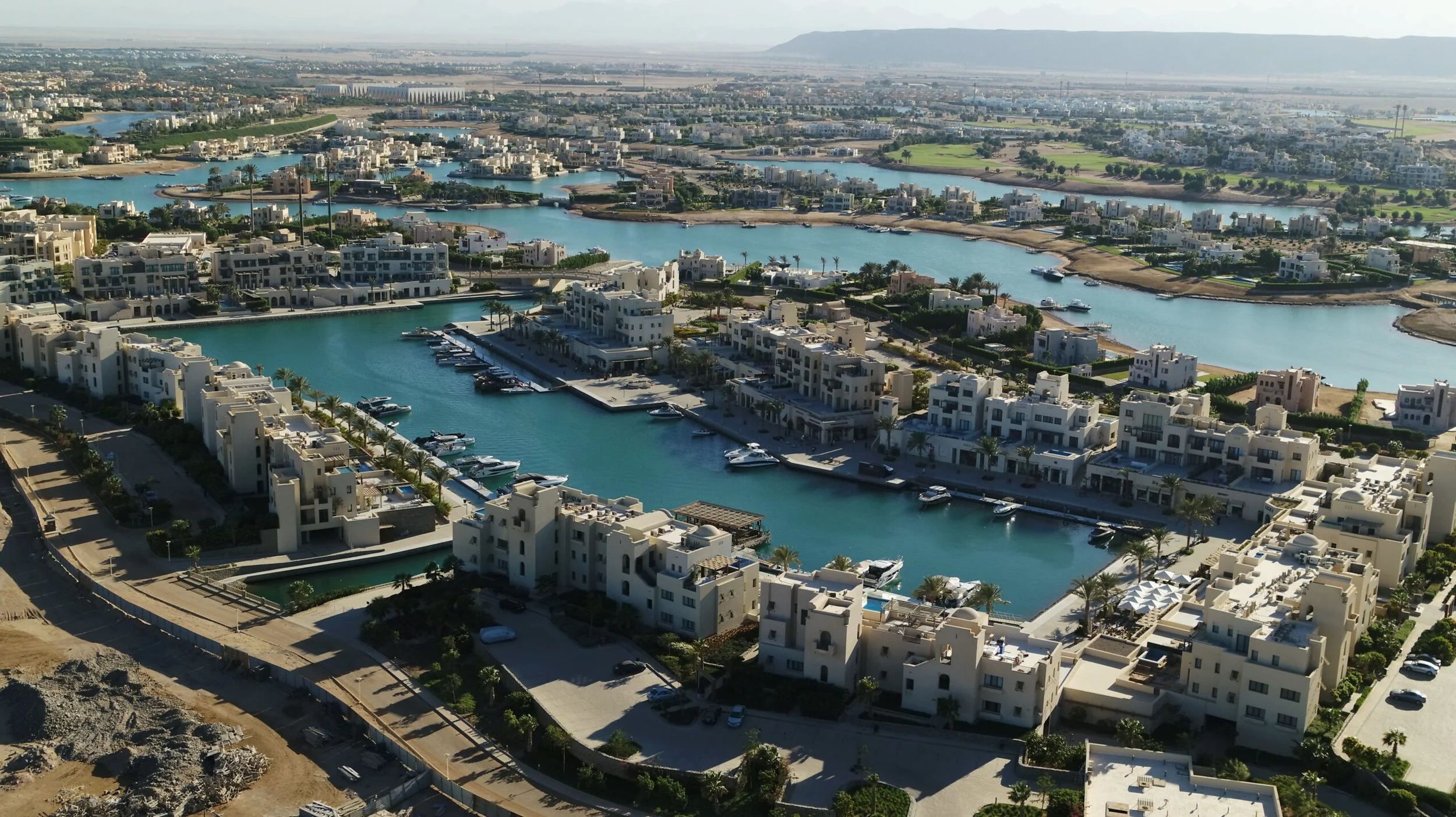
This aerial view of El Gouna shows the resort town as a mature, master-planned coastal destination in which lagoons, marinas, residential clusters, hospitality zones, and golf landscapes are woven into one integrated spatial system. OHK served as a consultant to the World Bank and USAID in helping the Government of Egypt, and later Orascom, advance the realization of El Gouna as part of a broader development concept centered on Integrated Resort Developments or Resort Towns—a model in which tourism, urbanism, infrastructure, and environmental planning are conceived together rather than as isolated hotel projects.
Lagoon-edge development introduces another variation. Lagoons change the logic of frontage. Instead of one singular sea edge, there may be multiple internal water interfaces, each generating different alignments, plot conditions, and accommodation strategies. This can encourage forms that are more fragmented, more distributed, and more intricately related to edge conditions than a simple oceanfront strip. Hospitality in such conditions may not read as one dominant bar facing the sea, but as a sequence of smaller masses, courts, water-oriented clusters, or hybrid compounds. In analytical terms, this is extremely useful because it shows how hydrological design and master planning can create an expanded field of resort morphology.
Golf-related areas also reveal a different pattern language. Golf-linked hospitality often changes the relationship between built form and open land. The orientation of rooms, villas, or public spaces may respond not only to the sea or lagoon, but to fairways, greens, and broad landscape corridors. This tends to favor lower densities, greater spread, premium edge positioning, and differentiated privacy conditions. Such areas may therefore move toward dispersed, clustered, or hybrid luxury forms even when the destination as a whole contains more compact hospitality types elsewhere. Again, the value of El Gouna lies not in proving that one typology dominates everything, but in showing that a mature resort town can sustain multiple morphological ecosystems at once.
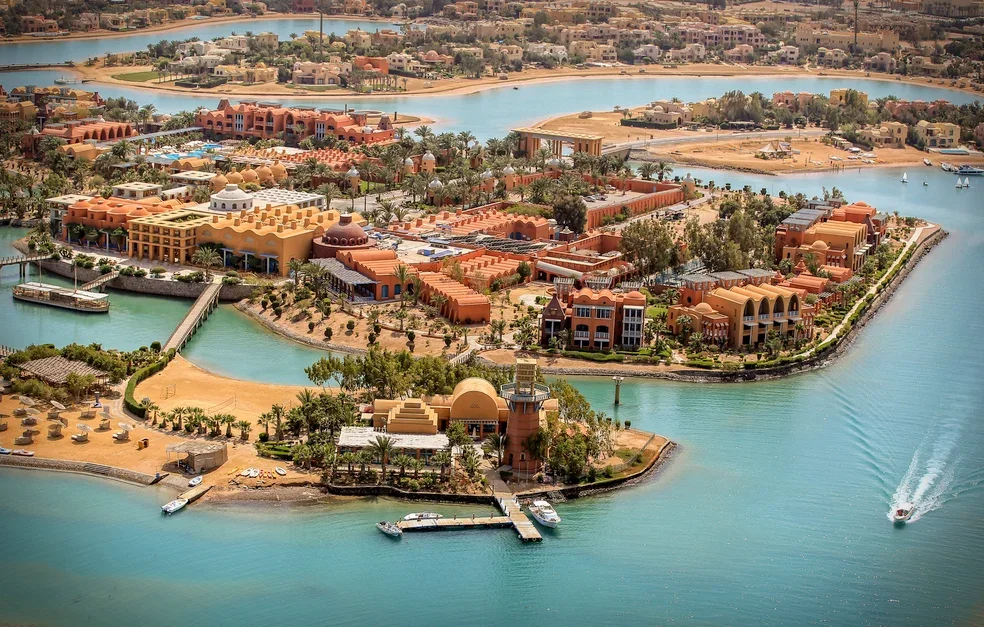
One of OHK’s very early projects, Sheraton Miramar Resort El Gouna was developed through a collaboration with Michael Graves, in which OHK helped adapt his design language to a more vernacular architectural expression suited to the Red Sea setting. Morphologically, the resort is best understood as a hybrid rather than a pure type. Its spatial condition is shaped by island-like distribution, bridges, clustered accommodation, and a fragmented relationship to water, while still retaining identifiable main buildings and organized hospitality cores. This combination gives the project a village-like character without making it a simple village morphology in any strict typological sense.
This is where named resort references can strengthen the reading, provided they are treated carefully. Properties such as Steigenberger Golf Resort El Gouna can be read through the lens of golf-linked and more distributed hospitality structure, where landscape adjacency and lower-density positioning matter greatly. Sheraton Miramar Resort El Gouna presents a different spatial condition, one shaped by island-like distribution, bridges, and a fragmented relationship to water that makes simple classification less useful than hybrid reading. Mövenpick Resort & Spa El Gouna can be examined through a more extensive waterfront and compound logic, where linearity, clustering, and hybrid organization intersect. The value of naming such examples is not to freeze them into rigid categories, but to show that one destination can contain multiple dominant tendencies that become clearer when read morphologically rather than only by brand or market segment.
For OHK, El Gouna carries additional significance because it is not an abstract case viewed from a distance. It is part of a professional landscape in which the relationship between tourism form, land logic, infrastructure, and destination identity has been directly engaged. That matters because morphology becomes more convincing when it is not only observed analytically, but understood through planning and design involvement. A resort town is never simply the sum of hotel footprints. It is a negotiated system of movement, frontage, publicness, environmental conditioning, investment sequencing, and experiential identity. Reading El Gouna morphologically helps reveal those relationships in a way that more isolated resort examples often cannot.
There is also a strong methodological reason to include such a section in this article. If Part 1 aims to establish a taxonomy that can later support measurement and AI-based recognition, then a place like El Gouna functions as an ideal intermediate scale between typological theory and territorial analysis. It is large enough to show complexity, but coherent enough to remain readable. It demonstrates why dominant morphology, secondary attributes, and hybrid classification all matter. It also shows why AI systems will eventually need to classify not only isolated resort compounds, but broader destination fabrics where hospitality, urbanity, water systems, and landscape are deeply intertwined.
In that sense, El Gouna is not merely an example. It is evidence that resort morphology becomes more powerful as the scale of observation expands. At the single-hotel level, morphology helps us understand operational and experiential structure. At the district level, it helps us read clustering, frontage logic, and movement patterns. At the destination level, it reveals how different hospitality types coexist, how growth is phased, how identity is differentiated, and how one resort town can become a mosaic of spatial systems rather than a repetition of one formula. That is precisely the kind of insight that conventional hospitality language often misses.
The larger lesson is that mature resort destinations should be read not as uniform brands, but as assemblages of morphologies. Some areas will be compact, some dispersed, some water-edge linear, some marina-urban, some golf-related, some highly hybridized. This diversity is not noise. It is structure. And once that structure is seen, the destination becomes open to a much richer level of planning, comparison, and future analysis.
In summary, a more granular reading of El Gouna shows how different hospitality properties express different dominant morphologies, while several also sit between multiple types because of phasing, waterfront condition, or hybrid program. For example:
Steigenberger Golf Resort El Gouna — best read as a hybrid between dispersed villa/resort logic and golf-linked clustered morphology. Its relationship to the golf landscape, lower-density spread, and differentiated accommodation condition push it away from a compact hotel model and toward a more distributed premium resort structure.
Sheraton Miramar Resort El Gouna — best read as a hybrid between dispersed pavilion morphology, clustered island-resort logic, and water-edge fragmentation. Because the property is broken across islands and linked by bridges, it resists simple single-category classification and is better understood as a spatially fragmented hybrid.
Mövenpick Resort & Spa El Gouna — best read as a hybrid between linear waterfront morphology, clustered resort organization, and centralized compound logic. It has stronger frontage orientation than some inland properties, but it also carries the internal coherence of a more organized resort compound.
Casa Cook El Gouna — can be read primarily as a courtyard-influenced boutique cluster, with aspects of low-rise pavilion logic. Its scale and layout make it less like a large destination resort and more like an intimate, design-led hospitality morphology organized around enclosed and semi-enclosed social spaces.
La Maison Bleue — best understood as a single-block or mansion-like hospitality morphology embedded within a broader resort-town condition. It is useful precisely because it shows that not all hospitality in El Gouna follows large compound logic; some parts of the town support highly concentrated boutique formats.
Ancient Sands Resort — can be interpreted as a hybrid between terraced, clustered, and golf-oriented resort morphology, particularly because of its topographic articulation and relationship to the landscape structure. It shows how even within El Gouna, section and terrain can complicate purely planar classification.
Fanadir Hotel El Gouna — best read as a compact boutique resort with centralized block logic, though its waterfront and marina-adjacent setting gives it a more mixed urban-resort edge condition than a conventional isolated hotel.
Cook’s Club El Gouna — leans toward a compact central-core hospitality morphology, with a stronger social-center orientation than more dispersed resort formats. It is useful as a contrast to the more fragmented and water-distributed properties in the town.
Taken together, these examples show that El Gouna is not defined by one dominant resort morphology, but by the coexistence of multiple spatial logics ranging from compact and centralized to fragmented, clustered, waterfront-oriented, and hybridized.
A resort town like El Gouna reveals that morphology is not just a way to classify isolated hotels, but a way to read the layered spatial intelligence of an entire tourism destination.
What this case helps illuminate with unusual force: (i) resort morphology operates at destination scale as well as project scale (ii) mature resort towns often contain multiple coexisting spatial logics (iii) marina, lagoon, golf, and waterfront conditions generate distinct morphological variations (iv) hybrid reading becomes more important as resort environments grow more layered (v) a destination-scale case like El Gouna forms a powerful bridge between taxonomy and later AI-based analysis
Why Morphology Matters in Practice: How Resort Form Shapes Experience, Operations, Ecology, Infrastructure, and Territorial Development Patterns
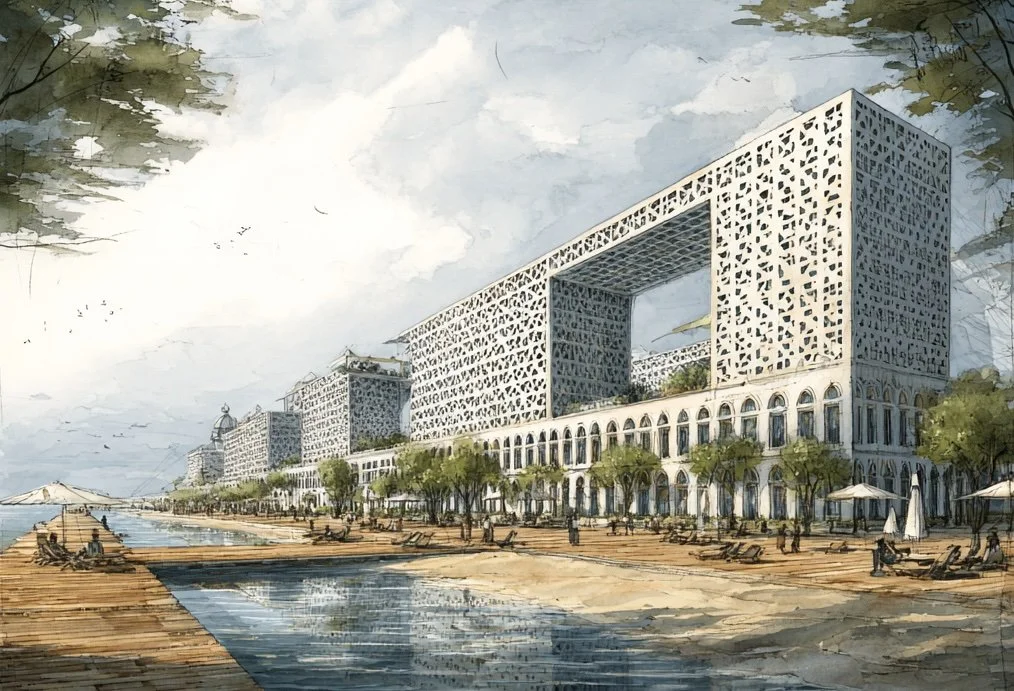
This illustration from OHK’s design archives presents a client-facing concept for a linear beachfront resort on the Red Sea, where the architecture is organized in a long, laterally stretched formation parallel to the shoreline. What defines this morphology is its emphasis on maximum frontage, sea views, and direct coastal relationship, with the resort unfolding along the water’s edge rather than enclosing a central space. The jetty extending beyond the fringing reef reflects a specifically Red Sea condition, enabling access to deeper water while preserving the shallow reef zone closer to shore.
Once a taxonomy is established, the obvious question is whether it matters beyond classification. The answer is yes, emphatically so, because morphology influences almost every meaningful dimension of resort performance. Different resort forms produce different experiential atmospheres, different operational burdens, different infrastructure requirements, different ecological pressures, and different territorial outcomes. In this sense, morphology is not a descriptive afterthought. It is one of the most consequential design decisions in the making of a destination.
Start with guest experience. A compact single-block resort tends to create convenience. Distances are short. Public amenities are close together. Guests quickly understand where things are. This can be excellent for short stays, conference functions, older guests, and destinations where climate makes long outdoor walking unpleasant. But compactness can also reduce the feeling of discovery. A dispersed pavilion resort, by contrast, may create privacy, immersion, and exclusivity. Guests feel they inhabit the landscape rather than merely observe it. Yet this comes at the cost of longer travel distances, more dependence on buggies, and sometimes a weaker sense of social center. Neither is inherently superior; each produces a different hospitality proposition.
Consider operational efficiency. Housekeeping routes, luggage handling, room service logistics, security coverage, maintenance workflows, and waste collection all depend on spatial organization. A winged or centralized resort usually performs better operationally because functions are concentrated. A highly dispersed villa resort requires more staff movement, more distributed technical systems, and often more redundancy. Over time, this affects margins and service consistency. What appears luxurious from the guest’s perspective may be cumbersome from the operations perspective. Morphology therefore shapes not just the guest journey but the invisible labor system behind it.
Now consider infrastructure. Compact resorts usually require shorter utility runs, less internal road length, and more efficient service distribution. Dispersed morphologies require more extensive networks for water, power, communications, wastewater, and transport. On sensitive sites, this can be the decisive issue. A morphology that seems light-touch because it is low-rise and scattered may in fact be far more intrusive underground and across the terrain than a more concentrated form. This is a critical point for planners and environmental reviewers: visual softness does not automatically mean infrastructural efficiency.
Morphology also shapes land consumption and shoreline use. Linear beachfront resorts maximize direct access to the sea, but they often consume large stretches of coast per room and can contribute to the privatization of public frontage. A more compact or clustered solution may preserve larger open spaces, ecological buffers, or public access corridors. Terraced hillside morphologies may consume less horizontal land but involve extensive grading and retaining interventions. Courtyard and core-based solutions can be land-efficient, but if scaled badly they may dominate viewsheds or disconnect guests from landscape. Each type has trade-offs, and morphology is the key that reveals them.
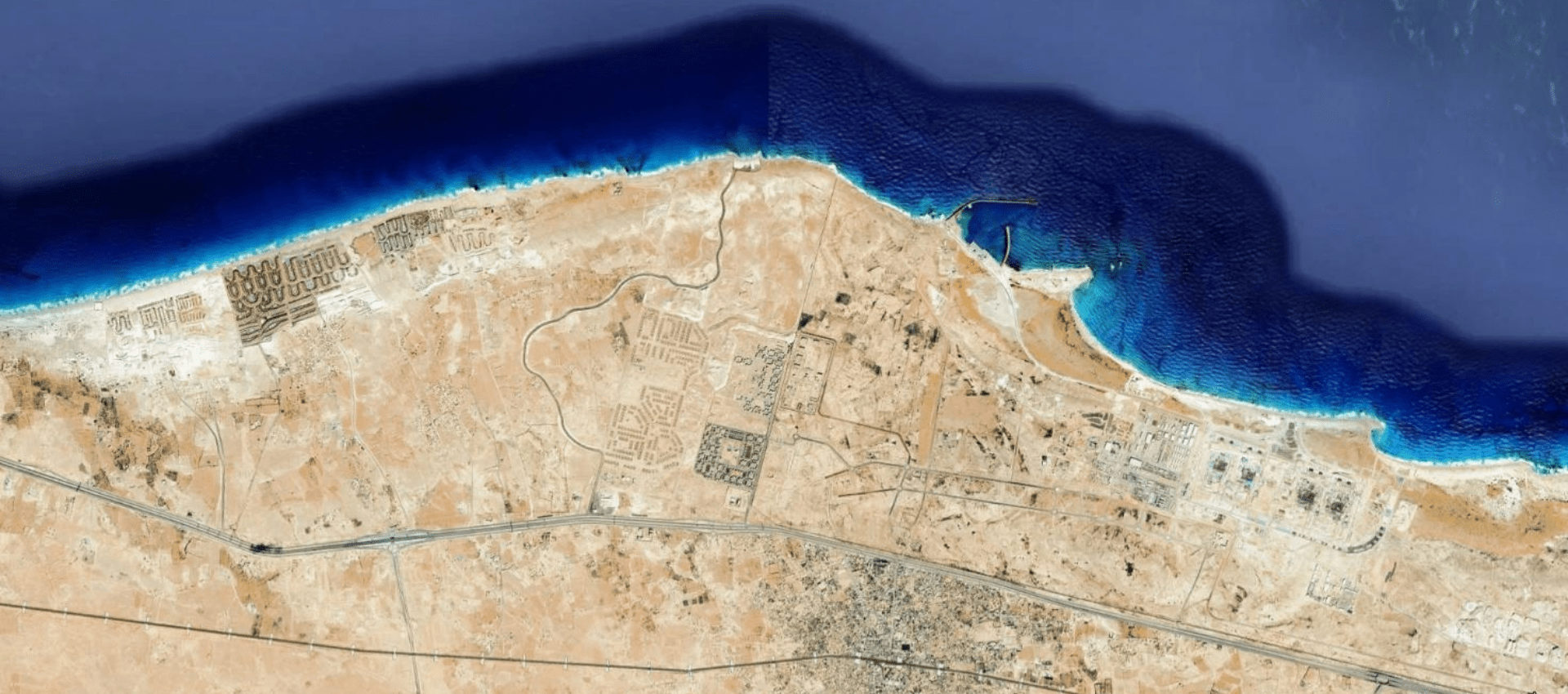
The older planning model on Egypt’s North Coast illustrates why resort morphology must be understood cumulatively rather than project by project. For decades, many resorts were developed as adjacent self-contained enclaves, each treated as an isolated scheme rather than as part of one connected territorial system. The result was a repeated coastal pattern of privatized frontage, fragmented access, duplicated infrastructure, and weak civic continuity. What appeared acceptable at the scale of the individual resort produced, at the scale of the destination, a far less coherent shoreline. The core planning failure was not only repetition itself, but the absence of a broader morphological vision for the coast.
From an environmental perspective, the implications are substantial. Different morphologies lead to different patterns of vegetation removal, habitat fragmentation, microclimate creation, irrigation demand, and movement disturbance. A golf-linked resort loop may generate a very different water and landscape burden than a compact seafront hotel. A dispersed villa resort may increase edge conditions and fragment habitat even while appearing low density. A courtyard-based desert resort may create shaded internal comfort with less landscape consumption if carefully designed. Environmental assessment should therefore move beyond room count and plot ratio toward the deeper question of spatial form.
Morphology further shapes resilience. On flood-prone coasts, certain patterns may be easier to evacuate, elevate, or phase adaptively. On steep slopes, terraced formats may reduce bulk but increase geotechnical sensitivity. In heat-exposed deserts, compact shaded forms may outperform highly dispersed layouts. In wind-heavy environments, enclosed and semi-enclosed forms may create better outdoor comfort. Morphology is therefore tied to climate responsiveness, not just visual arrangement.
The economic implications are equally significant. A central-core hybrid with premium villas may support a broader revenue ladder than a monolithic block. A dispersed luxury morphology may command higher rates but involve higher capital and operating costs. A linear beachfront resort may be financially attractive because it monetizes sea views extensively, yet may also create long-term public costs if it drives ribbon infrastructure expansion and erodes open access. Economists and investors who ignore morphology miss a major source of value differentiation and hidden cost.
At the scale of territorial planning, the consequences compound. A single resort type repeated across a destination can produce a landscape logic: strips, enclaves, clusters, nodes, or fragmented corridors. This is where planning usually fails. Authorities regulate each project individually but often fail to see the cumulative effect of morphological repetition. Ten linear resorts in a row do not equal ten isolated projects; together they create a coast-wide privatized strip. Multiple dispersed low-density resorts across a fragile landscape can create an infrastructural web far heavier than one might assume from their low-rise appearance. Morphology needs to be understood cumulatively.
This is also where resort morphology becomes deeply relevant to public policy. Instead of generic standards, planners can create morphology-aware regulation. They can encourage clustered forms over ribbon forms in certain landscapes, cap frontage consumption, require ecological corridors between compounds, or incentivize compact service cores with low-impact room clusters. Such regulation is far more intelligent than simply limiting height or requiring setbacks, because it addresses the spatial logic that truly shapes the destination.
For designers, understanding morphology also sharpens creativity. Taxonomy is not the enemy of imagination. On the contrary, once the structural consequences of each type are understood, designers can innovate more responsibly. They can hybridize with intention rather than by accident. They can choose a morphology that fits the site, climate, and business model instead of importing a visual trope. Morphological literacy therefore strengthens both freedom and discipline.
Resort morphology matters because form quietly governs experience, cost, ecology, and territorial consequence long before branding or architecture begin to explain a project.
What practice confirms again and again: (i) guest experience is shaped by spatial organization (ii) operational efficiency is a morphological outcome (iii) low visual density can still hide heavy infrastructure impact (iv) cumulative territorial effects matter more than project-by-project appearances (v) better policy begins when morphology becomes regulatable rather than merely observable
From Design Intuition to Analytical Intelligence: Why Formalizing Resort Morphology Creates the Foundation for Measurement, Comparison, and AI-Based Evaluation
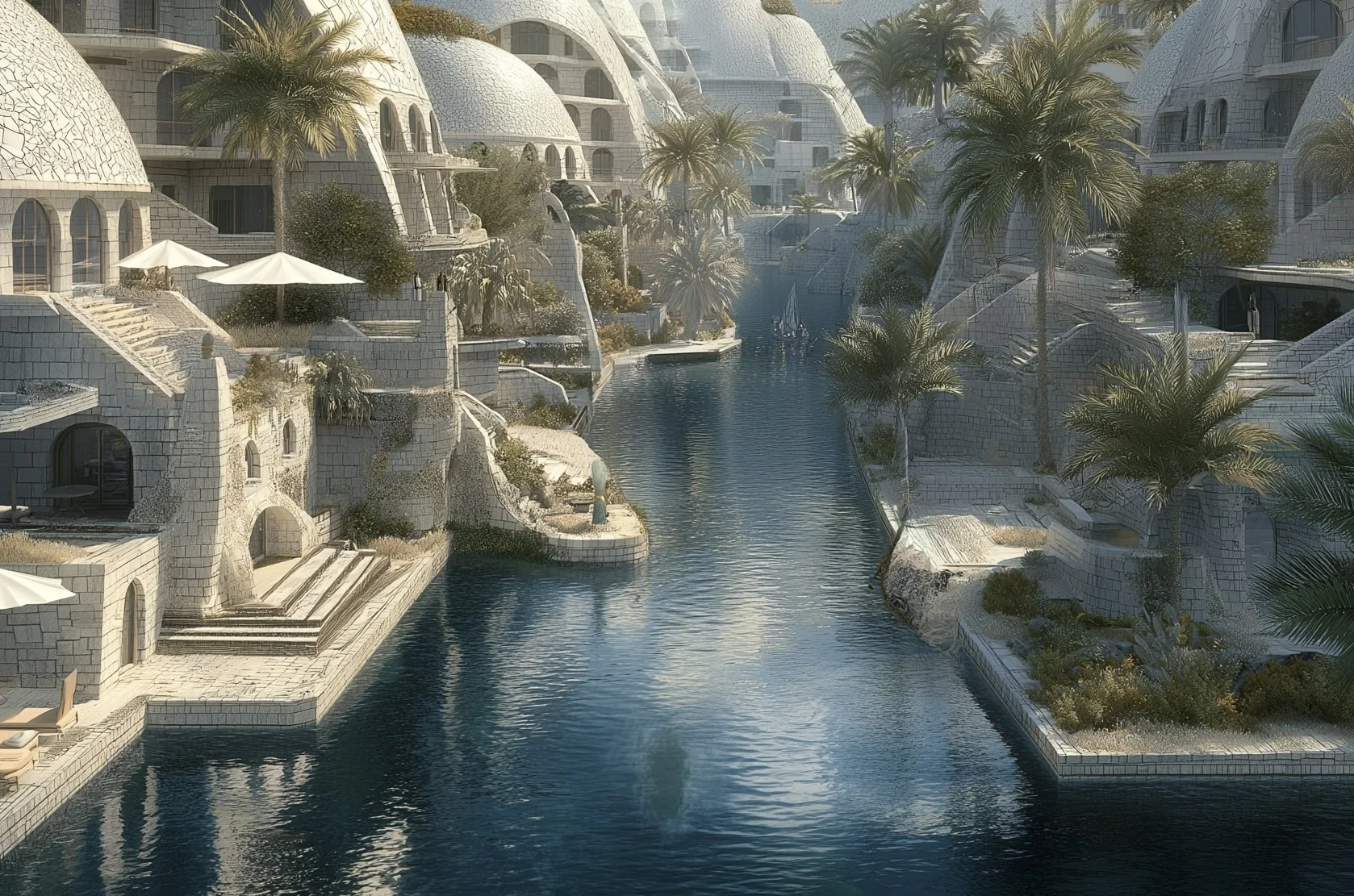
This illustration from OHK’s design archives presents a client-facing concept for a clustered village resort at the Siwa salt lakes, where the built form is intentionally concentrated into a dense, settlement-like composition in order to preserve the wider lake landscape. The site was deliberately selected close to a hill and embedded into a ridge condition so that the development could preserve the broader horizon view across the salt lakes while minimizing visual spread across the open terrain. What defines this morphology is the use of many small, low-rise hospitality volumes gathered closely together rather than spread loosely across the site, allowing the resort to occupy only a very limited footprint within the salt-lake environment. The architecture draws on the tactile language of kershef construction, with irregular handmade surfaces, softened edges, and textured earthen massing that root the project in Siwa’s material identity while reinforcing the intimate, village-like character of the resort.
The greatest value of formalizing resort morphology lies not in naming patterns for its own sake, but in creating the basis for measurement. Once a taxonomy exists, it becomes possible to associate each resort type with metrics, thresholds, tendencies, and consequences. This is the moment where design language becomes analytical infrastructure. Without this step, resort discourse remains descriptive and often subjective. With it, morphology becomes comparable across sites, investors, territories, and time.
The first shift is from type to metric. A resort is not merely a clustered village or a terraced hillside type. It can also be described through measurable indicators: land area per room, shoreline meters per key, building footprint coverage, internal road length, average distance from rooms to the central amenity core, vegetation retention rate, slope modification intensity, utility network length, and degree of spatial centrality. These indicators do not replace morphology, but they operationalize it. They allow one to see not only what type a resort belongs to, but what that type tends to imply.
The second shift is from project reading to portfolio comparison. Once multiple resorts are classified and measured, we can ask questions that design fields often leave unanswered. Which morphology is most land-efficient in a coastal setting without sacrificing premium positioning? Which type produces the highest infrastructure burden per room? Which types correlate with high shoreline privatization? Which hybrid models produce the best balance between revenue segmentation and environmental restraint? These are not merely academic questions. They are directly relevant to development finance, tourism strategy, and territorial governance.
The third shift is from isolated form to temporal analysis. A formalized morphology framework allows us to track how resorts evolve. A compact block may later acquire a villa extension and become a hybrid. A clustered system may densify into a more urbanized configuration. A linear strip may gradually add inland backfill components and create a second layer of development. Morphology, once measured, becomes something that can be monitored over time rather than simply admired or criticized in a static snapshot.
This analytical potential leads naturally to the role of AI and geospatial intelligence, which is the focus of Part 2. If resort morphology can be clearly defined and associated with measurable traits, then it becomes possible to train machine-learning systems to detect and classify it from plans, aerial images, or satellite data. But AI is not the starting point. Taxonomy is. A machine cannot reliably identify what humans have not clearly defined. This is why the conceptual rigor of Part 1 is not a side exercise. It is the groundwork that makes computational analysis possible.
Even before AI enters, the formalization of morphology already improves planning and design workflows. A government can require resort proposals to declare their morphological type and provide standard metrics. A developer can compare alternative site layouts not only visually but structurally. A lender can evaluate whether a proposed scheme is likely to create hidden infrastructure burdens. An environmental reviewer can assess whether a supposedly low-density project is actually highly invasive in network terms. In all of these cases, taxonomy becomes a decision-support system.
Another major benefit is the possibility of scenario testing. Once morphology is formalized, one can model how a given parcel might perform under different configurations. How would a 100-hectare coastal site behave if developed as a compact core, a linear strip, a clustered village, a hybrid core-and-villas model, or a dispersed luxury layout? What happens to road length, view access, green continuity, beach access, infrastructure cost, and room count under each option? This turns resort planning into a comparative design intelligence exercise rather than a one-shot master-planning gamble.
Formalization also creates a shared language across professions. Architects, planners, engineers, economists, ecologists, and data scientists often work on the same projects but use different conceptual frameworks. A robust morphological system can become a common platform. Designers can discuss experiential logic. Engineers can quantify infrastructure implications. Ecologists can map habitat fragmentation. Economists can link form to productivity. Data scientists can encode the structure for detection and simulation. This shared language is rare and extremely valuable.
At a more strategic level, formalization protects against superficiality. In many development contexts, decision-making is dominated by persuasive visuals, marketing language, and benchmark imitation. Morphological frameworks introduce discipline. They ask what the project is structurally doing, not only what it looks like. They expose contradictions between image and reality. A resort marketed as integrated with nature may prove to be one of the most dispersed and infrastructure-heavy forms. A project described as dense may actually preserve more ecological continuity than a visually softer alternative. Without formalization, these truths remain hidden.
Ultimately, the move from intuition to intelligence is about institutional maturity. Sectors mature when they learn to codify what was once implicit. Resort morphology today is at that threshold. The design world recognizes patterns informally. The planning world sees impacts unevenly. The data world has the tools to measure and model. The next step is to bring these together. That is why this article ends where the next one begins: with the proposition that once morphology is named, it can be identified, measured, tested, and used as a basis for smarter territorial decisions.
The moment resort morphology becomes formalized, it stops being a descriptive idea and becomes a platform for comparison, regulation, simulation, and AI.
What the path forward now requires: (i) convert types into measurable indicators (ii) compare morphologies across portfolios and territories (iii) track change over time rather than only initial design intent (iv) use taxonomy as the prerequisite for AI-based recognition (v) build a shared language across design, planning, ecology, and economics
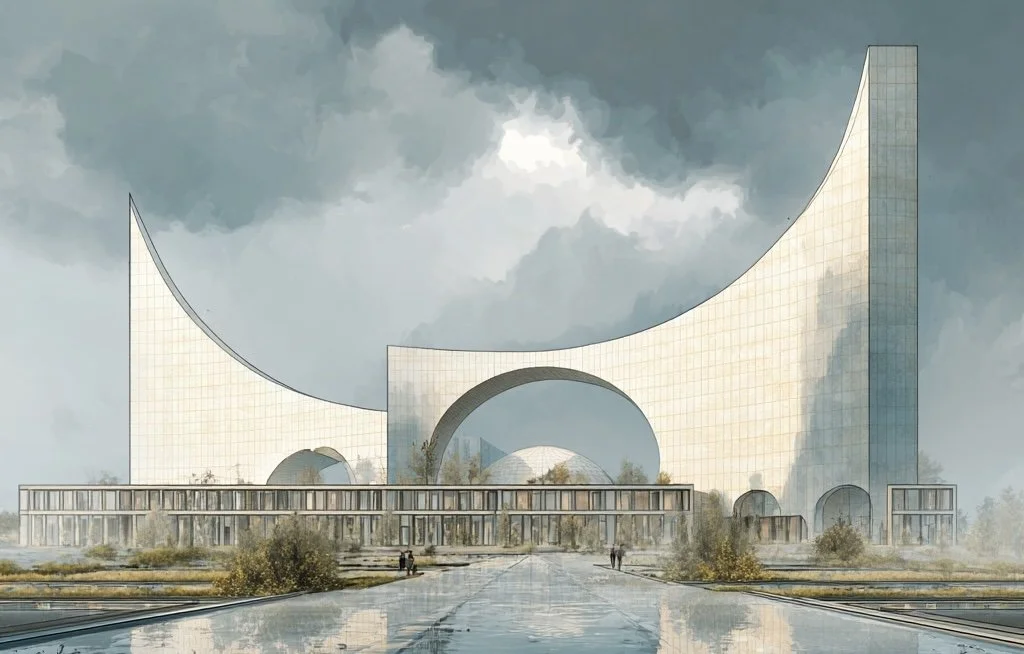
Client-facing concept proposed by OHK for the Jordanian side of the Dead Sea, this landmark resort was conceived as an integrated hospitality destination linked to a conference center and a museum, while also helping create a much-needed town center for the Dead Sea, where a coherent civic and social core has long been lacking. The design is expressed as a monumental U-shaped architectural form that frames a ceremonial central void and reflective water axis, reinforcing arrival, orientation, and visual drama. Its sculptural massing gives the project a strong civic presence while preserving its resort identity, allowing it to function as a destination for stay, gathering, exhibition, and regional cultural life.
In the end, the real contribution of resort morphology is that it makes the hidden structure of tourism development visible. It shows that resorts are not just branded destinations or architectural compositions, but repeatable spatial systems with measurable consequences. Once that is understood, resort design can no longer be discussed only in terms of image, luxury, or atmosphere. It must also be understood through form, pattern, and territorial effect. That is the conceptual foundation on which the next step begins: identification, measurement, and intelligent testing through AI.
At OHK, we approach tourism, territorial development, and complex destination challenges not only as planning and design questions, but as integrated problems of strategy, place, and long-term implementation. Our work brings together master planning, architecture, urban design, tourism development, landscape thinking, spatial analysis, and strategic advisory to help clients move from fragmented ideas to coherent and actionable visions. We build frameworks that connect site conditions, market positioning, environmental sensitivity, infrastructure logic, cultural identity, and development phasing into one integrated picture, allowing governments, investors, development institutions, and private-sector leaders to test alternatives rather than rely on isolated design gestures or reactive decision-making. Whether the issue is a resort destination, a tourism corridor, a waterfront, a heritage landscape, or a new urban district, our aim is the same: to turn complex conditions into clearer plans, stronger places, and more durable long-term value. Contact OHK to learn how our master planning, design, tourism, and strategic advisory capabilities can support better destination, development, and investment decisions worldwide.