

The New Automotive Power Struggle Is Rewriting How Global Carmakers Compete, Localize, and Make Money
A view on how battery cost, Chinese scale, hybrid pragmatism, software speed, policy barriers, and margin pressure are reshaping automotive advantage.

The global car industry is no longer a contest over who builds the best vehicle alone; it is a contest over who controls the complete mobility economics around batteries, software, localization, regulation, customer trust, and profitable scale.
The global automotive industry is not being disrupted by one company, one country, or one technology. It is being reshaped by a new industrial logic. For decades, automotive power was built on engine mastery, brand prestige, dealer reach, supplier orchestration, and large-scale manufacturing discipline. Those advantages still matter, but they no longer define the whole competitive game. The new battlefield is organized around battery cost, software capability, product cycle speed, powertrain flexibility, local manufacturing, trade exposure, charging ecosystems, and margin resilience. BYD is an important reference point, but it is not the whole story. Tesla, Toyota, Volkswagen, Hyundai-Kia, Ford, GM, Stellantis, Chery, Geely, Xpeng, Nio, CATL, and others reveal the wider strategic reset now underway.
Reading Time: 45 min.
All illustrations are copyrighted and may not be used, reproduced, or distributed without prior written permission.
Summary: The automotive sector has entered a more complex phase than the simple “EVs replace gasoline cars” narrative suggests: electrification is advancing, but profitability, infrastructure, hybrids, tariffs, batteries, and localization now determine who actually wins. Global electric-car sales exceeded 17 million in 2024, more than 20% of global car sales, while China alone sold more than 11 million electric cars and remained responsible for more than 70% of global EV production. Yet the transition is uneven: China has scale and price competitiveness, Europe is policy-driven but vulnerable to Chinese imports, the United States remains protected and slower-moving, and emerging markets are becoming the new expansion frontier. The core management lesson is that future winners will not merely launch EVs; they will master the full economic system of batteries, software, hybrids, localization, service, policy risk, financing, residual value, and profitability. Herewith, “electric cars” generally follows the IEA convention and includes battery-electric vehicles and plug-in hybrids unless otherwise stated.
The overall arc is: Old automotive hierarchy —> China’s EV operating system —> battery-led cost reset —> BYD as one integrated case —> Tesla as the software-and-charging countermodel —> Toyota’s hybrid contradiction —> German premium and Volkswagen pressure —> U.S. profitability trap —> global localization battle —> boardroom playbook
The End of the Old Automotive Hierarchy Is Now a Strategic Reality, Not a Prediction

The companies that once won through engines, scale, and brand prestige must now compete in an arena where speed, software, batteries, and regional adaptability define relevance.
For most of the twentieth century and the first two decades of the twenty-first, the automotive industry had a recognizable hierarchy. Germany dominated the premium-engineering imagination. Japan dominated reliability, lean manufacturing, and hybrid discipline. The United States dominated trucks, large SUVs, auto finance, and scale in its home market. South Korea built a powerful challenger model through design, warranty confidence, manufacturing discipline, and improving quality. China was largely seen as a volume market, a manufacturing base, or a joint-venture destination rather than the center of global automotive innovation.
That hierarchy is no longer stable. The basis of advantage has shifted from engine excellence to system economics. The car is still a physical product, but the profit equation now depends on battery cost, software architecture, charging convenience, electronic integration, local-content rules, supply-chain resilience, and the ability to refresh products at speed. The winners are not simply those that build the best individual car. The winners are those that control more of the economic architecture around the car.
This shift is visible in the numbers. The IEA reported that global electric-car sales exceeded 17 million in 2024, reaching more than 20% of global car sales. China alone sold more than 11 million electric cars in 2024, more than the entire world sold only two years earlier. China also remained the world’s EV manufacturing hub, responsible for more than 70% of global EV production. These figures matter because scale is not only a demand indicator. Scale creates supplier learning, purchasing leverage, platform repetition, battery cost reduction, factory utilization, software feedback, and consumer normalization.
The old automotive hierarchy was built around the internal combustion engine. That created barriers to entry because engine performance, emissions compliance, transmission calibration, crash safety, manufacturing quality, and global service networks required decades of capability accumulation. Electric vehicles do not eliminate engineering complexity, but they relocate it. The new complexity sits in battery packs, electronics, software-defined features, thermal management, charging behavior, energy efficiency, over-the-air updates, advanced driver-assistance systems, and data-enabled ownership models. This is not a smaller challenge; it is a different challenge.
That distinction explains why the competitive field has changed so quickly. Tesla showed that a new entrant could build enormous brand power around software, charging, direct sales, and a simplified product architecture. BYD showed that battery-led vertical integration and China-scale manufacturing could create extraordinary price-performance pressure. Toyota showed that hybrids remain commercially powerful where customers are not ready for full battery-electric adoption. Hyundai-Kia showed that disciplined fast-following can produce globally credible EVs without abandoning internal-combustion and hybrid optionality. Chery, Geely, Xpeng, Nio, Leapmotor, and Aito show that China’s challenge is not concentrated in one company.
The old hierarchy is not dead, but it is being forced to defend itself on unfamiliar terms. Premium brands can still command loyalty, but they must justify the premium with software, interior experience, charging access, safety, service, and residual value. Mass-market brands can still win volume, but only if their cost structures can survive Chinese pricing pressure. U.S. automakers can still harvest profits from trucks and large SUVs, but those profits do not automatically fund a competitive EV transition. Japanese automakers can still benefit from hybrid discipline, but they must avoid being late where BEV adoption accelerates.
The strategic implication for management teams is blunt: the EV transition is not only a powertrain transition. It is a restructuring of industrial advantage. A company that launches electric models while preserving slow development cycles, fragmented platforms, weak software, expensive batteries, and regionally inflexible production has not truly transformed. It has merely electrified parts of an old operating model.
The next decade will therefore separate automakers into three groups. The first will be system leaders: companies that integrate batteries, software, manufacturing, policy, and customer economics into a coherent model. The second will be adaptive incumbents: companies that preserve brand strengths while rebuilding cost and speed. The third will be strategic drifters: companies that talk about electrification but remain trapped between legacy profit pools and unprofitable EV ambitions.
The automotive hierarchy is being rewritten because the source of advantage has moved from engines and heritage toward battery economics, software speed, regional policy, and full-system cost control.
Lessons for executives redefining competitive advantage beyond the old car-company hierarchy: (i) automakers should benchmark cost architecture and product-cycle speed, not only brand strength and vehicle quality; (ii) EV strategy must include battery sourcing, software control, charging access, residual values, and service economics; (iii) legacy advantages remain valuable only when they are translated into the new industrial logic; (iv) China should be treated as a competitive laboratory, not merely a sales region or manufacturing base; (v) boards should ask whether management is electrifying old habits or redesigning the operating model itself.
China Did Not Merely Build EV Companies; It Built an EV Operating System
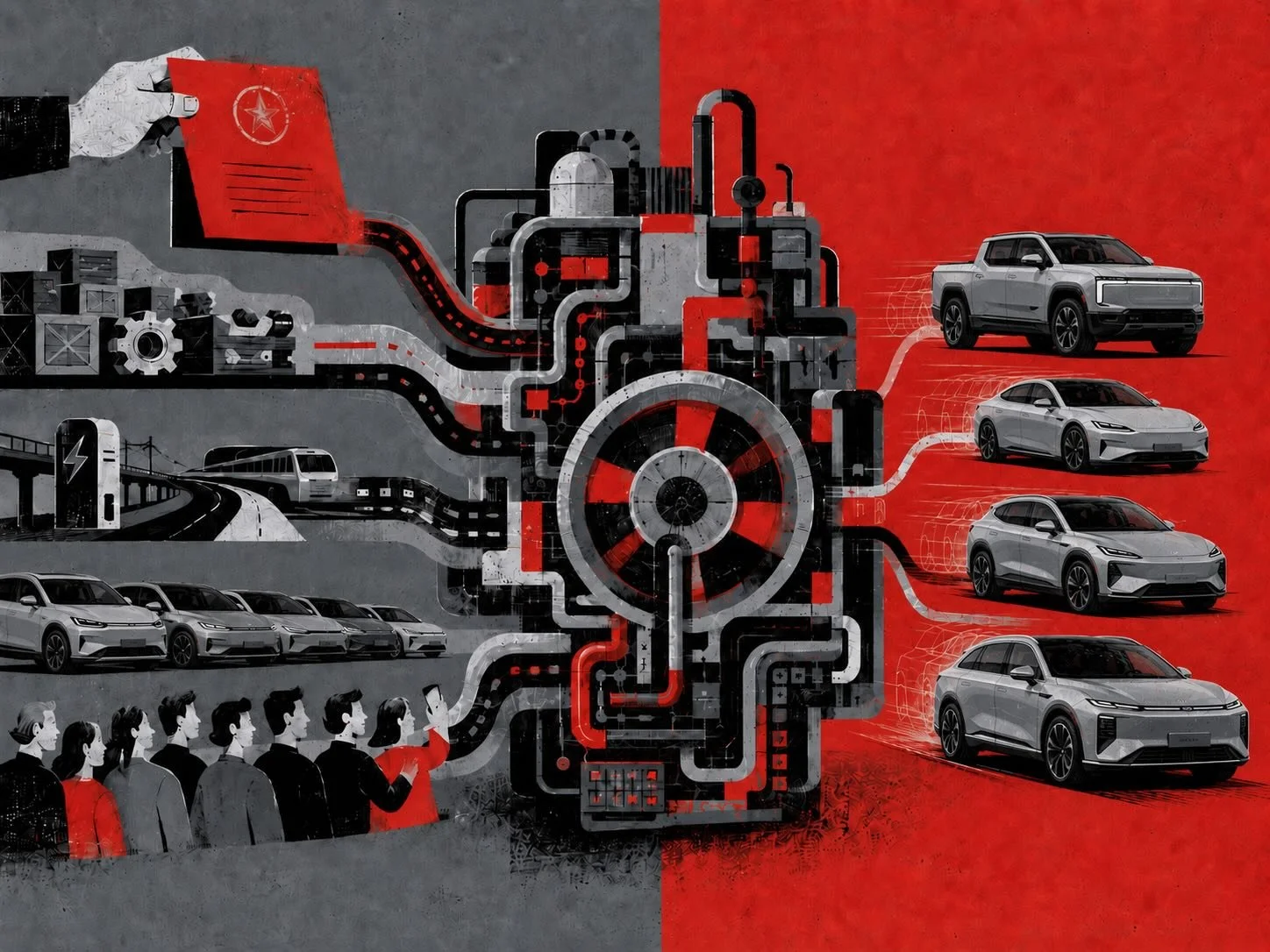
China’s real automotive advantage is not only cheaper vehicles, but a dense industrial machine that turns policy, suppliers, infrastructure, competition, and consumer demand into accelerated learning.
The rise of Chinese automakers cannot be understood through the lens of individual corporate performance alone. China built an EV operating system: large domestic demand, dense supplier networks, battery scale, industrial policy, urban charging deployment, consumer incentives, local software ecosystems, brutal price competition, and fast product iteration. BYD is one of the most visible winners from that system, but Chery, Geely, SAIC, Leapmotor, Xpeng, Nio, Li Auto, Aito, and CATL are also expressions of the same ecosystem.
The scale of China’s system is difficult to overstate. The IEA reported that Chinese electric-car models were typically cheaper than the average EV in emerging markets and that Chinese imports accounted for 85% of electric-car sales in Brazil and Thailand in 2024. Across emerging economies outside China, Chinese imports made up 75% of the increase in electric-car sales in 2024. That means China is not only producing EVs for domestic demand; it is exporting affordability into markets where Western and Japanese automakers often struggle to offer compelling low-cost electric models.
Industrial policy helped create that system. CSIS estimated that Chinese government support for the EV sector totaled $230.9 billion cumulatively from 2009 to 2023, including buyer rebates, sales-tax exemptions, charging infrastructure, R&D programs, and government procurement. This does not mean every Chinese EV success is artificial. It does mean that China lowered the risk of experimentation, built demand ahead of many other markets, and allowed firms to scale into a supplier ecosystem that competitors now have to confront.
The system has also become intensely competitive. China’s car market has faced years of price pressure, and Reuters reported that Chinese car sales fell 18% in the first quarter of 2026 from a year earlier, with exports becoming more important as domestic economics tighten. China exported 5.8 million vehicles in the prior year, almost 20% more than a year earlier, and industry forecasts pointed to 7.4 million exports in 2026. This is not merely export ambition; it is also a response to domestic overcapacity, slowing growth, and margin pressure.
That creates a paradox. China’s EV operating system has produced world-class cost competitiveness, but it has also produced too many competitors, intense discounting, and pressure on profitability. A market that forces companies to become fast and lean can also force them into damaging price wars. The same system that creates export power can create domestic financial stress. This is why the global industry should avoid simplistic conclusions. China’s EV rise is neither purely a triumph of free-market efficiency nor purely a subsidy story. It is a hybrid industrial phenomenon: state-enabled, privately executed, technologically real, and economically messy.
The supplier ecosystem is particularly important. CATL, for example, held a reported 38.1% share of the global EV battery market in the first ten months of 2025 and supplies automakers including Tesla, BMW, Volkswagen, Xiaomi, and Nio. Its 2026 Hong Kong fundraising of about $5 billion was intended to support overseas factory expansion, zero-carbon initiatives, R&D, and working capital. This matters because batteries are now the industrial heart of the automotive transition, and China’s battery champions give Chinese automakers a structural advantage in cost, speed, and access.
Chinese automakers are also globalizing with different strategic personalities. BYD emphasizes vertical integration, LFP batteries, plug-in hybrids, and scale. Chery is pursuing a “Toyota plus Tesla” model, explicitly combining quality and technology, while expanding in Europe through local production in Barcelona and international brands such as Omoda and Jaecoo. Chery sold 2.8 million cars in 2025, and its global sales nearly quadrupled from 2020 to 2025.
The management lesson is that competitors should not ask, “How do we beat BYD?” That is too narrow. They should ask, “How do we compete against the Chinese EV operating system?” That system includes battery suppliers, software ecosystems, manufacturing clusters, government support, export financing, price competition, and increasingly, localization abroad. BYD may be the most visible case, but it is not the only strategic threat.
China’s automotive challenge is powerful because it is not one company’s success; it is an integrated operating system of batteries, suppliers, policy, scale, speed, and export ambition.
Lessons for leaders interpreting China as an ecosystem rather than a single competitor: (i) competitive benchmarking should include Chinese supplier density, battery access, pricing, and product-launch cadence; (ii) industrial policy should be treated as a market-shaping force, not a footnote; (iii) Chinese export growth reflects ambition and domestic economic pressure at the same time; (iv) global incumbents must study Chery, Geely, Xpeng, Nio, Leapmotor, Aito, SAIC, and CATL alongside BYD; (v) the strategic response must target the system’s economics, not only the most famous company within it.
Battery Economics Have Become the Central Cost War in Global Automotive Strategy

The battery has become the new strategic balance sheet of the car industry, shaping not only vehicle cost but pricing power, localization, safety, and long-term competitiveness.
The battery is no longer a component category. It is the central cost war of the automotive industry. In an internal-combustion vehicle, the engine and transmission carried enormous engineering and brand significance. In an electric vehicle, the battery pack determines a large share of cost, range, weight, charging behavior, safety profile, residual value, and consumer confidence. That makes battery strategy a board-level issue, not a procurement exercise.
Battery prices have moved sharply. The IEA reported that lithium-ion battery pack prices fell 20% in 2024, the largest drop since 2017, driven by lower critical mineral prices and squeezed battery margins, especially through competition in China. The IEA’s 2026 battery-market commentary added that average battery prices declined by another 8% in 2025, while Chinese battery pack prices were 30% lower than in the United States and 35% lower than in Europe. LFP batteries became more than 40% cheaper on average than NMC alternatives and accounted for more than half of EV batteries globally.
These numbers change the strategic equation. A company with access to lower-cost batteries can lower vehicle prices, improve range, defend margins, or add features without destroying economics. A company with high battery costs faces the opposite problem: either charge more and risk losing volume, cut prices and damage margins, or absorb losses while waiting for scale. This is why battery sourcing, chemistry, pack architecture, and regional supply chains are now critical.
LFP chemistry is central to this debate. LFP batteries generally offer lower material cost and reduced dependence on nickel and cobalt, though they may have different energy-density characteristics than some nickel-rich chemistries. BYD has built much of its EV architecture around LFP, including its Blade Battery. BYD states that its Blade Battery passed nail-penetration testing without smoke or flames, offers more than 5,000 charging cycles, and improves space efficiency compared with traditional battery packs. These are company claims and should be interpreted as part of BYD’s technical positioning, but the broader point is clear: BYD has turned battery architecture into a consumer-facing and cost-facing strategic asset.
Tesla followed a different path. It built a powerful system around software, manufacturing simplification, charging infrastructure, and direct customer relationships, while also using different battery chemistries and suppliers across vehicle types and geographies. Toyota has taken yet another path, emphasizing a multi-pathway strategy in which hybrids, plug-in hybrids, BEVs, fuel cells, and regional solutions coexist. The important point is not that every automaker must use the same chemistry or integration model. The important point is that every automaker must have a battery strategy that fits its market position, regions, customer economics, and margin requirements.
Battery strategy is also becoming geopolitical. The EU imposed countervailing duties on China-built BEVs after concluding that China’s BEV value chain benefited from unfair subsidies that threatened economic injury to EU producers. The duties included 17.0% for BYD, 18.8% for Geely, 35.3% for SAIC, 7.8% for Tesla Shanghai after individual examination, 20.7% for other cooperating companies, and 35.3% for non-cooperating companies. In the United States, Chinese EV tariffs were increased to 100% in 2024, and lithium-ion EV battery tariffs were increased to 25%.
That means battery advantage cannot be separated from local manufacturing. A low-cost China-made battery system may be powerful in Brazil, Thailand, or parts of Europe, but far less usable in the United States under current tariff conditions. European automakers must manage Chinese competition while protecting local capacity and meeting emissions requirements. U.S. automakers must source batteries competitively while operating inside a protected but often higher-cost market. Emerging-market buyers may benefit from lower-priced Chinese vehicles but face questions about after-sales service, parts, charging infrastructure, and local industrial policy.
The consulting implication is direct: battery cost is now a strategic control point. Automakers do not necessarily need to own every cell factory, but they need deep control over chemistry choice, pack design, supplier economics, recycling, warranty data, thermal behavior, charging compatibility, and regional sourcing. A company that treats batteries as a commodity input will be structurally disadvantaged against firms that treat batteries as the organizing principle of vehicle economics.
Battery economics have become the new engine of automotive competition because they determine affordability, margin resilience, range, safety, localization options, and geopolitical exposure at once.
Lessons for decision-makers making battery strategy a board-level control point: (i) battery strategy must include chemistry, sourcing, pack design, warranty, recycling, and regional policy exposure; (ii) LFP economics are reshaping affordability, especially where Chinese supply chains dominate; (iii) battery cost gaps between China, Europe, and the United States are now strategic gaps; (iv) tariff regimes can convert a technical battery advantage into a regional disadvantage; (v) automakers should manage batteries as a profit-system architecture, not as a purchasing category.
BYD Is the Sharpest Integrated Case, but Its Lessons Are More Valuable Than Its Mythology

BYD’s significance lies less in being an unstoppable winner and more in showing how integration can create advantage while also amplifying exposure to price, margin, and governance pressure.
BYD deserves attention because it compresses many of the industry’s new competitive principles into one company. It began with battery capability, moved into vehicles, scaled inside China’s EV operating system, developed a strong plug-in hybrid position, pushed aggressively into exports, and became one of the clearest examples of battery-led cost competition. But the more sophisticated lesson is not that BYD is unbeatable. The lesson is that BYD reveals both the strengths and vulnerabilities of the new automotive model.
BYD’s strategic strength begins with integration. Unlike many legacy automakers that moved from engines into batteries, BYD moved from batteries into cars. This shaped its instincts. It could think of vehicle architecture, battery design, pricing, and manufacturing as connected decisions. Its Blade Battery proposition, its LFP orientation, its plug-in hybrid portfolio, and its mass-market pricing all point to an operating model built around energy storage as a strategic core rather than a sourced component.
The company’s growth has been extraordinary, but recent financial data shows that scale does not eliminate pressure. Reuters reported that BYD’s 2025 net profit fell 19% to 32.6 billion yuan, its first annual profit decline in four years. Revenue growth slowed to 3.5%, its weakest pace in six years, while headcount fell 10.2% to 869,622 by year-end. BYD’s automotive gross profit margin slipped to 20.5%, down 1.8 percentage points from a year earlier. The company also faced pressure because cars priced under 150,000 yuan accounted for more than 61% of its domestic sales in November, exposing it to the most price-sensitive segments.
The pressure continued into 2026. BYD’s first-quarter net profit fell 55.4% year on year to 4.1 billion yuan, while revenue fell 11.8% to 150.2 billion yuan. Reuters reported that BYD’s domestic sales declined for a seventh straight month through March 2026, even as overseas shipments remained strong. This is the most important corrective to the mythology: BYD is a powerful company, but it is not immune to price wars, subsidy changes, domestic saturation, or margin compression.
The company’s working-capital model has also drawn attention. Reuters reported that BYD had moved away from using in-house financial notes issued through its Dilian system to pay some suppliers, shifting toward commercial paper or bank notes, according to sources briefed on the matter. BYD said the Dilian system complied with regulatory guidelines and that it had sped up payments to suppliers, but the episode highlights a broader point: fast growth can be partly financed by supplier terms, and those terms become more sensitive when the industry enters a margin squeeze.
BYD’s international push is therefore both an opportunity and a necessity. As domestic competition intensifies, foreign markets offer higher margins, brand expansion, and diversification. Reuters reported that BYD is targeting 1.5 million overseas vehicle sales in 2026 or higher, implying growth of more than 40% from 2025. It is also pushing ultra-fast charging technology and manufacturing localization to regain technological edge and expand international credibility.
This is where the BYD lesson becomes industry-wide. Integration gives speed and cost advantages, but it also increases exposure when the integrated system comes under pressure. Price leadership creates volume, but price wars damage margins. Supplier leverage supports growth, but can create governance and reputational risk. Export growth unlocks opportunity, but tariffs and local-content rules force localization. Battery advantage creates differentiation, but technology claims must be backed by trust, safety, and after-sales support.
Other carmakers can learn from BYD without copying it. Tesla can learn from BYD’s affordability discipline. Volkswagen can learn from BYD’s China-specific speed. Toyota can learn from BYD’s plug-in hybrid scale while maintaining its own multi-pathway approach. Ford and Stellantis can learn that EV launches without cost architecture can become financially painful. Hyundai-Kia can learn how to respond tactically on price while preserving profitability. Chinese peers can learn that growth without margin quality will eventually be scrutinized.
BYD is most useful not as an idol or villain, but as a compressed case study in how integration, battery economics, price competition, export ambition, and margin risk now interact.
Lessons for executives extracting BYD’s transferable insights without copying its model blindly: (i) vertical integration can create powerful cost and speed advantages, but it must be matched with financial discipline; (ii) price leadership is valuable only if it does not permanently erode margin quality; (iii) supplier-payment practices become strategic risk when growth slows and regulators intervene; (iv) overseas expansion must become localization rather than pure export dependence; (v) the best lesson from BYD is not imitation, but understanding how the new EV economic system works under stress.
Tesla Shows the Opposite Path: Software, Charging, Brand Power, and the Affordability Constraint

Tesla’s challenge is that the model that made electric vehicles desirable must now prove it can also make them broadly affordable without weakening the economics that made Tesla exceptional.
Tesla is the most important countermodel to BYD. Where BYD’s story begins with batteries, industrial scale, and China-market cost pressure, Tesla’s story begins with software, direct customer relationships, charging infrastructure, brand intensity, simplified manufacturing, and over-the-air vehicle improvement. Tesla did not simply build EVs; it changed what customers expected from an EV. The company made the car feel more like a technology platform than a conventional vehicle with an electric powertrain.
That strategic architecture remains powerful. Tesla’s 2025 delivery data show that it delivered 1,636,129 vehicles for the full year, including 1,585,279 Model 3/Y vehicles. In the fourth quarter of 2025 alone, Tesla delivered more than 418,000 vehicles and deployed 14.2 GWh of energy storage products. The scale is material, but Tesla’s significance is not only volume. It also built a charging ecosystem, a direct-sales model, software-update capability, and a brand that gave it early pricing power.
Tesla’s charging network is one of its strongest strategic assets. In its 2025 annual filing, Tesla stated that it offers Supercharger access to non-Tesla vehicles in support of its mission and noted that major automakers have announced adoption of the North American Charging Standard in certain markets. This matters because charging infrastructure is not just convenience. It is a customer-acquisition tool, an ecosystem lock-in mechanism, and a trust signal.
But Tesla now faces a challenge similar to the one BYD has made visible: affordability. Reuters reported in April 2026 that Tesla’s lower-cost EV plan could help boost volumes and address slowing demand, especially in China and Europe, but investors were concerned about margin dilution. One investor quoted by Reuters framed the issue directly: if Tesla can maintain mid-teens margins while increasing volume, operating leverage works; if not, the lower-cost model risks weakening profitability.
This creates a strategic tension. Tesla built its early advantage by making EVs aspirational. BYD and other Chinese automakers are making EVs aggressively affordable. Tesla’s brand remains powerful, but the market is moving toward a feature-per-dollar comparison in which Chinese vehicles often look compelling. A customer comparing a Tesla with a lower-priced Chinese EV may evaluate range, interior features, connected services, charging speed, warranty, and financing. Tesla can still win, but it must increasingly win on total ownership experience, not novelty alone.
Tesla’s model also faces regional constraints. In China, domestic competitors have narrowed technology gaps and compete aggressively on price. In Europe, Tesla faces both local automakers and rising Chinese imports. In the United States, tariffs protect Tesla from direct Chinese import competition, but that protection also reduces the urgency for U.S. consumers to experience lower-priced Chinese alternatives. Protection buys time; it does not guarantee long-term global competitiveness.
The Tesla-BYD contrast is strategically useful. BYD demonstrates battery-led cost integration and mass-market breadth. Tesla demonstrates software-led ecosystem control and charging-enabled trust. BYD has plug-in hybrid flexibility; Tesla remains largely committed to battery-electric purity. BYD faces domestic price-war margin pressure; Tesla faces volume growth and margin pressure as it moves downmarket. BYD must globalize legitimacy; Tesla must defend brand relevance as competitors catch up.
The lesson for other automakers is not to choose one model mechanically. Most incumbents need elements of both. They need Tesla’s software discipline, charging thinking, and customer-interface control. They also need BYD’s battery cost discipline, manufacturing speed, and price-band realism. They need Toyota’s powertrain pragmatism where full EV adoption is slow. They need Hyundai-Kia’s adaptive pricing and product cadence. The winning model will be hybrid in the strategic sense: not necessarily hybrid powertrains, but hybrid operating capabilities.
Tesla remains one of the most important companies in the transition because it changed the mental model of the car. But the next phase is harder than the first. The first phase rewarded EV evangelism, brand intensity, and early adopter demand. The next phase rewards affordability, service, charging reliability, software quality, global manufacturing, and margins under pressure.
Tesla proved that the car could become a software-enabled mobility platform, but the next competitive test is whether that platform can scale affordably without sacrificing margin strength.
Lessons for strategists comparing Tesla’s platform model with China’s cost-led challenge: (i) charging networks can be strategic infrastructure, not merely customer support; (ii) software and over-the-air capability remain powerful differentiators when they improve ownership experience; (iii) brand strength must increasingly be defended through affordability and lifecycle value; (iv) lower-cost models can expand volume but may dilute margins if cost architecture is not ready; (v) incumbents should combine Tesla-style ecosystem control with Chinese-style cost discipline rather than treating them as alternatives.
Toyota’s Hybrid Strategy Is the Industry’s Most Important Contradiction to EV Absolutism

Toyota reminds the industry that customers do not buy energy-transition theories; they buy mobility solutions that fit their infrastructure, budgets, habits, and confidence in daily use.
Toyota is often described as slow on full battery-electric vehicles, but that description misses the strategic nuance. Toyota’s position is not simply reluctance; it is a deliberate multi-pathway view of global demand. Toyota argues that customers in different regions require different decarbonization routes, including hybrids, plug-in hybrids, battery-electric vehicles, fuel cells, and region-specific solutions. Whether one agrees with the pace or not, Toyota’s strategy has become more relevant as the EV transition proves uneven across regions.
Toyota’s own framing is clear. Toyota Europe described its multi-pathway approach as providing customers with sustainable choices regardless of where they live or their circumstances. The company’s strategy includes flex-fuel hybrids in South America, fuel-cell vehicles in Japan, and new BEV launches in Europe, where BEV adoption is stronger. Toyota also reported record European sales of 1.217 million vehicles in 2024 under this approach.
Recent production planning reinforces the point. Reuters reported that Toyota plans to boost hybrid and plug-in hybrid output to about 6.7 million vehicles by 2028, roughly 30% above its 2026 target. The report also said hybrids would account for about 60% of Toyota’s production by 2028, up from around 50% in 2026, although Toyota emphasized that these figures were reference estimates for suppliers and partners rather than formal production targets.
This is not a trivial divergence from the dominant EV narrative. Many policymakers and investors assumed that the path from internal combustion to battery-electric vehicles would be relatively linear. Toyota’s strategy says the path is segmented. In wealthy urban markets with charging access, BEVs can scale quickly. In rural markets, emerging economies, apartment-heavy cities, and regions with weak charging infrastructure, hybrids or plug-in hybrids may deliver more immediate consumer acceptance. For some customers, the issue is not ideology; it is convenience, affordability, range confidence, resale value, and charging access.
BYD’s success in plug-in hybrids actually strengthens Toyota’s argument, even though the two companies compete. BYD does not rely only on BEVs; it has scaled plug-in petrol-electric hybrids alongside battery-electric vehicles. Reuters reported that in China, automakers launched 16 new extended-range EVs and 37 new plug-in hybrids in 2024, compared with 32 new fully electric models. Forecasts cited by Reuters from a major automaker anticipated that EREVs and plug-in hybrids together could account for about 35% of China sales, compared with about 45% for EVs.
That data creates an important strategic conclusion: the contradiction to EV absolutism is not anti-electric. Hybrids and plug-in hybrids are part of electrification. The issue is how much battery, how much charging dependence, and how much behavioral change the customer is willing to accept at a given price point. Toyota’s long-standing hybrid capability and BYD’s plug-in hybrid scale both point to the same demand reality: many buyers want electrified efficiency without full dependence on public charging.
There are risks in Toyota’s approach. If BEV adoption accelerates faster than expected in a major region, Toyota may appear underexposed. If software-defined features become more important than mechanical reliability, Toyota must compete in a domain where Tesla and Chinese automakers have changed expectations. If regulators move aggressively toward zero-emission mandates, hybrids may become transitional rather than durable. The multi-pathway strategy buys resilience, but it can also create complexity.
Still, Toyota’s contradiction is valuable because it forces executives to think in market segments rather than slogans. The question is not “Are EVs the future?” The question is “Which powertrain architecture wins which customer, in which region, under which infrastructure, at which total cost of ownership?” That is a more useful management question.
The industry’s next phase will likely be powertrain plural, not ideologically pure. BEVs will grow strongly. Hybrids will remain relevant. Plug-in hybrids and extended-range EVs will occupy a pragmatic middle. Internal-combustion vehicles will persist in certain segments and regions longer than policy rhetoric suggests. The winners will be those that map technology to customer economics rather than forcing one global answer.
Toyota’s hybrid strategy matters because it shows that electrification is not one path; it is a portfolio of customer economics shaped by infrastructure, affordability, regulation, and trust.
Lessons for executives building powertrain portfolios instead of chasing a single narrative: (i) hybrids and plug-in hybrids should be assessed as electrification tools, not as failures of EV ambition; (ii) customer readiness differs by region, housing type, income level, charging access, and driving pattern; (iii) BYD’s plug-in hybrid success and Toyota’s hybrid discipline point to the same pragmatic demand reality; (iv) BEV investment remains essential where regulation and infrastructure support faster adoption; (v) powertrain strategy should be built around total cost of ownership, not ideological purity.
The German Premium Model Is Under Pressure, but Not Obsolete

German automakers still have powerful brands, but their future strength depends on converting heritage into faster software, sharper cost structures, and locally relevant customer value.
German automakers remain formidable. Volkswagen has scale, engineering depth, manufacturing experience, brands across price segments, and a global footprint. Mercedes-Benz, BMW, Audi, and Porsche still command premium recognition that most new entrants cannot replicate overnight. But the German model is under pressure because the basis of premium value is changing. Engineering heritage is no longer enough when Chinese competitors offer strong feature density at lower prices and when software, infotainment, driver assistance, battery efficiency, and local relevance matter more than before.
Volkswagen’s China reset shows how serious the pressure has become. Reuters reported that Volkswagen cut its 2030 China sales target to up to 3.2 million vehicles annually, down from a previous target of as many as 4 million. It also lowered China margin ambitions to 4%–6%, compared with the double-digit margins it once generated there. Since 2023, Volkswagen has cut about 1.5 million units of production capacity in China, sold, closed, or repurposed five vehicle and engine plants, and reduced its China workforce from around 90,000 to 70,000 employees.
Volkswagen’s own reporting underscores the broader transformation challenge. The group reported €321.9 billion in 2025 sales revenue, roughly level with the prior year, but operating result fell 53% to €8.9 billion, with an operating margin of 2.8%. Its CFO stated that the 2025 operating margin, even adjusted for restructuring, was not sufficient in the long run and that the group needed to reduce costs, leverage synergies, reduce complexity, and continue investing in electric vehicles and software.
The premium brands are also under pressure. Mercedes-Benz sales in China fell 19% in 2025 to 552,000 vehicles, and the decline accelerated to 27% in the first quarter of 2026. Mercedes plans seven new models in China by 2027 and advanced driver-assistance systems co-developed with Chinese technology firm Momenta, which reflects a broader pattern: even premium European brands need local technology adaptation to compete in China.
Porsche illustrates the premium-risk problem even more sharply. Reuters reported that Porsche’s operating return on sales collapsed to 1.1% in 2025 from 14.1% a year earlier, with earnings hit by €3.9 billion in extraordinary charges. Porsche forecast only a modest recovery to 5.5%–7.5% in 2026. This does not mean Porsche’s brand is broken. It means that even elite brands can face severe pressure when EV demand, China weakness, tariffs, product strategy, and cost structure collide.
The German challenge is not simply that Chinese cars are cheaper. It is that Chinese cars are cheaper and increasingly feature-rich. In China, customers expect digital cockpits, driver-assistance features, rapid product updates, high interior technology content, and strong value. Premium European cars must therefore defend price gaps with more than leather, heritage, and badge power. They must offer software that feels current, charging access that reduces friction, intelligent localization, and ownership economics that justify the premium.
However, the German model is not obsolete. German brands still have strengths in safety, brand trust, design, ride quality, manufacturing consistency, dealer reach, and premium customer experience. Volkswagen’s scale still matters. BMW and Mercedes still have globally recognized brands. Porsche still has emotional pricing power in performance vehicles. The issue is not disappearance; it is recalibration. German automakers must become faster, simpler, more software-capable, more China-specific, and more disciplined on cost.
The deepest lesson from Volkswagen and the premium brands is that incumbency can become a burden when it creates slow decision-making, platform complexity, high fixed costs, and regional inflexibility. But incumbency can also be an advantage if the company uses its resources to transform intelligently. The problem is not legacy; the problem is unmanaged legacy.
The German automotive model is not obsolete, but its premium must now be re-earned through software, localization, cost discipline, and visible customer value.
Lessons for leaders defending premium and scale against feature-rich lower-cost challengers: (i) premium pricing must be justified through ownership experience, software, safety, service, and residual value; (ii) China requires local product relevance and faster technology integration, not simply global model exports; (iii) platform complexity and high fixed costs become dangerous when price competition intensifies; (iv) restructuring should simplify the operating model rather than merely reduce headcount; (v) legacy brands can remain powerful if they convert heritage into trust while rebuilding speed and cost competitiveness.
Ford, GM, and Stellantis Reveal the Profitability Trap of the EV Transition

The American and transatlantic EV dilemma is that electrification can be strategically necessary while still financially destructive when platforms, batteries, incentives, and demand are misaligned.
The U.S. automotive story is different from Europe’s and China’s. The United States remains a high-margin market for trucks, SUVs, and large vehicles. It is protected from Chinese EV imports by high tariffs. It has deep capital markets, strong domestic brands, and customers with established preferences for large vehicles. Yet these advantages do not automatically translate into profitable EV leadership. The U.S. challenge is not merely demand. It is unit economics.
Ford illustrates the problem. Reuters reported that Ford lost $4.8 billion in its EV and software unit in 2025 and projected losses of $4.0 billion to $4.5 billion in that unit in 2026. Ford has been working toward EV profitability, but the mission was complicated by dampened demand after elimination of the $7,500 U.S. consumer tax credit. This is a crucial point: electrification is not financially neutral. If an automaker lacks sufficient scale, battery cost control, platform efficiency, and pricing power, EV growth can destroy cash rather than create it.
Stellantis reveals the risk of over-forecasting the pace of transition. Reuters reported that Stellantis announced €22.2 billion of charges in the second half of 2025 as it scaled back EV ambitions. The company had previously aimed for fully electric vehicles to represent 100% of European sales and 50% of U.S. sales by 2030. Reuters noted that fully electric vehicles accounted for 19.5% of European sales and 7.7% of U.S. new car sales last year, below the assumptions underlying more aggressive EV plans. Stellantis’ new CEO called the earlier assumptions “over optimistic.”
GM offers a more mixed picture. Its truck and large-vehicle economics remain strong, and its North American margins can be supported by full-size pickups and SUVs. But the broader industry lesson still applies: profitable ICE franchises can fund EV investment, but they can also create strategic hesitation. Companies dependent on high-margin gasoline trucks must decide how quickly to cannibalize their own profit pools. Move too slowly, and competitors define the future. Move too aggressively, and the company risks destroying near-term earnings.
The U.S. market is also structurally protected from direct Chinese EV competition. The USTR’s 2024 tariff action increased tariffs on Chinese EVs to 100% and lithium-ion EV batteries to 25%. This gives U.S. automakers time, but protection is not transformation. A protected market can delay competition; it cannot by itself create low-cost battery supply, software excellence, charging reliability, or global export competitiveness.
The U.S. vehicle preference mix adds another complication. Large EVs require large batteries, and large batteries increase cost. A full-size electric pickup may be technologically impressive but expensive to build, heavy, and dependent on customers willing to pay a premium. Chinese automakers often compete with smaller, lower-cost EVs where battery size and price architecture are more manageable. That difference matters because the global EV affordability battle is being fought largely in compact and mid-sized segments.
Ford, GM, and Stellantis must therefore solve a difficult portfolio problem. They need to protect profitable ICE products while building EV capability. They need affordable EVs without collapsing margins. They need battery partnerships without surrendering strategic control. They need dealer networks to support EV customers, not resist the transition. They need software that feels modern. They need to manage policy volatility, especially when incentives change. And they need to decide which EV segments they should avoid because the economics are structurally unattractive.
The U.S. lesson is sobering: launching EVs is easier than making money from EVs. That does not mean EVs are a bad business. It means EV profitability requires an integrated cost system, not a compliance product. The automaker must align battery cost, platform scale, manufacturing design, software, pricing, financing, incentives, and after-sales economics. Without that, every additional EV sold can deepen losses.
The U.S. automaker challenge is not whether EVs can be built; it is whether they can be built profitably without sacrificing the cash engines that fund the transition.
Lessons for executives avoiding the EV profitability trap while preserving strategic optionality: (i) EV launches should be approved only with a credible path to unit-level and platform-level profitability; (ii) profitable truck and SUV franchises can fund transition, but they can also delay necessary operating-model change; (iii) tariff protection should be used to rebuild competitiveness, not to postpone difficult decisions; (iv) affordable EVs require battery, platform, and manufacturing redesign rather than simple price reductions; (v) capital allocation must distinguish regulatory compliance, brand signaling, and truly scalable profit pools.
Global Expansion Is Becoming a Localization Battle, Not an Export Race
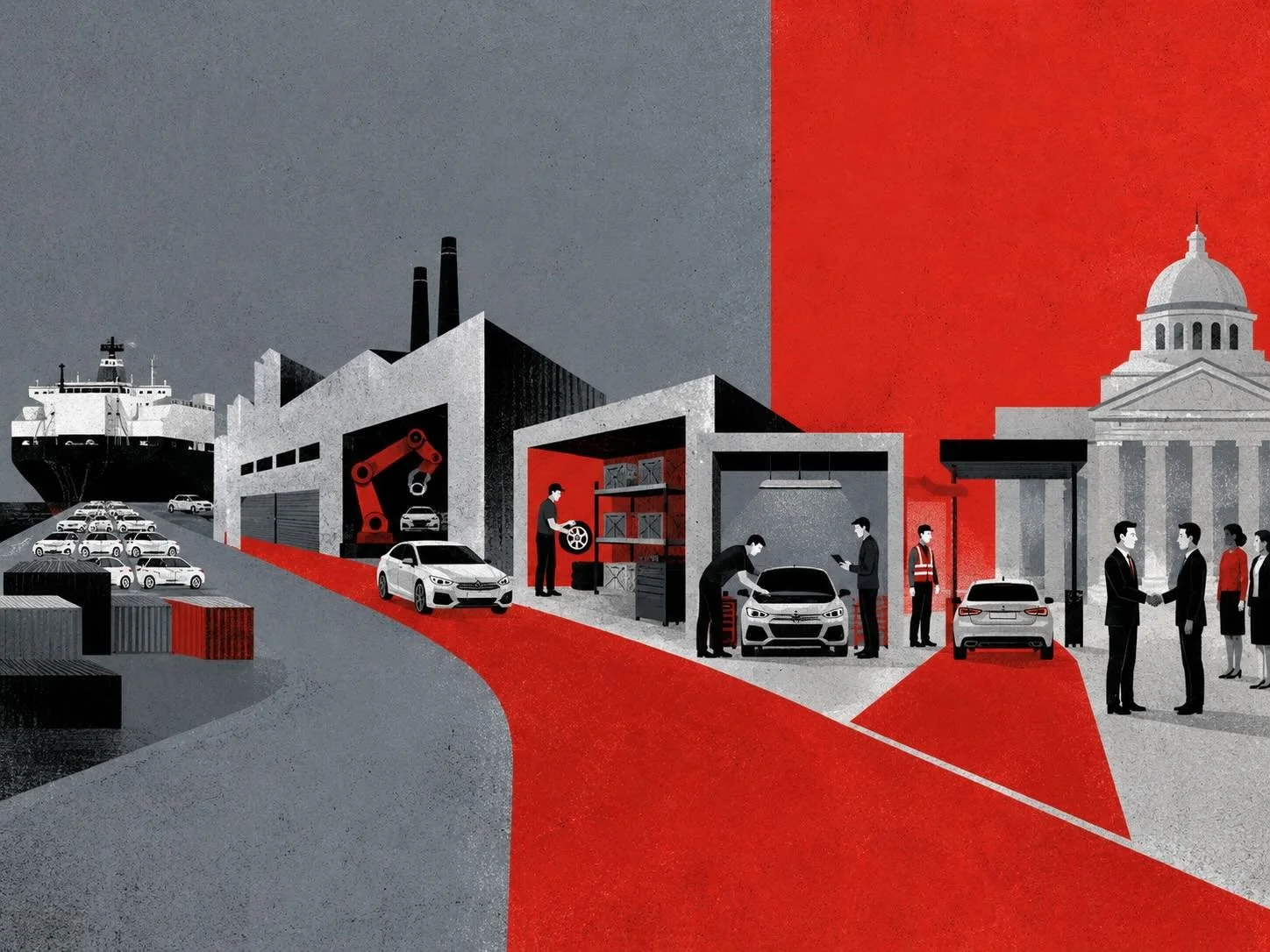
The next global automotive winners will not simply ship vehicles across borders; they will build local credibility through factories, suppliers, service networks, compliance, and political trust.
The next phase of automotive competition will be regionalized. The old model of producing in one low-cost center and exporting globally is being constrained by tariffs, local-content rules, industrial policy, national-security concerns, labor scrutiny, charging infrastructure, and after-sales expectations. The global EV race is therefore becoming a localization battle: which automakers can combine competitive products with local manufacturing, local suppliers, local jobs, local service, and local political legitimacy.
Europe is the clearest battleground. In March 2026, Reuters reported that overall car registrations in the EU, Britain, and EFTA rose 11.1% to 1,581,169 vehicles, the strongest year-on-year gain in 23 months. Battery-electric registrations jumped about 42%, plug-in hybrids rose nearly 32%, and electrified vehicles accounted for about 70% of registrations. Tesla registrations rose 84.3% year on year, while BYD registrations rose 147.6% to 37,580 vehicles.
Those numbers explain why European incumbents are responding. Kia’s CEO said the company had narrowed its vehicle price gap with Chinese models in Europe to 15%–20%, down from 20%–25%, depending on market. Kia also acknowledged that Chinese companies had launched an aggressive push with low-priced EV models and that their market share in some European countries had risen faster than expected. This is a practical example of how Chinese competition changes pricing even when European tariffs exist.
Tariffs do not eliminate competition; they change the rules of competition. The EU’s countervailing duties make China-built BEVs more expensive, but Chinese automakers can respond through local production, pricing adjustments, exports before tariff deadlines, product mix changes, or partnerships. The United States is more restrictive, with tariffs around 100% effectively blocking direct Chinese passenger-EV imports for now. But that does not make Chinese competition irrelevant. It simply shifts the competitive pressure into global benchmarks, Mexico-related concerns, battery supply, and emerging-market expansion.
Emerging markets may be even more strategically important than Europe. The IEA reported that Brazil’s EV sales more than doubled in 2024 to 125,000, reaching a sales share above 6%, and that Chinese imports made up 85% of Brazil’s EV sales. In Thailand, the average price of a battery-electric car reached parity with an average conventional car, helped by Chinese models. These markets often combine rising consumer demand, limited legacy EV offerings, and government interest in local investment.
Localization will also test governance. Global automakers must manage labor compliance, supplier quality, warranty execution, data rules, software updates, charging partnerships, and parts availability. A vehicle that is competitive on purchase price can fail strategically if buyers cannot service it, finance it, insure it, or resell it with confidence. Localization is therefore not only about factories. It is about the full customer and institutional ecosystem.
The global automaker of the future will likely operate with regional playbooks. China will remain a scale and technology laboratory. Europe will be policy-driven and intensely contested. The United States will be protected but costly. Southeast Asia and Latin America will become growth battlegrounds. The Middle East may become a premium, fleet, and infrastructure opportunity. India will demand affordability, localization, and regulatory patience. Africa will remain early-stage but strategically relevant over the longer term.
The winners will be those that can localize intelligently without losing scale. Too much localization creates complexity. Too little localization creates tariff exposure and political vulnerability. The optimal model is regionally adapted global architecture: shared platforms where possible, localized production and sourcing where necessary, and brand propositions tuned to each market’s economics.
Global EV expansion is no longer about exporting the cheapest car; it is about building enough local legitimacy to survive tariffs, politics, service expectations, and regional customer economics.
Lessons for global strategy teams turning exports into durable local market positions: (i) localization should include manufacturing, suppliers, service, financing, data compliance, and after-sales support; (ii) tariffs change competitive behavior but rarely eliminate well-capitalized rivals; (iii) Europe is becoming a price-and-policy battleground where Chinese, Korean, American, and legacy European players are all adjusting; (iv) emerging markets may offer faster growth because Chinese imports have narrowed affordability gaps; (v) automakers should design regional playbooks rather than assume one global EV strategy will travel unchanged.
Close-Out: A Playbook for Competing in the New Automotive Power Struggle

Winning the new automotive cycle requires boards to govern contradictions deliberately, balancing EV ambition, hybrid resilience, cost discipline, software control, regional policy, and cash quality.
The next automotive cycle will not reward companies that merely declare an EV strategy. It will reward companies that make hard choices about where they play, which powertrains they offer, which capabilities they control, which regions they localize, which platforms they simplify, and which profit pools they defend or exit. The industry is moving from product competition to system competition. Boards need to govern accordingly.
The first board question is which customer economics the company can win. A premium brand should not chase every low-cost EV segment. A mass-market brand cannot rely on heritage if Chinese and Korean competitors offer better feature-per-dollar. A truck-heavy U.S. automaker must decide where electrification truly matches customer needs. A Japanese automaker with hybrid strength must decide where hybrids are a bridge and where BEVs need acceleration. Strategy starts with refusing unattractive battles.
The second question is what battery position the company needs. The board should understand battery chemistry, pack cost, supplier concentration, regional price gaps, warranty risk, recycling plans, and exposure to tariffs. It should ask whether the company can compete if Chinese battery pack prices remain materially lower than U.S. or European prices. It should ask whether the company’s EV platforms are designed around battery economics or whether batteries are being forced into legacy product architectures.
The third question is how much powertrain plurality is required. Toyota’s multi-pathway approach, BYD’s plug-in hybrid strength, and China’s rising extended-range and plug-in hybrid launches all show that the transition is not uniform. Boards should not let ideology replace segmentation. The right question is: which powertrain delivers the best customer value, regulatory fit, and margin in each region?
The fourth question is whether software is a differentiator or a weakness. Tesla changed the industry by making software visible to customers. Chinese automakers have increased expectations for digital cockpits, driver assistance, and rapid feature updates. European and U.S. automakers must ensure software is not treated as an outsourced accessory. Software affects customer experience, service cost, safety, data value, and brand perception.
The fifth question is whether the company’s regional model is coherent. A global platform may be efficient, but regional realities differ. Europe has tariffs and emissions policy. The United States has high Chinese tariffs and volatile incentives. China has extreme competition and fast consumer expectations. Brazil, Thailand, and other emerging markets are seeing Chinese imports reshape affordability. A board should demand region-specific answers on pricing, sourcing, localization, and regulatory exposure.
The sixth question is whether growth quality is being measured correctly. Unit sales are not enough. BYD’s recent profit pressure, Ford’s EV losses, Stellantis’ writedowns, Volkswagen’s restructuring, and Porsche’s margin collapse all show that volume can be misleading. Boards should track gross margin by platform, battery cost per vehicle, software defect rates, warranty reserves, supplier payment days, working capital, residual values, financing performance, charging access, and customer retention. Growth without cash conversion is not a strategy.
The seventh question is how the company will manage strategic contradiction. The industry is full of contradictions. EVs are growing, but hybrids remain powerful. Chinese automakers are highly competitive, but many face margin pressure. Tariffs protect local players, but can slow learning. Premium brands retain loyalty, but must justify higher prices. Software creates differentiation, but increases execution risk. Localization reduces political exposure, but increases complexity. The best boards will not seek one simplistic answer. They will govern a portfolio of trade-offs.
The final question is what capabilities must be owned. Not every company needs to own cell production, charging networks, software stacks, and financing arms. But every company must control the points where value and risk concentrate. Battery architecture, customer data, software experience, safety systems, residual-value management, dealer or service quality, and regulatory trust are too important to leave unmanaged.
The strategic mandate is therefore clear: redesign the automotive operating model around profitable electrification, regional resilience, and customer economics. The companies that succeed will not necessarily be those with the most radical public statements. They will be those with the most coherent systems.
The response to the new automotive power struggle should not be panic or imitation, but disciplined redesign of cost, capability, powertrain choice, localization, and margin governance.
Lessons for converting automotive disruption into strategic control and enterprise value: (i) choose defensible segments instead of chasing every EV opportunity; (ii) control the strategic points of battery, software, customer data, safety, and residual value; (iii) manage powertrain plurality by region rather than forcing one universal answer; (iv) measure growth through cash conversion, margin quality, warranty cost, and working capital, not only volume; (v) use tariff protection, hybrid profits, and legacy cash flows to accelerate transformation rather than delay it.
The global automotive industry is entering a more demanding phase than the first wave of electrification. The debate is no longer whether electric vehicles will matter; they already do. The harder question is which companies can make the transition profitable, localized, trusted, and strategically coherent.
BYD demonstrates the power and pressure of battery-led integration. Tesla demonstrates the importance of software, charging, and customer-interface control. Toyota demonstrates the resilience of hybrid pragmatism. Volkswagen and German premium brands show that heritage must be re-earned under new economics. Ford and Stellantis show that EV ambition without cost discipline can become financially destructive. Chery, Geely, Xpeng, Nio, Leapmotor, Aito, Hyundai-Kia, and CATL show that the competitive field is broadening, not narrowing. The future belongs to automakers that understand the car is no longer the whole product. The real product is the complete economic system around mobility: battery, software, charging, service, financing, regulation, localization, trust, and lifecycle value.
OHK has supported clients in analyzing sectors, understanding competitive advantage, and shaping practical strategies across industries. We help clients look beyond headline narratives to assess the commercial, institutional, financial, geographic, regulatory, and geopolitical conditions that determine whether opportunities can succeed over the long term. Our work connects ambition to implementation by examining market dynamics, demand, competitiveness, operating models, financing, execution risk, and strategic resilience. Across sector analysis, strategy, planning, and investment assessment, our aim remains consistent: clearer judgment, stronger systems thinking, and more durable outcomes. To discuss how OHK can support your next phase of sector strategy, competitive positioning, or economic transformation in Jordan and the wider region, please contact us.