

The UAE’s Exit From OPEC: Strategic Autonomy, Market Disorder, and the New Oil Bargaining Model
A perspective on how Abu Dhabi’s production freedom reshapes prices, alliances, capital allocation, and energy-transition strategy

The UAE’s exit signals that the next energy order will reward countries that combine resource ownership with speed, infrastructure control, fiscal resilience, and strategic independence.
The UAE’s decision to exit OPEC and OPEC+ should be read less as a narrow oil-market announcement and more as a strategic autonomy event. The formal rationale emphasizes long-term economic vision, an evolving energy profile, and accelerated domestic energy investment, effective May 1, 2026. That framing matters because it places the move in the language of national portfolio strategy rather than short-term price opportunism. In management consulting terms, the UAE is shifting from a coordinated-supply participant to an independent capital allocator with more direct control over output, timing, customer relationships, and reserve monetization.
Reading Time: 40 min.
All illustrations are copyrighted and may not be used, reproduced, or distributed without prior written permission.
Summary: The strategic thesis is straightforward: the UAE is converting invested capacity into decision rights. Having spent heavily to expand production capacity, Abu Dhabi faced a widening gap between what it could produce and what group quota discipline allowed it to monetize. Reuters reports the UAE had pumped roughly 3.4 million barrels per day, while its capacity could rise toward 5 million barrels per day if it’s able to monetize expanded capacity and once shipping and export logistics normalize; HSBC estimates a more gradual ramp to above 4.5 million barrels per day over 12–18 months after Hormuz access is restored. The near-term market effect is constrained by the Strait of Hormuz disruption, but the long-term consequence is larger: OPEC+ loses a core Gulf producer, Saudi Arabia carries more of the balancing burden, and global buyers face a more volatile but potentially more competitive oil market. The UAE’s exit is therefore not only about oil. It is about sovereignty over cash flows, flexibility over fixed coordination, and speed over consensus.
The overall arc is: Strategic trigger → decision-rights shift → supply math → alliance fracture→ logistics constraint → UAE monetization logic → consumer and inflation pass-through → transition-era strategic playbook → close-out agenda.

Abu Dhabi is not merely seeking more barrels; it is redesigning the governance model around who gets to decide when national assets are monetized.
Strategic Autonomy: Why This Is a Decision-Rights Event, Not Merely a Production Event
The UAE’s withdrawal from OPEC and OPEC+ is best understood through the lens of decision rights. In any coordinated industry structure, whether airlines, telecoms, shipping alliances, or oil-producing blocs, the economic bargain is simple: participants sacrifice some individual flexibility in exchange for collective influence. For decades, OPEC membership offered producers a seat inside the pricing architecture of global oil. The reward was not only market stabilization; it was diplomatic visibility, policy coordination, and a mechanism for influencing the terms on which producers sold into the world economy. But the cost was also clear: when national production capacity grows faster than agreed quotas, the member with the most idle capital begins to feel constrained by the very architecture that once provided power.
That is the UAE’s strategic inflection. The official announcement framed the exit as aligned with the country’s long-term strategic and economic vision, its evolving energy profile, and accelerated investment in domestic production. This is not accidental language. It signals that the UAE now views flexibility as more valuable than formal coordination. In consulting terms, Abu Dhabi is moving from “portfolio participation” to “portfolio optimization.” It is no longer content to be valued only by its contribution to a collective production ceiling. It wants the ability to optimize across crude, gas, petrochemicals, trading, refining, infrastructure, and foreign investment on its own timetable.
The most important strategic question is not “Will the UAE immediately flood the market?” The better question is: Who now owns the option value of UAE barrels? Under OPEC+, that option value was partly socialized. Abu Dhabi’s spare capacity helped support collective credibility, but its deployment was mediated by negotiations. Outside the bloc, that option value becomes a national instrument. It can be used to win market share, strengthen long-term customer relationships in Asia, deepen energy diplomacy, support fiscal planning, and reinforce the UAE’s position as an investable, commercially pragmatic energy hub.
There is also a governance point. OPEC+ coordination depends on the credibility of restraint. Restraint works when members believe the group will protect their interests better than unilateral action would. Once a high-capacity producer concludes that the marginal barrel is more valuable under independence than under quota, the governance model weakens. Reuters reported that the exit would reduce OPEC+ control over global production from about 50% to 45%, a meaningful decline because market power in oil is not simply about reserves; it is about controllable supply, spare capacity, and the ability to coordinate behavior under stress.
The UAE’s decision also reflects a broader Gulf trend: national economic models are becoming more differentiated. Saudi Arabia is pursuing Vision 2030 with large-scale domestic megaprojects, fiscal expansion, tourism, mining, logistics, and industrial diversification. The UAE already has a deeper base in trade, aviation, finance, real estate, logistics, tourism, free zones, and international capital intermediation. That means the two economies may both diversify away from oil dependence, but they do not necessarily require the same oil strategy. The UAE can tolerate more independent price and production flexibility because its non-oil ecosystem gives it a wider operating base, while still using hydrocarbon cash flows to fund national competitiveness.
This is why the exit should not be read as purely adversarial. It is more sophisticated than a simple rupture with Saudi Arabia or a simple rejection of OPEC. It is a recognition that the value of coordination declines when the opportunity cost of constraint rises. If Abu Dhabi has built capacity, lowered production costs, enhanced Murban’s marketability, expanded downstream capabilities, and developed alternative export infrastructure, then its management logic changes. It becomes less rational to keep valuable capacity idle merely to preserve a legacy institutional bargain.
The analogy is powerful. Joint ventures, alliances, and industry associations are useful when they enhance strategic degrees of freedom. They become problematic when they reduce the ability to monetize sunk investment, move with speed, and capture demand windows. The UAE is effectively saying that the market has entered a phase where speed, capital discipline, and optionality matter more than committee-based equilibrium management.
The UAE’s exit is not principally a bet against OPEC; it is a bet that sovereign control over production timing is now more valuable than collective influence over restraint.
A further strategic signal is that the UAE’s move should be treated as part of a broader realignment pattern, not as an isolated oil-market maneuver. The language of strategic autonomy is important because it implies a sovereign preference for speed, discretion, and unilateral execution over slower regional consensus mechanisms. The move had reportedly been circulating in the background for several years, which suggests this was not a crisis-driven improvisation but a premeditated repositioning. The timing around a GCC summit also adds symbolic weight: when a country chooses differentiated representation at a high-level regional gathering while simultaneously asserting independence in oil policy, markets should read that as more than technical quota dissatisfaction. The UAE appears to be signaling that its future relationships with OPEC, the GCC, and potentially wider Arab institutional structures will be judged by one standard: do they accelerate or constrain Abu Dhabi’s strategic agenda?
Lessons learned — The strategic-autonomy conclusion for executives evaluating whether legacy alliances still create value: (i) alliances must be re-tested when capital commitments outgrow governance flexibility; (ii) decision rights can be more valuable than formal influence when markets become volatile; (iii) sunk capacity creates pressure to monetize, not simply to coordinate; (iv) national strategies diverge when economic portfolios mature at different speeds; (v) the most important asset is not only production capacity, but the freedom to deploy it.
The Supply Math: Capacity, Quotas, Spare Barrels, and the Economics of Incremental Output

When the gap between production capacity and permitted output becomes large enough, restraint stops looking like discipline and starts looking like underutilized national infrastructure.
The quantitative core of the UAE’s move lies in the gap between capacity and quota. Reuters reported that Abu Dhabi pumped around 3.4 million barrels per day before war-related disruptions, with a quota around 3.5 million barrels per day, while the country could raise output toward 5 million barrels per day if export logistics normalize. HSBC expects a more gradual increase, estimating that ADNOC could lift production above 4.5 million barrels per day after Hormuz access is restored, phased over 12 to 18 months rather than delivered in one sudden supply shock.
The distinction between “could” and “will” matters. In energy-market strategy, capacity is not the same as deliverable supply. A producer needs wells, processing, storage, export terminals, shipping routes, commercial buyers, financing structures, and pricing mechanisms. Yet the existence of credible spare capacity changes bargaining power immediately, even before the barrels arrive. If customers believe UAE supply can scale after disruption eases, the forward curve, term-contract negotiations, and buyer behavior may adjust in anticipation. Market participants do not wait for physical barrels to move; they price probabilities.
The EIA noted in 2024 that ADNOC had targeted 5 million barrels per day of crude oil production capacity by 2027, supported by a capital expenditure increase to $150 billion over 2023–2027. The same EIA analysis highlighted that the UAE was one of the few OPEC members, alongside Saudi Arabia, with notable spare crude production capacity. U.S. government trade data later stated that ADNOC had increased crude production capacity to 4.85 million barrels per day, moving closer to the 5 million target, and that the UAE had consistently sought a higher quota to capitalize on low per-barrel production costs.
From a management consulting standpoint, this is a classic capacity monetization problem. If a firm spends billions to expand a plant, but an industry agreement limits output below plant potential, the asset’s return on invested capital is impaired. In the UAE’s case, the implied capacity gap is material. Moving from roughly 3.4 million barrels per day to 4.5 million barrels per day would add approximately 1.1 million barrels per day. At an illustrative oil price of $80 per barrel, that is about $32.1 billion in annual gross sales before costs, fiscal take, partner economics, and price effects. At $100 per barrel, it is roughly $40.2 billion. Moving from 3.4 million to 5.0 million barrels per day implies an incremental 1.6 million barrels per day, or roughly $46.7 billion annually at $80 and $58.4 billion at $100. These are not profit estimates; they are gross-revenue illustrations showing why idle capacity creates strategic impatience.
The global market impact depends on demand elasticity, inventory levels, competing non-OPEC growth, and whether other producers respond. A single incremental million barrels per day can matter enormously in a tight market but less in an oversupplied one. The IEA’s medium-term outlook expected global oil demand to rise by 2.5 million barrels per day from 2024 to 2030, reaching a plateau around 105.5 million barrels per day, while global production capacity was expected to increase by 5.1 million barrels per day to 114.7 million barrels per day by 2030.
This makes the exit both rational and risky. It is rational because the UAE can pursue market share while demand still exists. It is risky because if many producers follow the same logic, the market can shift from coordinated restraint to competitive overproduction. The oil market has a long history of such cycles. When producers compete for share rather than balance, prices can fall quickly; when disruptions constrain supply, prices can spike. The UAE is positioning itself to be advantaged in both environments: more independent in high-price periods, more competitive in lower-price periods, and less exposed to the opportunity cost of collective restraint.
The spare-capacity angle is particularly important. Spare capacity is not simply unused production. It is a market-stabilization asset. It gives producers geopolitical relevance because they can respond to shocks faster than new entrants can develop supply. If the UAE’s spare capacity exits the OPEC+ coordination framework, OPEC+ loses not only barrels but also response capability. That weakens the group’s ability to signal credible future supply management.
The exit transforms UAE spare capacity from a collective stabilizing asset into a national strategic option with direct commercial, fiscal, and geopolitical value.
The commercial arithmetic sharpens the case for exit. If the UAE is capped around 3.3–3.4 million barrels per day while its strategic ambition is closer to 5 million barrels per day, the foregone volume is roughly 1.6–1.7 million barrels per day. At an illustrative $90 per barrel, that gap is equivalent to approximately $50 billion to $56 billion in annual gross revenue opportunity before costs, taxes, fiscal structures, and price effects. That is not a marginal optimization; it is a national-scale capital allocation issue. The economics become even more compelling if the UAE’s extraction cost curve is as low as market specialists suggest, with onshore production sometimes discussed near $2 per barrel and offshore production around $4 per barrel. In that context, quota restraint does not merely limit output; it suppresses the monetization of one of the world’s most competitive hydrocarbon cost positions.
Lessons learned — The supply-economics conclusion for leaders translating capacity into competitive advantage: (i) capacity that cannot be deployed becomes a drag on return on capital; (ii) spare capacity creates leverage even before barrels physically move; (iii) incremental volume has different value in tight, balanced, and oversupplied markets; (iv) quota systems become fragile when members’ asset bases diverge; (v) independent production freedom can raise national upside while increasing system-wide volatility.
OPEC+ Cohesion: Saudi Arabia’s Heavier Balancing Burden and the Risk of Compliance Slippage

OPEC+ now faces a credibility problem because the producer most able to grow outside the system has shown that independence may be more valuable than compliance.
OPEC+ has always operated as a coalition of unequal incentives. Some members need higher prices for budgets. Others need higher volumes to offset declining fields, debt pressure, or underinvestment. Some have spare capacity; many do not. Some can credibly cut and restore output; others are already producing near technical limits. In that context, the UAE’s exit matters because it removes from the coordination pool a high-capacity, high-credibility Gulf producer. It is not comparable to a small producer leaving with limited ability to influence market balance. Reuters described the UAE as the largest oil producer to depart OPEC and reported that its departure would complicate OPEC+ efforts because the alliance would control less global production.
The fundamental problem is discipline under asymmetry. OPEC+ works when members believe restraint is shared and cheating is manageable. But production agreements often face a collective-action problem: each member benefits from others cutting while it quietly overproduces. Saudi Arabia historically solved part of this problem by acting as swing producer, absorbing disproportionate restraint and occasionally threatening market-share competition to discipline noncompliance. But that role becomes more expensive when a major neighbor with expanding capacity exits the quota system.
It is reported that OPEC once controlled more than 50% of global output, but its share has declined to around 30% of total oil and liquids output, while OPEC+ controlled roughly 50% of global production in 2025. The UAE’s departure is expected to reduce that OPEC+ share to around 45%. Those numbers point to a structural decline in cartel leverage. The issue is not that OPEC+ becomes irrelevant overnight. It does not. The issue is that each percentage point of lost controllable supply makes coordination more fragile, especially when non-OPEC producers such as the United States, Brazil, Guyana, and others operate outside the quota framework.
Saudi Arabia’s burden therefore increases in three ways. First, it must carry more of the signaling role. If prices fall, markets will look to Riyadh to cut, not to Abu Dhabi. Second, it must manage internal member expectations. If remaining members perceive that the UAE can monetize freely while they remain constrained, quota compliance may weaken. Third, Saudi Arabia must balance its own fiscal and strategic ambitions. The St. Louis Fed’s FRED database, sourcing IMF data, shows Saudi Arabia’s projected 2025 fiscal breakeven oil price at about $90.94 per barrel, much higher than the UAE’s corresponding $49.95 per barrel. This asymmetry matters because a producer with a higher fiscal breakeven has less tolerance for a prolonged price war.
The UAE, by contrast, has a relatively stronger ability to absorb lower prices, at least on fiscal breakeven metrics. That does not mean the UAE wants low prices. No hydrocarbon exporter benefits from unnecessary price destruction. But it means Abu Dhabi may be structurally more willing to trade some price level for volume, market share, and reserve monetization. For Saudi Arabia, whose domestic transformation agenda is capital-intensive, the trade-off is sharper. Higher prices support fiscal capacity. Higher volumes may not compensate if the price decline is large.
This is where the consulting lens becomes useful. OPEC+ is now facing a member-value-proposition challenge. Like any alliance, it must prove that membership creates more value than independence. For members with stagnant production, debt pressure, or limited spare capacity, OPEC+ may still provide price support and diplomatic weight. For a high-capacity, low-cost producer with global customer relationships, the value proposition is less obvious if quotas suppress monetization. The UAE’s departure may not trigger a mass exit, but it will force every member to re-run its own membership economics.
The most likely scenario is not immediate collapse. Reuters cited sources and analysts suggesting the group would likely remain together, even if weaker. Iraq, for example, was reported as having no plan to leave because it still wants stable and acceptable prices. That is plausible. Many members still benefit from coordinated price support. But the system’s credibility has been impaired. In markets, credibility often matters more than formal structure. If traders believe future compliance will weaken, prices may reflect higher expected volatility even before members actually defect.
The strategic risk is a delayed one. Once Hormuz constraints ease, the UAE has an incentive to increase output. If other members respond by pressing for higher quotas or quietly exceeding limits, Saudi Arabia faces a choice: tolerate erosion, cut deeper, or defend market share. None of those options is costless. Tolerating erosion weakens leadership. Cutting deeper subsidizes competitors. Defending market share risks lower prices. That is the new bargaining geometry.
The UAE’s exit does not kill OPEC+, but it forces Saudi Arabia to defend coordination with fewer shared barrels and a weaker compliance narrative.
The deeper institutional risk is not that OPEC+ immediately disintegrates, but that its disciplinary architecture becomes less credible. OPEC has always had a compliance problem: members often test quota limits, but usually not so aggressively that Saudi Arabia is forced to retaliate. The traditional Saudi enforcement mechanism has been the implicit threat of opening the taps, driving prices down, and punishing free riders. The UAE’s exit weakens that mechanism because it removes one of the few producers with genuine surplus capacity from the coordinated system. The question for other members becomes increasingly blunt: why should they restrict output if a major Gulf producer can leave, expand market share, and avoid direct penalty? This is why the UAE decision is structurally powerful. It does not need to trigger immediate exits to damage OPEC+; it only needs to make quota restraint look like a weaker bargain.
Lessons learned — The coalition-governance conclusion for policymakers managing alliances under unequal incentives: (i) alliances weaken when high-performing members perceive the rules as penalizing investment; (ii) fiscal breakevens shape negotiating behavior as much as ideology does; (iii) swing producers carry hidden costs when others free-ride on restraint; (iv) credibility can erode before formal institutions collapse; (v) coalition value propositions must evolve as member economics diverge.
The Hormuz Constraint: Why the Near-Term Market Impact Is Capped but the Long-Term Signal Is Powerful
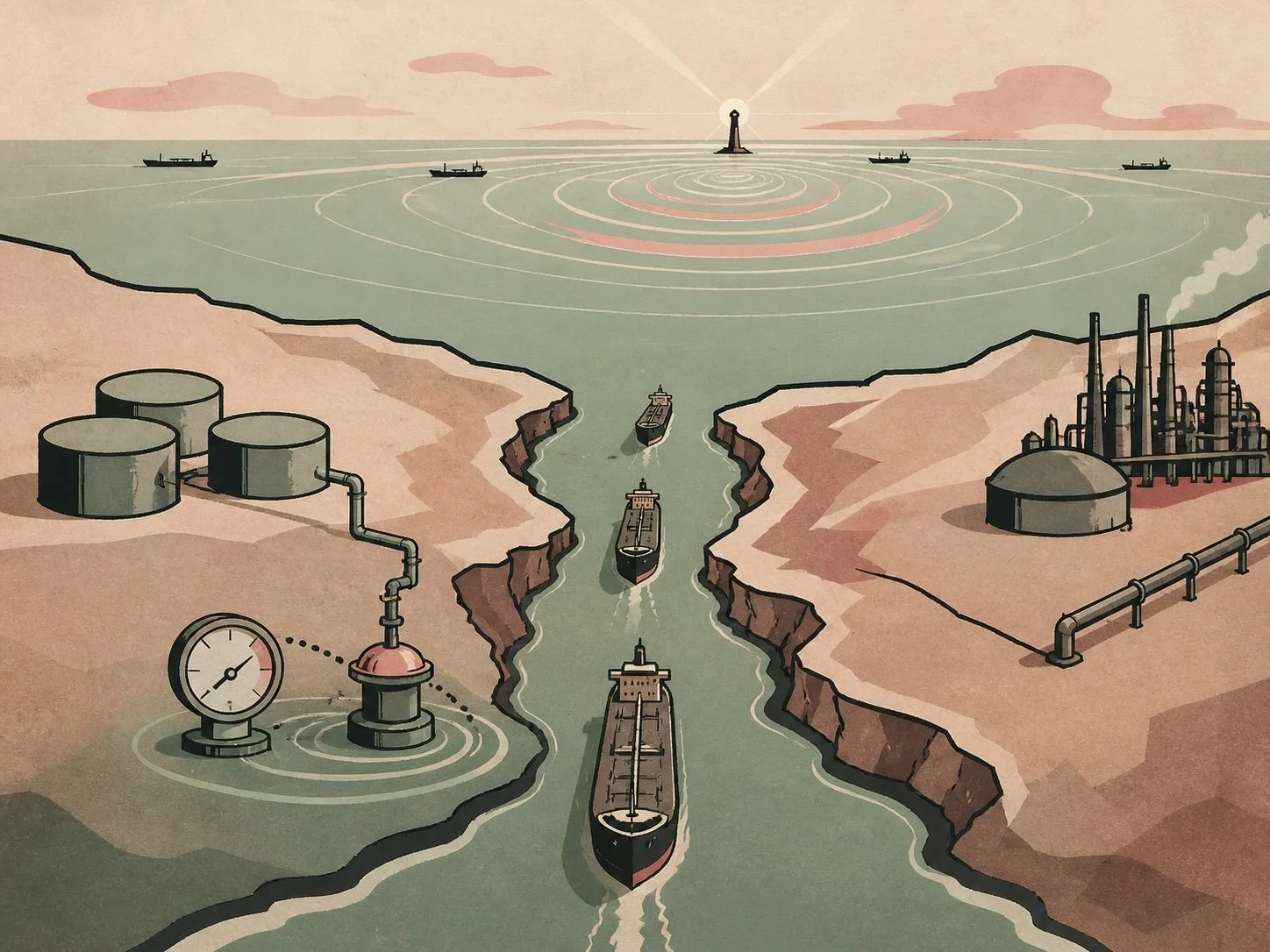
The UAE’s production freedom is strategically meaningful today, but its commercial impact will be determined by the slower realities of chokepoints, shipping lanes, insurance, and physical delivery.
The immediate paradox is that a quota-independent UAE cannot fully exploit quota freedom if it cannot move barrels freely. The Strait of Hormuz is the critical operating constraint. EIA data show that oil flows through the strait averaged around 20 million barrels per day in 2024, roughly 20% of global petroleum liquids consumption, and represented more than one-quarter of global seaborne oil trade. The same EIA analysis notes that very few alternatives exist if the strait is closed or severely disrupted.
That is why the near-term effect of the exit is more strategic than physical. HSBC assessed that the UAE’s departure would have limited immediate supply impact because Gulf crude exports remain constrained by disruptions in the Strait of Hormuz. HSBC also noted that the Abu Dhabi Crude Oil Pipeline, which bypasses Hormuz by moving crude to Fujairah, has capacity of up to about 1.8 million barrels per day and is likely already operating at or near full utilization. Put simply: the UAE may have more legal freedom to produce, but logistics, security, and export-routing constraints limit how much of that freedom can be monetized today.
This is a crucial difference between announced strategy and deployable strategy. Boardrooms often confuse the two. A company may announce expansion, but if distribution channels are blocked, working capital is constrained, or customers cannot receive product, the commercial impact is delayed. The UAE’s exit is therefore a forward option. It matters now because it changes expectations; it converts into material volume only when shipping normalizes, infrastructure recovers, and buyers can take delivery at scale.
Meanwhile, the current oil market is already stressed. The IEA’s April 2026 Oil Market Report said global oil supply fell by 10.1 million barrels per day to 97 million barrels per day in March, with continued attacks on energy infrastructure and restrictions through Hormuz contributing to the largest disruption in history. OPEC+ output fell by 9.4 million barrels per day month-on-month to 42.4 million barrels per day. In such a setting, the short-term price driver is not UAE independence; it is constrained flow. Even if traders believe UAE barrels will eventually be bearish, the physical market today can remain bullish because immediate supply is impaired.
That is visible in prices. Trading Economics reported Brent rising to around $115.40 per barrel on April 29, 2026, the highest since June 2022, amid intensifying supply concerns and the effective closure of Hormuz. The World Bank, through Reuters reporting, projected a 24% surge in energy prices in 2026 under a baseline in which acute disruptions end in May, with Brent expected to average $86 per barrel and potentially $115 per barrel if the conflict persists or worsens. Those figures show the market’s dual logic: prices can be high today because of disruption, while the UAE exit can still be bearish over the medium term if it adds supply later.
This creates a two-stage scenario. Stage one is the constraint stage, where logistics dominate. During this phase, the UAE’s exit may trim upside expectations but cannot offset the physical bottleneck. Stage two is the normalization stage, where access improves and the UAE’s independent production choices become more relevant. In that phase, additional UAE barrels could rebuild depleted inventories, pressure prices lower, and challenge OPEC+ supply management. HSBC’s expectation of a gradual 12–18-month ramp is important because it suggests a controlled transition rather than a sudden flood.
For importers and corporates, the lesson is to avoid one-dimensional oil-price forecasts. The same event can be bullish in one timeframe and bearish in another. The exit weakens long-term coordination, but near-term disruption can still lift prices. Energy buyers should therefore separate availability risk from price-formation risk. Availability risk is about whether barrels can move. Price-formation risk is about whether the market expects more or less coordinated supply in the future. Hormuz is currently about availability. The UAE exit is about future price formation.
Strategically, this makes the UAE’s timing notable. Announcing independence during a disruption can appear counterintuitive, but it also means the country is resetting its institutional position before the recovery phase. If the strait reopens and Gulf producers begin rebuilding export flows, Abu Dhabi will not need to negotiate its output ceiling through OPEC+. It will already have altered the rules of engagement.
The Strait of Hormuz limits the immediate barrels, but it does not limit the strategic signal that the UAE wants freedom before the recovery cycle begins.
The immediate price reaction also underlines the distinction between policy freedom and physical flow. In theory, a major producer exiting a quota regime should be bearish for prices because it signals more future supply. Yet the market can still rise when the physical system is constrained, particularly if the Strait of Hormuz remains disrupted and Gulf barrels cannot move normally. That is why the UAE’s decision has not automatically delivered relief to importing countries. The move changes the future supply regime, but it does not instantly solve chokepoint risk, insurance costs, tanker availability, refinery scheduling, or security uncertainty. For energy buyers, this is the key operational insight: a producer can announce supply-side liberalization while the market remains tight because the binding constraint is logistics, not policy. The market is therefore pricing two realities at once: near-term scarcity and medium-term supply competition.
Lessons learned — The logistics-and-market-timing conclusion for supply-chain leaders facing physical bottlenecks: (i) legal freedom does not equal deliverable supply when chokepoints are constrained; (ii) market expectations can shift before physical volumes move; (iii) disruption and oversupply risks can coexist across different time horizons; (iv) infrastructure optionality is a strategic asset, not a back-office detail; (v) buyers should separate short-term availability risk from medium-term price-formation risk.
The UAE’s National Business Model: Monetizing Low-Cost Barrels While Building a Post-Oil Platform

The UAE is using oil not as a legacy dependency but as a strategic cash-flow engine to reinforce industrial depth, customer loyalty, and post-oil competitiveness.
The UAE’s exit fits a broader national business model: monetize hydrocarbons efficiently while scaling non-oil competitiveness. The country is not simply “choosing oil over transition.” It is pursuing a more complex model: produce advantaged barrels, expand gas and downstream value chains, deepen industrial capacity, and use hydrocarbon cash flows to fund diversification. ADNOC states that it aims to produce more lower-cost and lower-carbon-intensive barrels, increase production capacity to 5 million barrels per day by 2027, and leverage clean grid power and gas-based feedstocks to build low-carbon value chains. ADNOC also describes Murban as having carbon intensity less than half the global industry average.
That positioning is commercially significant. In a world of tightening climate scrutiny, not all barrels are equal. Buyers, financiers, refiners, and regulators increasingly differentiate between crude grades based on emissions intensity, reliability, contractual flexibility, and supply security. A low-cost, relatively lower-carbon barrel has an advantage in a decarbonizing but still oil-consuming world. It is more likely to remain competitive if demand growth slows and higher-cost barrels are pushed to the margin. This is the UAE’s implicit bet: if the world continues consuming oil while gradually transitioning, the winners are the producers with low costs, reliable logistics, strong customer access, and credible emissions intensity claims.
The national fiscal context reinforces the logic. FRED data sourced from the IMF show the UAE’s projected 2025 fiscal breakeven oil price at about $49.95 per barrel, far below Saudi Arabia’s projected $90.94 per barrel. This gives the UAE more pricing flexibility. It can pursue volume and market share with less fiscal stress than producers whose budgets require much higher oil prices. Again, this does not mean the UAE wants cheap oil. It means Abu Dhabi has a stronger resilience buffer if prices fall due to competition or demand weakness.
The UAE also retains meaningful hydrocarbon dependence. U.S. government trade data states that oil exports account for about 25% of UAE GDP, while the oil and gas sector has accounted for about 70% of government revenues in recent years. The same source reports that ADNOC is investing $150 billion to increase maximum sustainable production from about 4 million barrels per day to 5 million barrels per day by 2027, while expanding LNG and downstream projects. This combination explains the policy balance: the UAE is diversified enough to be strategically flexible, but oil remains important enough that leaving production capacity idle is economically unattractive.
From a capital-allocation perspective, the exit improves the internal coherence of ADNOC’s investment case. If a national oil company invests heavily in capacity but remains structurally capped by external quotas, the return thesis is diluted. By leaving the quota framework, Abu Dhabi improves the probability that new upstream investment can translate into throughput, sales, and customer capture. It also strengthens ADNOC’s negotiating posture with international partners. Investors and counterparties prefer assets with clearer route-to-market and fewer politically mediated production constraints.
There is also a downstream and industrialization angle. The UAE is not only selling crude. It is building refining, petrochemical, LNG, logistics, and industrial ecosystems. U.S. trade data notes ADNOC’s downstream expansion, including a $45 billion effort to upgrade downstream operations, and the Ruwais derivatives platform intended to expand chemical capacity. More upstream flexibility can support these ambitions by ensuring feedstock availability and improving integration across the value chain. The strategic prize is not simply “more barrels.” It is higher capture across the hydrocarbon value chain.
The management consulting interpretation is that the UAE is building a hydrocarbon-to-industrial platform, not merely an oil-export model. The country wants optionality across crude exports, refined products, chemicals, LNG, low-carbon fuels, trading, storage, and foreign energy investments. OPEC+ quotas may stabilize crude prices, but they do not necessarily optimize a country’s integrated energy-industrial platform. If Abu Dhabi’s value creation increasingly depends on the full portfolio, then crude-output coordination becomes only one variable among many.
The risk is reputational and strategic. Critics may argue that accelerated production conflicts with climate goals. The UAE’s response is likely to be that advantaged, lower-carbon-intensity barrels should displace higher-cost and higher-intensity supply during the transition. Whether one accepts that argument or not, it is a coherent commercial strategy. It says: the transition will not eliminate oil immediately, and while oil remains consumed, the most efficient producers should capture the remaining demand window.
The UAE is not simply exiting a cartel; it is aligning production freedom with a national platform strategy that connects oil, gas, industry, capital, and transition positioning.
The UAE’s strategy is also increasingly customer-led. Abu Dhabi is not only seeking to sell more crude; it is seeking to reward and deepen relationships with countries and companies that have built refining, storage, and downstream systems around UAE crude, especially Murban. That gives the decision a commercial logic beyond production volume. If customers have invested capital into assets configured for UAE supply, then Abu Dhabi has an incentive to become a more reliable, unconstrained, long-term supplier to those counterparties. The same logic supports expansion into trading, petrochemicals, and higher-margin downstream segments. Crude output is therefore the anchor product, not the whole business model. The UAE is attempting to capture more value across the hydrocarbon chain by combining upstream flexibility, customer-specific crude quality, downstream integration, and an increasingly independent trade policy that moves faster than regional consensus frameworks.
Lessons learned — The national-platform conclusion for executives linking assets, policy, and capital allocation: (i) production strategy must fit the full economic portfolio, not only the upstream segment; (ii) fiscal resilience expands strategic room for volume-based competition; (iii) low-cost and lower-carbon barrels gain advantage as demand growth slows; (iv) downstream integration increases the value of feedstock control; (v) quota independence can improve the investment case for capacity-heavy national champions.
Consumer, Inflation, and Corporate Impact: Why the Same Move Can Lower Future Prices Yet Raise Present Anxiety

For households and companies, the UAE exit is not a simple price relief story; it is a volatility story with different winners across time horizons.
For consumers and corporates, the UAE exit has an ambiguous but important implication. Over the medium term, more independent UAE production could place downward pressure on oil prices, especially if it weakens OPEC+ discipline and encourages other producers to compete for market share. Over the near term, however, the market is being driven by disruption, not abundance. That is why consumers may see high fuel prices even while analysts discuss a future supply increase. The oil market can price scarcity today and oversupply tomorrow at the same time.
The practical consumer channel begins with crude prices but does not end there. Crude oil is a feedstock for gasoline, diesel, jet fuel, marine fuel, petrochemicals, and indirectly for freight, food, and manufactured goods. A $10 per barrel change in crude prices is equivalent to about 23.8 cents per gallon before refining margins, taxes, distribution costs, currency movements, and local regulation, because one barrel contains 42 gallons. That arithmetic does not predict pump prices mechanically, but it illustrates why oil shocks move through household budgets and business cost bases quickly.
Current forecasts already point to pressure. The EIA’s Short-Term Energy Outlook shows a revised 2026 Brent crude oil spot price forecast of $96 per barrel, compared with a previous forecast of $79, and a 2026 retail diesel price forecast of $4.80 per gallon, compared with a previous forecast of $4.12. Diesel matters because it is the fuel of trucks, buses, construction equipment, mining fleets, agricultural machinery, and many backup generators. When diesel rises, the cost impact spreads beyond drivers to retailers, farmers, builders, logistics companies, and ultimately consumers.
The World Bank’s warning is even broader. Reuters reported that the World Bank expected energy prices to rise 24% in 2026 under its baseline and overall commodity prices to rise 16%, with fertilizer prices projected to increase 31% due partly to surging urea costs. The same report said developing-economy inflation was projected at 5.1% under the baseline, potentially 5.8% if the conflict persists, while growth in developing economies was projected to slow to 3.6% from a pre-war forecast of 4%. This matters because oil is not only an energy commodity; it is a macroeconomic transmission mechanism.
For corporate leaders, the exit should trigger a reassessment of procurement strategy. Many companies still treat fuel as a cost line rather than a strategic risk. That is a mistake. Energy volatility affects working capital, inventory policy, supplier solvency, customer pricing, hedging strategy, and margin guidance. Airlines, shipping companies, trucking fleets, manufacturers, food distributors, construction firms, and retailers should all evaluate whether their contracts allow timely pass-through of fuel costs. Firms with fixed-price customer contracts and variable fuel inputs can suffer margin compression quickly.
The UAE’s exit also changes the medium-term hedging conversation. If the market believes OPEC+ cohesion is structurally weaker, volatility may rise even if average prices eventually fall. A less coordinated market can produce sharper cycles: price spikes during disruptions and faster declines when supply normalizes. That is not a simple “good for consumers” or “bad for producers” story. It is a volatility story. Consumers may benefit from lower future prices if additional UAE supply arrives, but businesses may still face higher insurance costs, freight surcharges, and hedging premiums during the transition.
Central banks and finance ministries will also be attentive. High energy prices can lift headline inflation, influence wage expectations, and complicate interest-rate decisions. But if the UAE’s independence later contributes to additional supply and lower prices, the disinflationary effect could arrive after the initial shock. Policymakers therefore face sequencing risk: tightening monetary conditions in response to current energy inflation could collide with future supply normalization that reduces price pressure. This is especially important for emerging markets with fuel subsidies, dollar debt, and food-import exposure.
A sophisticated interpretation should therefore avoid simplistic conclusions. The UAE exit may be beneficial for consumers over the medium term if it adds supply, weakens coordinated restraint, and prevents prices from remaining artificially high. But the near-term reality is dominated by security and logistics disruptions. The correct corporate response is not to guess a single oil price. It is to build scenarios: high-price disruption, normalization with UAE ramp-up, OPEC+ retaliation or deeper cuts, and multi-producer market-share competition. Each scenario implies different procurement, pricing, inventory, and financing decisions.
Consumers may eventually benefit from more UAE supply, but businesses must first survive the volatility bridge between today’s disruption and tomorrow’s looser coordination.
For consumers, the most important distinction is between the eventual price effect and the immediate price experience. If the UAE ramps production materially after export routes normalize, oil prices could face downward pressure, with some market commentary pointing to a potential $5–$10 per barrel reduction under a looser supply regime. That would feed into lower gasoline, diesel, freight, food, and manufactured-goods costs over time. But the near-term consumer experience may still be painful because disruption can overwhelm future-supply expectations. There is also a U.S. policy paradox: American consumers benefit from cheaper oil, but the U.S. shale industry has historically relied on a price floor partly created by OPEC restraint. A weaker OPEC+ may therefore be good for motorists and inflation but less comfortable for higher-cost producers whose economics depend on sustained price support.
Lessons learned — The consumer-and-corporate-risk conclusion for companies exposed to fuel-sensitive economics: (i) oil shocks travel through diesel, freight, food, and working capital faster than many budgets assume; (ii) lower future prices do not eliminate near-term volatility risk; (iii) contract pass-through terms are strategic protections, not legal details; (iv) hedging should manage scenarios rather than express price predictions; (v) procurement leaders need board visibility when energy becomes a macroeconomic transmission channel.
The Transition-Era Logic: The Green Paradox, Demand Plateau, and the Race to Monetize Advantaged Barrels

The transition does not make oil strategy obsolete; it makes the race to monetize the lowest-cost and most defensible barrels more urgent.
The UAE’s exit is also a transition-era move. The world is not moving from oil dependence to oil irrelevance overnight. Instead, it is entering a more complex phase in which oil demand growth slows, electric vehicles gain share, non-OPEC supply grows, climate policies tighten unevenly, and producers race to determine which barrels remain competitive. This is precisely the kind of environment in which producers with low-cost, relatively lower-carbon barrels become more aggressive about monetization. The strategic fear is not only lower prices; it is stranded optionality.
The IEA’s Oil 2025 outlook is central to this logic. It forecasts global oil demand rising by 2.5 million barrels per day from 2024 to 2030, reaching a plateau around 105.5 million barrels per day by the end of the decade, with growth slowing from roughly 700,000 barrels per day in 2025 and 2026 to very limited growth later, and a small decline expected in 2030. It also expects electric vehicles to displace 5.4 million barrels per day of global oil demand by the end of the decade. That does not mean oil demand collapses. It means the growth window narrows.
At the same time, the IEA expects world oil production capacity to rise by 5.1 million barrels per day to 114.7 million barrels per day by 2030, outpacing the projected demand increase. In strategic terms, this is a looming overcapacity problem. If capacity growth exceeds demand growth, competition intensifies. Producers with higher costs, weaker logistics, higher emissions intensity, or less reliable governance become vulnerable. Producers with low costs and strong infrastructure seek to capture demand before the market becomes more crowded or less profitable.
This is where the “green paradox” logic enters. When producers believe future climate policy, electrification, or demand substitution will reduce the value of underground reserves, they may accelerate extraction today to monetize before the window closes. That behavior can conflict with climate objectives, but it is economically rational from the producer’s perspective. The UAE’s move fits this pattern, though with a sophisticated twist: it is not simply accelerating volume; it is trying to position its barrels as advantaged barrels in a constrained demand future.
ADNOC’s own framing reinforces this. It emphasizes lower-cost and lower-carbon-intensive production, a 5 million barrels per day capacity target by 2027, and Murban’s carbon intensity being less than half the global industry average. That is a competitive positioning statement. It says the UAE wants to be among the last barrels standing, not among the first barrels displaced. In a plateauing market, the winners are not necessarily those with the largest reserves. They are those with the lowest delivered cost, best customer access, most resilient balance sheets, and most credible environmental performance.
For management teams, this reframes the transition debate. The question is not “oil or renewables?” The better question is: Which legacy cash flows fund the next platform, and how quickly must they be harvested? The UAE is using oil to fund diversification, industrialization, AI ambitions, infrastructure, logistics, finance, and clean-energy positioning. That does not make the transition simple or conflict-free. It makes it a portfolio-management challenge. Hydrocarbon cash flows remain valuable, but the strategic use of those cash flows matters more than ever.
The risk is that many producers adopt the same logic simultaneously. If every producer tries to monetize before demand plateaus, the market can become oversupplied, pushing prices down and undermining fiscal plans. The UAE is better positioned than many because of its fiscal breakeven, capacity investments, and diversified economy. But even advantaged producers are not immune to market-price declines. A low-cost producer can win share in a price war, but it still earns less per barrel if the market falls sharply.
There is also a geopolitical transition angle. As oil demand growth shifts toward emerging Asia, producers increasingly compete not only on price but on reliability, financing, infrastructure partnerships, and downstream integration. The UAE’s independent status may allow it to design bilateral energy relationships more flexibly, especially with Asian buyers seeking security and diversification. Instead of negotiating within a bloc’s production framework, Abu Dhabi can package crude supply with storage, refining, petrochemicals, LNG, logistics, investment, and technology cooperation.
The deeper lesson is that transition does not eliminate producer strategy; it intensifies it. As the future demand curve becomes less certain, the value of optionality rises. The UAE has chosen to own more optionality directly. Whether this accelerates decarbonization, delays it, or simply redistributes rents toward more efficient producers will depend on policy, technology, and demand behavior. But strategically, the move is consistent: when the market’s future narrows, monetize the advantaged barrel while building the next economic engine.
The UAE is acting like a transition-era optimizer, monetizing advantaged oil capacity before demand growth slows while using proceeds to reinforce the post-oil platform.
The move also fits the classic green paradox logic: when producers believe future demand may decline because of electrification, climate policy, or changing consumer behavior, they have an incentive to monetize reserves sooner rather than later. This is especially relevant for a country holding a large share of global reserves and facing a world where oil demand may remain high into the 2030s but weaken materially thereafter. The UAE’s likely conclusion is pragmatic: if demand today remains near 100 million barrels per day, but future demand could fall as electric vehicles, efficiency, and decarbonization accelerate, then the rational producer response is to front-load advantaged barrels while they still command value. This does not mean the UAE is abandoning transition positioning. It means it is using the transition timeline as a reason to accelerate monetization of low-cost, relatively low-carbon-intensity crude before the window narrows.
Lessons learned — The energy-transition conclusion for leaders balancing legacy cash flows and future platforms: (i) slowing demand growth increases competition among producers rather than eliminating strategy; (ii) advantaged barrels gain value when the market starts discriminating by cost and carbon intensity; (iii) transition risk can accelerate production incentives before it reduces consumption; (iv) legacy cash flows should fund future platforms, not perpetuate dependence; (v) optionality becomes the core strategic asset when demand visibility declines.
Close-Out Section — The Board-Level Playbook for an Uncoordinated Oil Market
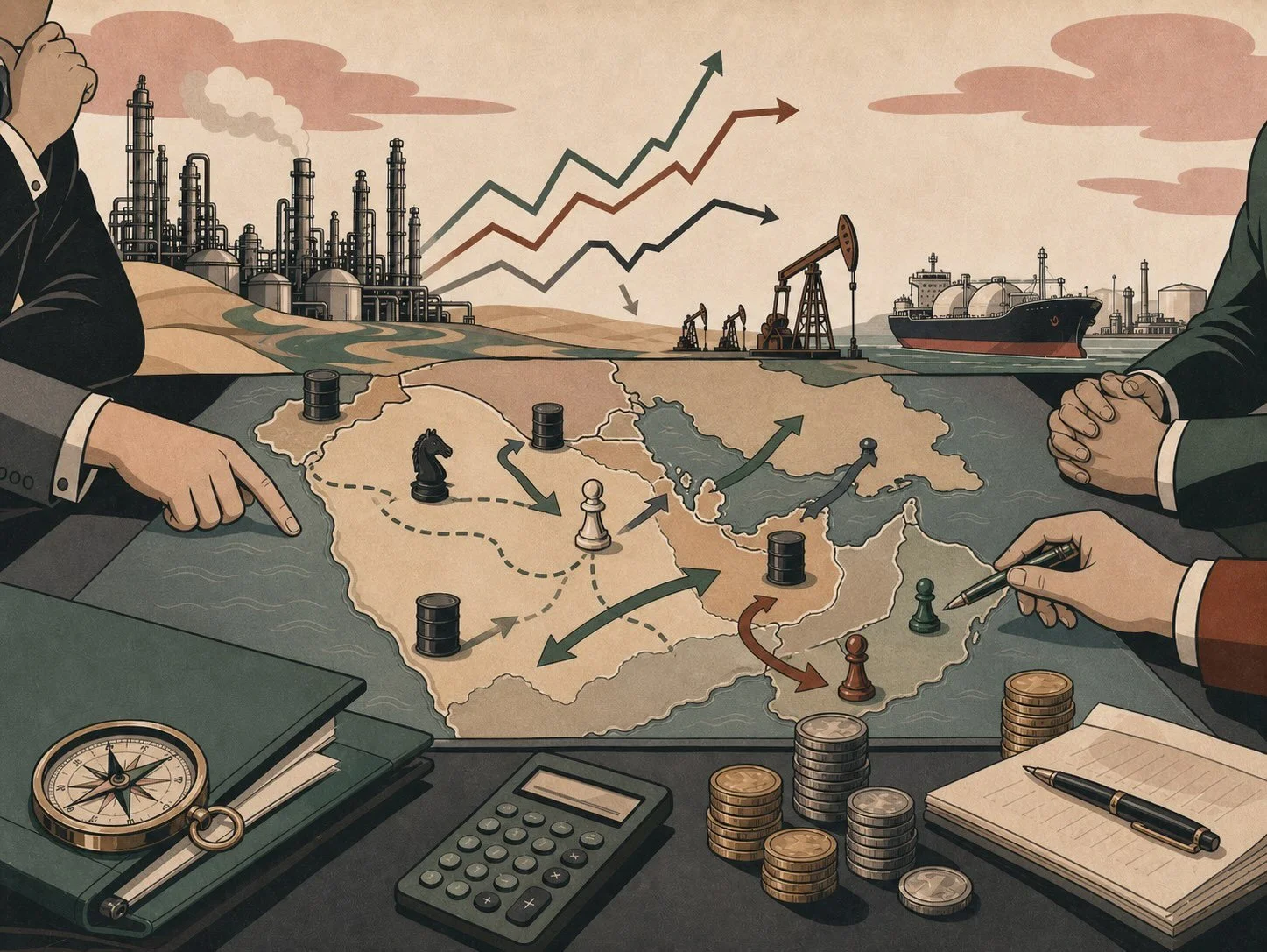
The boardroom implication is clear: energy strategy can no longer be outsourced to OPEC assumptions, because producer behavior is becoming more national, commercial, and unpredictable.
The UAE’s exit creates a new decision environment for boards, ministries, investors, and energy buyers. The old question was: “What will OPEC+ decide?” The new question is broader: How will a less cohesive producer system behave under stress, normalization, and transition? That is a materially harder question because it requires reading not only formal meeting outcomes but also national fiscal pressure, infrastructure recovery, customer contracting, spare-capacity incentives, and competitive behavior among producers outside the coordination framework.
The first board-level implication is that oil-market strategy must become scenario-led. Single-point forecasts are dangerous in a market that can swing between disruption and oversupply. Scenario one is prolonged disruption: Hormuz constraints remain material, Brent stays elevated, energy inflation persists, and governments intervene through subsidies, reserves, or rationing. Scenario two is managed normalization: shipping improves, the UAE gradually increases production, inventories rebuild, and prices moderate. Scenario three is competitive overproduction: UAE output rises, other members loosen compliance, OPEC+ loses credibility, and prices fall sharply. Scenario four is Saudi-led defense: Saudi Arabia cuts deeper or coordinates with remaining members to offset UAE barrels, limiting price declines but increasing diplomatic tension. Each scenario requires different corporate and policy responses.
The second implication is that energy-importing governments should treat supply security as a portfolio problem, not a diplomacy problem alone. The EIA’s Hormuz data show that roughly 20 million barrels per day moved through the strait in 2024, equal to about 20% of global petroleum liquids consumption. No serious importing economy can ignore that concentration risk. Governments should revisit strategic petroleum reserves, alternative crude sourcing, LNG exposure, refining flexibility, fuel subsidies, and demand-response mechanisms. The UAE’s exit may improve future supply availability, but it does not solve chokepoint vulnerability.
The third implication is for investors. A less coordinated oil market can produce both opportunity and risk. Low-cost producers with balance-sheet resilience may benefit from market-share competition. High-cost producers may suffer if prices fall after disruption eases. Refiners may benefit or suffer depending on crude differentials, product cracks, and regional supply imbalances. Logistics assets, storage, pipelines, and trading operations may gain value as volatility rises. Investors should not treat “oil price up or down” as the only investment thesis. The more powerful thesis is volatility monetization and asset-positioning across the value chain.
The fourth implication is for national oil companies. The UAE has effectively raised the strategic bar. Producers now need to prove not just that they have reserves, but that they can convert reserves into advantaged, reliable, lower-emission, customer-aligned supply. ADNOC’s emphasis on lower-cost and lower-carbon-intensive barrels, plus its production-capacity target, is an example of that positioning. Other producers may need to respond with better emissions data, stronger customer integration, improved capital discipline, or more transparent production economics. In a plateauing demand world, “we have oil” is not enough. The question is: why should the next marginal buyer choose your barrel?
The fifth implication is for OPEC+ itself. The alliance can remain relevant, but it must adapt. Its traditional toolkit—cuts, quotas, ministerial meetings, and signaling—may not be sufficient when a major Gulf producer has opted out. To preserve credibility, OPEC+ will need tighter compliance monitoring, clearer quota logic, and a more compelling value proposition for members with growing capacity. Reuters reported that the alliance is likely to remain intact but weaker, with the UAE’s exit reducing OPEC+ control over global production from about 50% to 45%. That is not fatal, but it is strategically consequential.
The final implication is that the UAE has changed the narrative of Gulf energy strategy. For decades, the region was often analyzed through the lens of producer coordination. The new lens is producer differentiation. Saudi Arabia, the UAE, Qatar, Kuwait, Iraq, Iran, and Oman do not have identical fiscal needs, export constraints, gas positions, industrial strategies, or geopolitical priorities. The UAE’s exit makes that divergence visible. It is a reminder that the Gulf is not a monolith; it is a set of competing national business models with overlapping interests and increasingly distinct strategies.
For executives, the practical playbook is clear: map energy exposure, stress-test margins, renegotiate fuel pass-through clauses, diversify supply, review hedging policy, monitor OPEC+ compliance behavior, track UAE ramp-up signals, and treat energy volatility as a strategic variable. For policymakers, the agenda is equally clear: protect vulnerable consumers without distorting demand permanently, maintain strategic reserves, diversify import routes, accelerate efficiency, and avoid assuming that producer coordination will always stabilize markets. For investors, the opportunity is in understanding which assets gain from volatility, not merely which stocks rise when oil rises.
The UAE’s exit marks the beginning of a more differentiated oil order, where national strategy, infrastructure optionality, and capital discipline matter more than bloc membership alone.
It is important to focus on behavior, not statements. The decisive indicators will be whether the UAE moves toward maximum sustainable production after logistics normalize, whether Saudi Arabia responds with deeper cuts or market-share defense, and whether other OPEC+ members begin exceeding quotas more openly. A second signal set sits outside oil: the pace of UAE moves on trade partnerships, regional diplomacy, investment attraction, and institutional independence. The country’s broader competitive agenda increasingly overlaps with Saudi Arabia’s own ambitions in tourism, finance, logistics, technology, and global capital attraction. That means oil is one theater inside a wider Gulf competition for influence, talent, capital, and strategic relevance. Boards should therefore treat the UAE exit not as an isolated commodity event, but as a sign that regional economic rivalry is becoming more explicit, more commercial, and more globally consequential.
Lessons learned — The boardroom-action conclusion for decision makers preparing for a less coordinated oil system: (i) scenario planning must replace single-price forecasting; (ii) supply security requires infrastructure and inventory strategy, not only diplomatic relationships; (iii) volatility can be monetized by well-positioned assets but punishes weak balance sheets; (iv) producers must compete on cost, carbon, reliability, and customer integration; (v) OPEC+ can survive, but its strategic value proposition must be rebuilt for a more differentiated producer landscape.

The UAE’s exit from OPEC and OPEC+ is a defining signal of the next oil-market era: less coordinated, more competitive, more infrastructure-constrained, and more shaped by national portfolio strategy. It does not make OPEC irrelevant, nor does it guarantee permanently lower prices. It creates a more complex market in which short-term disruption can coexist with medium-term supply expansion, and where advantaged producers move faster to monetize capacity before demand growth plateaus. The strategic lesson is clear: the winners will be those who control optionality—over barrels, logistics, customers, capital, and timing.
The oil market is moving from an era of producer blocs to an era of producer strategies. The UAE’s exit shows how a low-cost, infrastructure-rich, globally connected Gulf economy can choose autonomy when collective discipline no longer maximizes national value. The winners in this environment will not simply be the countries with the largest reserves. They will be the countries that can convert reserves into flexible supply, customer loyalty, fiscal resilience, downstream margin, geopolitical leverage, and transition-era relevance.
OHK has been active across the MENA region for more than three decades, supporting clients in understanding how energy resilience, infrastructure performance, market volatility, and policy choices translate into real economic value. At OHK, we help clients look beyond headline energy narratives to assess the analytical, commercial, regulatory, technical, and geopolitical conditions that determine whether energy systems can remain reliable, affordable, and competitive over the long term. Our work links ambition to implementation through advanced analytics, scenario modeling, demand forecasting, fuel-risk assessment, investment appraisal, infrastructure planning, and resilience strategy. Across strategy, planning, and modeling, our aim remains consistent: clearer judgment, stronger systems thinking, and more durable outcomes. To discuss how OHK can support your next phase of energy resilience, analytics, modeling, and strategic transformation, contact us.