

How the U.S.-Iran Conflict Could Elevate Jordan’s Strategic Value and Regional Position
Why residency policy, healthcare, logistics, mining, and corridor reopening deserve to be read as one national opportunity
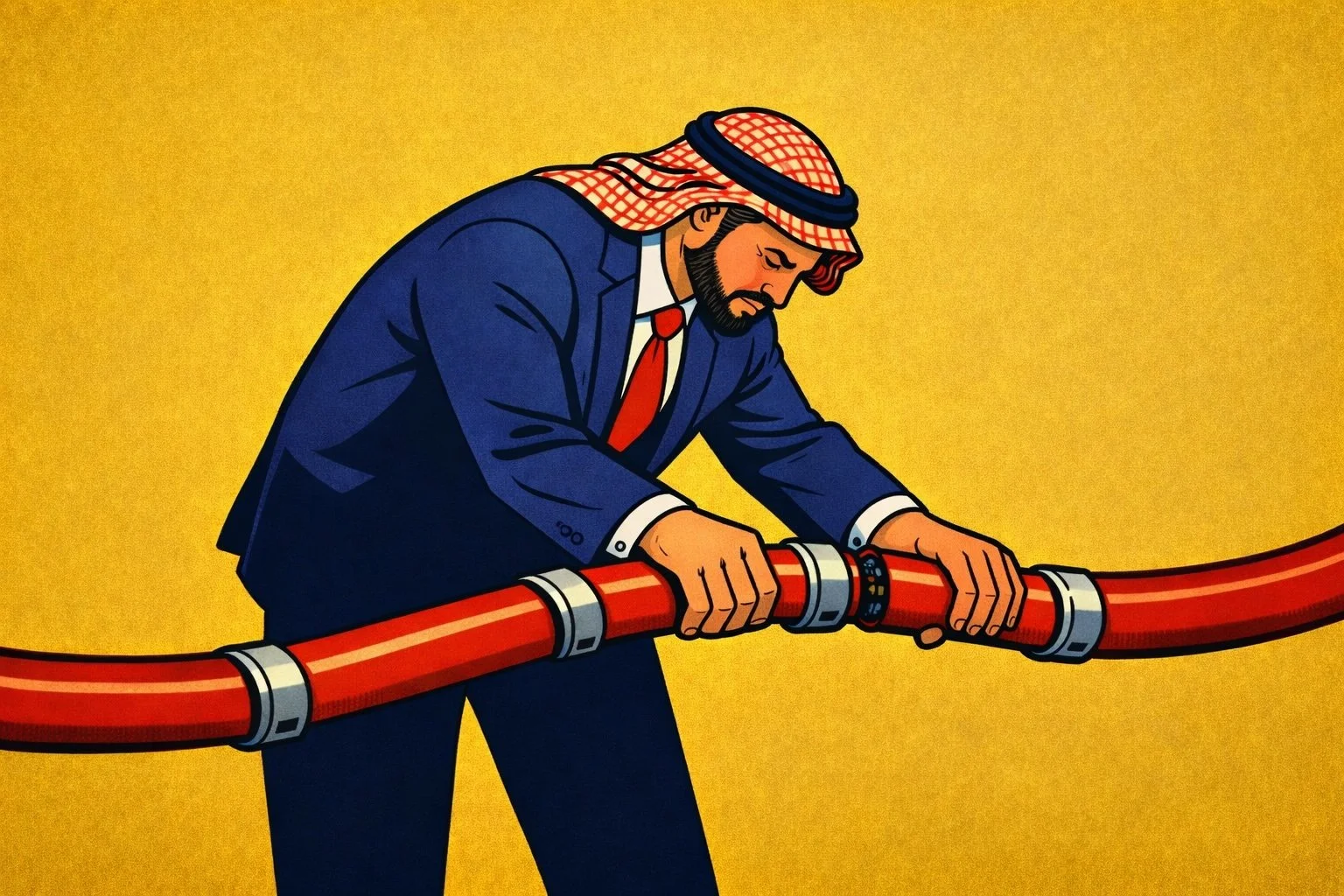
Jordan’s moment may lie not in becoming larger than its neighbors, but in becoming more valuable to a region in search of trusted platforms, resilient corridors, selective capital destinations, and high-quality service hubs.
Jordan is not the obvious winner from a prolonged U.S.-Iran conflict. It is an oil importer, it remains highly sensitive to regional confidence shocks, and its tourism industry has repeatedly suffered when the wider neighborhood appears unstable. The IMF has already warned that oil-importing states such as Jordan face pressure from higher commodity prices and possible weakness in remittances when regional war intensifies. At the same time, the IMF has also emphasized that before the latest war shock, Jordan’s economy had shown real resilience: real GDP growth reached 2.8 percent in 2025, inflation stayed below 2 percent, and the banking system remained resilient, while the IMF’s current country profile still projects 2.7 percent real growth in 2026. Jordan therefore enters this period not as a collapsing frontier, but as a country under pressure whose relative value may rise if it can turn resilience into strategy.
The argument is not that Jordan benefits automatically from war. The argument is that prolonged instability in the Gulf-Levant system could increase the premium placed on exactly the things Jordan can offer if it is organized enough to package them: a secure and incentive-rich Aqaba platform, a reputation for administrative seriousness relative to its neighbors, strong healthcare capabilities, rising medical tourism, targeted investor residency pathways, improving trade links to Iraq and Syria, and an industrial-mining rail strategy that could make southern Jordan more valuable than it has been in decades. In 2025, Jordan’s tourism revenue rose to $7.79 billion, FDI inflows increased 25.1 percent to about $2.205 billion, and bilateral trade with Syria rebounded sharply, while container throughput through Aqaba also strengthened. These are not fantasies. They are the beginnings of a usable platform story. The question is whether Jordan can turn that story into a coherent national revaluation.
Reading Time: 50 min.
All illustrations are copyrighted and may not be used, reproduced, or distributed without prior written permission.
Summary: Jordan’s opportunity in a prolonged U.S.-Iran conflict is subtler than Egypt’s but potentially cleaner in design. Jordan lacks Suez and does not possess the scale advantages of Egypt or the capital depth of the GCC, so it should not try to imitate either model. Its opening lies elsewhere. Jordan can benefit if regional instability makes trust, selective specialization, and corridor optionality more valuable. Aqaba can become more important as a trade, logistics, warehousing, and export platform because it combines a full-service port with the tax and customs advantages of the Aqaba Special Economic Zone. Tourism can improve not primarily through mass beach diversion, but through high-trust segments such as medical, wellness, religious, conference, and quality cultural travel. Safe-haven capital can increase selectively in logistics, healthcare, education, mixed-use real estate, and light industry. Long-stay regional households and investors can be attracted through Jordan’s investor residency pathways and eased property-linked residency rules. And reopened links to Iraq and Syria can make Jordan more valuable as a gateway to reconstruction, transit, and regional supply chains.
The quantitative logic strengthens the thesis. Tourism revenue reached $7.79 billion in 2025, equal to roughly 14.6 percent of Jordan’s 2024 nominal GDP of $53.35 billion. FDI inflows of $2.205 billion in 2025 were about 4.1 percent of that GDP base. This means that Jordan does not need giant breakthroughs to move the macro needle. A few hundred million dollars of extra tourism, a modest uplift in logistics and storage, several hundred million in additional FDI, and stronger resident spending can add up quickly in a relatively small economy. The GDP analytics therefore argue that if Jordan executes well, a realistic medium-term gain could be around 1 to 3 percent of GDP above the no-action path, with upside beyond that if Aqaba, rail, tourism upgrading, and regional corridor normalization reinforce one another. The prize is not that Jordan becomes a different country overnight. The prize is that it becomes a more valuable platform state than its size would normally suggest.
The overall arc is: regional war shock and short-run pain —> Jordan’s strategic repricing —> Aqaba as the main lever —> stability premium and capital rotation —> tourism upgrading rather than mass tourism —> residency and livability appeal —> mining, rail, and industrial scaling —> Iraq and Syria corridor optionality —> quantitative upside —> GDP transmission —> reform and execution test —> strategic close-out.
Jordan Is Hurt in the Short Run, but Repriced in Strategic Value

Jordan’s strategic value rises when uncertainty deepens, because in a darker region even a small source of steadiness can matter disproportionately.
The intellectually honest place to begin is with the downside. Jordan is not insulated from a prolonged U.S.-Iran conflict; it is exposed to it. The IMF has warned that oil importers such as Jordan face higher commodity costs and possible pressure on remittances from Gulf-based workers when the regional war intensifies. That is a genuine macro risk for a country that imports energy, manages a structurally sensitive external balance, and depends heavily on regional confidence. The same IMF and Reuters reporting also show that the broader Middle East and North Africa outlook has darkened sharply because of the war. So any serious analysis must reject the lazy claim that Jordan simply “wins” from the crisis. In the short run, it very clearly does not. It may face higher import bills, softer travel sentiment, and more cautious private-sector behavior. That is precisely why Jordan’s opportunity should be described as a repricing of relative value, not as an immediate windfall. When the region becomes harder to trust, the countries that remain usable, predictable, and diplomatically legible can suddenly become more important than their size suggests. Jordan belongs in that category.
That relative-value argument becomes more convincing when one looks at Jordan’s pre-shock performance. The IMF said in April 2026 that before the current war escalated, Jordan’s economy had continued to demonstrate resilience, with real GDP growth reaching 2.8 percent in 2025, inflation staying below 2 percent, and the Central Bank maintaining strong reserve buffers while the banking system remained resilient. Those facts matter because geopolitical opportunity is easiest to capture when the domestic macro framework is at least moderately credible. A state that is already wobbling badly has trouble converting external shocks into advantage. Jordan, by contrast, entered 2026 with a reputation for prudence, international support, and relatively serious policy management. This does not make it rich, but it does make it legible to investors, lenders, insurers, and regional businesses looking for an alternative base. Jordan’s official FDI data reinforces the point: inflows rose 25.1 percent in 2025 to $2.205 billion, with a large Arab component and meaningful European participation. That is not the profile of a market being abandoned. It is the profile of a market that some investors are already willing to treat as a selective haven of order.
The reason Jordan’s strategic value may rise in wartime has less to do with hydrocarbons and more to do with intermediation. Jordan sits between the Levant, Iraq, Saudi Arabia, and the Red Sea. It has one seaport, Aqaba, but that port is tied to a special economic zone with simplified procedures, reduced taxes, customs exemptions, and relatively open rules on foreign capital and profit transfer. The state also continues to push large infrastructure ideas—rail, water desalination, gas production, industrial zones, and logistics corridors—that, if executed, could make Jordan more capable of handling flows that need a reliable midpoint. The Prime Minister’s January 2026 interview was revealing on exactly this point. He described the railway from Aqaba as the first stage of a broader system that could later extend toward Saudi Arabia, Syria, and Türkiye, while also stating that the National Carrier desalination project is set to deliver 300 million cubic meters of water annually and that the government aims for Risha gas production to meet more than 80 percent of Jordan’s natural-gas needs by 2030. These are not short-term gains, but they show a state thinking in platform terms.
That is why Jordan should be analyzed not as a country that replaces the Gulf, and not as a country that suddenly dominates regional trade, but as a country whose option value rises when the region’s dominant nodes become more exposed. Jordan can become a staging ground, a service jurisdiction, a medical and educational base, a logistics hinge, a warehousing point, a residency option, and eventually a land corridor beneficiary. The crisis does not erase Jordan’s weaknesses. It changes the premium assigned to its strengths. That is the deeper strategic point. Countries like Jordan rarely benefit from turmoil through scale; they benefit through credibility, specialization, and access. The more unstable the region becomes, the more those traits can matter.
Jordan’s opportunity begins not when instability disappears, but when instability makes steadiness itself more valuable—and Jordan starts to be seen as one of the few places in the region that still gives off usable light.
Once Jordan is understood as a strategic source of steadiness in a darker regional environment: (i) Jordan is exposed to the short-run costs of instability and should not pretend otherwise; (ii) the Kingdom’s real opportunity lies in the relative repricing of trust, predictability, and institutional coherence; (iii) in unsettled times, usability can matter more than scale; (iv) quiet strengths such as moderation, order, and administrative legibility can become economic assets; (v) Jordan’s broader upside begins the moment it is recognized not as the brightest power in the room, but as one of the few reliable lights still on.
Aqaba Could Become Jordan’s Main Lever for Trade, Logistics, and Export Monetization

Aqaba’s importance lies in its scale-defying role as Jordan’s narrow but highly strategic opening to trade, logistics, and wider regional opportunity.
If Jordan has one geographic asset capable of carrying a major strategic argument, it is Aqaba. Aqaba is not just Jordan’s only seaport. It is the one place where trade, logistics, tourism, real estate, residency, customs flexibility, and industrial ambition can all be bundled into a single development proposition. That bundling matters because in a volatile region, a port-city is more valuable when it can behave like a platform ecosystem rather than a narrow shipping facility. The Aqaba Special Economic Zone Authority explicitly markets the zone around this logic. ASEZA highlights a 5 percent tax on net income for most projects, customs exemptions on imports, simplified licensing through a single investment window, no restrictions on foreign currency dealings, no restrictions on profit and capital transfers abroad, and a strategic location linking the Middle East to North Africa and East Asia. Jordan’s Invest in Aqaba materials add that logistics-center enterprises engaged in transit, export, and re-export enjoy particularly strong treatment. This gives Jordan something more interesting than a port: it gives Jordan a rules-based commercial enclave that can be sold to regional capital as an organized place to land.
The traffic data suggests Aqaba already has momentum. Official figures cited by Petra show that inbound container volumes through Aqaba rose to 325,259 TEUs in the first eight months of 2025, up from 275,151 TEUs in the same period of 2024, while outbound container volumes also rose 6.7 percent to 73,426 TEUs. That does not make Aqaba a mega-port by global standards, but it does show that cargo is moving in the right direction and that supply-chain flows through Jordan can strengthen even before any grand geopolitical reordering is complete. In a conflict-prone regional setting, this kind of evidence matters because it demonstrates operating traction. Investors, logistics companies, and shippers do not respond only to maps and speeches. They respond to throughput, customs reliability, and the practical signs that a corridor is becoming easier to use rather than harder. Aqaba’s recent container performance tells exactly that story.
What makes Aqaba especially interesting is that Jordan is now trying to reposition it as both a commercial hub and a livability destination. In May 2025, Petra reported that the Jordanian cabinet had approved a broad package of incentives aimed at transforming Aqaba into a world-class destination for tourism, investment, and long-term residency. The initiative explicitly sought to attract investors, retirees, and professionals from Jordan and abroad, especially from neighboring Arab countries, and linked Aqaba’s future to a top-100 global destination ambition in real estate and quality of life. That is a strikingly sophisticated framing. It means the state is no longer thinking of Aqaba solely as a customs and port zone, but as a place where maritime logistics, quality urbanism, and long-stay residency could reinforce one another. For Jordan, that is exactly the correct strategy. Aqaba will never outscale Dubai, Jeddah, or Port Said. But it may not need to. It can instead become the region’s most credible mid-sized mixed-use platform if it gets the combination of regulation, urban experience, and commercial speed right.
The war-related opportunity follows directly from that. As Gulf routes and Gulf-adjacent assumptions become more contested, capital may look more favorably at a Red Sea base that is smaller, calmer, cheaper, and administratively more coherent for selected uses. Aqaba can benefit not only from goods moving through it, but from the services attached to those goods: warehousing, bonded storage, customs processing, legal documentation, ship services, freight forwarding, regional headquarters, tourism spillover, and mixed-use real estate demand. The challenge, of course, is scale. Aqaba is valuable precisely because it is compact and manageable, but that also means it can be overwhelmed by weak planning, infrastructure bottlenecks, or speculative development detached from real demand. The lesson is that Aqaba should not be developed as a vanity project. It should be developed as Jordan’s most monetizable interface with the wider region. If policymakers understand that, Aqaba becomes more than a city. It becomes the operational anchor of Jordan’s entire strategic response to regional instability.
Aqaba matters not because it can rival the biggest ports in the region, but because it can become the most organized place where Jordan’s logistics, residency, tourism, and investment strategies actually meet.
What the Aqaba argument reveals once it is read as a full economic system rather than as a port story alone: (i) Aqaba’s value comes from combining trade rules, urban appeal, and logistics rather than from tonnage alone; (ii) ASEZA’s incentives give Jordan a real policy tool rather than a vague aspiration; (iii) rising container volumes prove that Aqaba is already gaining operational traction; (iv) the city’s future is strongest when port, tourism, and residency are planned together; (v) Jordan should think of Aqaba as a monetizable interface with the region, not merely as a harbor at the end of a road.
Jordan Can Benefit from a Stability Premium and Safe-Haven Capital Rotation

Jordan’s appeal in uncertain times lies not in attracting all capital, but in standing out as a trusted and selectively favored place for it to land.
The safest way to discuss capital inflows into Jordan is to avoid exaggeration. Jordan is not about to absorb the kind of capital volumes that the GCC can attract, and no prudent investor would describe it as a universal safe haven. But relative safe-haven status is a different matter. In periods of regional stress, capital often reallocates not toward perfect safety but toward the nearest jurisdiction that combines legal seriousness, geopolitical moderation, and workable access to regional markets. Jordan fits that description better than many observers acknowledge. Official data reported by Petra shows that FDI inflows rose 25.1 percent in 2025 to about $2.205 billion, up from $1.618 billion in 2024. Arab countries supplied 61.3 percent of that total, while European investors contributed 13.7 percent. Those numbers suggest something important: even before the full implications of the current conflict are digested, Jordan is already receiving meaningful external capital from both regional and non-regional sources. That is not a trivial baseline. It implies that the market is prepared to finance Jordan selectively when the policy and project structure make sense.
The sectors receiving or likely to receive that capital also support the broader thesis. Petra’s reporting on the Ministry of Investment’s 2025 annual report showed strong growth in macro investment indicators and expanded use of exemptions and incentives. Other official updates noted that transportation and storage, real estate, manufacturing, mining, and finance all featured materially in the FDI mix over the year. This is exactly the composition one would expect if Jordan were becoming attractive as a resilience jurisdiction rather than as a single-bet story. Capital is not coming only for one glamour sector. It is showing interest in the connective tissues of the economy—finance, storage, logistics, industry, land, and regulated service sectors. That makes Jordan’s investment profile more robust than a narrow real-estate boom would. In a war-fractured regional setting, investors often prefer diversified practical assets over symbolic mega-projects. Jordan is well placed to market exactly those kinds of opportunities.
There is also a softer but equally important element: political intelligibility. Jordan is not viewed as a revisionist or disruptive actor. It remains deeply tied to Western and Gulf relationships, receives strong multilateral backing, and generally presents itself as a serious reforming state even when execution is incomplete. The IMF’s April 2026 staff-level statement praised prudent macroeconomic policies, reserve buffers, and banking resilience. Investors may disagree about Jordan’s speed, bureaucracy, or market size, but they usually do not struggle to understand what Jordan is trying to be. That matters. In crisis periods, many investors favor jurisdictions whose political and administrative trajectory is clear enough to underwrite. Jordan’s advantage is not dazzling growth. It is credibility under stress. That is often enough to win selective capital flows in healthcare, education, logistics, tourism, energy infrastructure, and export-oriented manufacturing.
The challenge is that Jordan must not confuse a stability premium with passive entitlement. Safe-haven inflows go where execution is fast, contract enforcement is reliable, profit repatriation is boring, and licensing is legible. Jordan has improved, but investors still care about cost, land assembly, energy pricing, labor-market flexibility, and administrative speed. This is why the capital story should be told carefully. Jordan is not likely to become a magnet for speculative excess. It is more likely to become a magnet for disciplined capital seeking regional diversification. That includes family offices looking for quality assets outside the most exposed nodes, manufacturers seeking stable access to trade agreements, healthcare investors, logistics operators, and Gulf or Iraqi investors wanting a second base with lower political temperature. If Jordan embraces that identity—selective, serious, rules-based, and professionally moderate—then the war can indeed raise its relative appeal. Not because money is fleeing everywhere else, but because some money is looking for a place that feels durable enough to stay.
Jordan’s capital opportunity is not to become the region’s biggest magnet, but to become the region’s most believable destination for investors who value order more than spectacle.
What the stability-premium logic says once stripped of hype and translated into investment behavior: (i) Jordan’s safe-haven case is selective rather than universal; (ii) the existing FDI growth proves that confidence is already real in some sectors; (iii) diversified inflow patterns are healthier than a one-sector boom; (iv) political intelligibility is itself an investment asset during wartime; (v) Jordan must earn each extra dollar by making implementation faster and less stressful than in competing jurisdictions.
Medical, Wellness, Religious, and High-Trust Tourism Could Become a Bigger Win for Jordan

Jordan’s tourism advantage lies in combining care and comfort, making trust itself part of the visitor economy.
Jordan’s tourism opportunity should be framed very differently from Egypt’s. Jordan is not best placed to compete for sheer volume. It is better placed to compete for high-trust tourism: medical tourism, wellness travel, religious circuits, premium cultural itineraries, business events, and family travel that prizes safety, quality, and manageable scale over spectacle. The data from 2025 shows the sector already rebounding from the severe shock of the Gaza war period. According to Petra, tourism revenue rose 7.6 percent in 2025 to $7.79 billion, reversing the decline of 2024, and the increase was driven by a 15.3 percent rise in tourist numbers. Revenue growth was strongest from Europe, Asia, and the Americas, which matters because those are precisely the source markets most likely to care about trust, cultural depth, and differentiated experiences. Jordan’s tourism authorities have also been pushing product diversification, with official promotion at ITB Berlin highlighting medical, wellness, adventure, and community-based tourism rather than only the classical Petra-Wadi Rum route. That is strategically smart. It means Jordan is already trying to sell quality and distinctiveness rather than mass throughput alone.
The medical and wellness dimension is especially important. Petra’s June 2025 coverage of the 8th Medical Tourism World Summit quoted the health minister saying Jordan is implementing a National Medical Tourism Strategy (2025–2027) built around governance, marketing, investment incentives, and service quality. The same report noted more than 100 pre-priced treatment packages, an upcoming “Salamtak” digital platform, and a government effort to improve the patient experience while relaxing visas and improving air connectivity. Most importantly, the minister said the number of medical tourists had nearly doubled from 111,000 in 2020 to more than 225,000 in 2024 and was expected to reach 290,000 in 2025, above pre-COVID levels. Another Petra report from October 2025 described Jordan’s “success story” in medical and wellness tourism and highlighted the country’s advanced healthcare system and regional reputation. This is exactly the sort of tourism segment that can outperform in a tense region because patients, families, and organized healthcare travelers make decisions differently from mass leisure tourists. They care about clinical quality, visas, predictable treatment packages, and a manageable social environment. Jordan scores relatively well on all of those dimensions.
Jordan’s official tourism infrastructure also supports a broader high-trust positioning. Visit Jordan maintains formal hospital listings and dedicated medical travel information, while the tourism board and ministry continue promoting wellness, religious, and conference segments in parallel. This matters because Jordan can layer multiple motives into one trip: treatment or wellness at the Dead Sea, cultural or biblical sites in Madaba and beyond, business meetings in Amman, short-haul coastal time in Aqaba, and desert experiences in Wadi Rum. A smaller country has an advantage here. It can sell multi-purpose itineraries that are easy to understand and short on friction. In a war-shadowed region, that simplicity becomes part of the product. Travelers who would hesitate to build a long, uncertain itinerary across multiple jurisdictions may prefer a single country that combines care, pilgrimage, culture, and rest within a compact geography. Jordan should exploit that ruthlessly.
The larger point is that Jordan’s tourism future may be strongest when it stops chasing only large arrival numbers and instead focuses on high-value, trust-intensive categories. Medical tourism, religious tourism, premium cultural circuits, conference travel, and retirement-linked long stays are all less vulnerable to the same kind of impulsive demand swings that damage low-commitment leisure travel. They are also more closely linked to the other sectors Jordan wants to grow: healthcare, education, urban services, real estate, logistics, and aviation. If Jordan can make these segments feel seamless—visa, transport, hospital coordination, multilingual service, insurance recognition, cultural programming—it can turn tourism from a fragile headline industry into a more resilient service export. That would be an ideal response to regional instability: not more volume for its own sake, but more quality-adjusted demand that fits the country’s comparative advantages.
Jordan’s biggest tourism opportunity is not to become louder than its neighbors, but to become the place people choose when health, trust, meaning, and ease matter more than spectacle.
What tourism ultimately shows is that once Jordan’s strengths are measured by trust rather than by mass numbers alone: (i) Jordan’s tourism recovery is already real and data-backed; (ii) medical and wellness travel give Jordan a defensible niche that conflict may actually strengthen; (iii) compact multi-purpose itineraries are a competitive advantage in an anxious region; (iv) high-trust tourism supports healthcare, education, and urban services beyond hotels; (v) Jordan should optimize for quality-adjusted demand rather than only chasing the largest possible arrival count.
Residency, Education, Healthcare, and Long-Stay Demand Could Reposition Jordan as a Livability Platform

Jordan’s long-term advantage lies in turning trust into livability, making residency, education, and healthcare part of a more durable platform for staying, not just visiting.
One of the most overlooked opportunities for Jordan is not tourism in the narrow sense, but long-stay demand. Jordan can market itself as a place to live temporarily or semi-permanently for investors, professionals, retirees, treatment-seeking families, students, and regionally mobile households who want a country that feels serious, familiar, and manageable. This is where policy changes in 2025 become strategically important. The Ministry of Investment’s official residency page states that investor residency can be granted within 14 working days and extends to spouses, children, and parents where conditions are met. In July 2025, the cabinet also approved an updated framework for granting citizenship and residency to investors. Earlier in the year, the cabinet eased residency rules by removing the previous JD10,000 deposit requirement for certain foreign property owners and reducing the required bank deposit for non-property-owning applicants for five-year residency from JD20,000 to JD10,000. These changes may look administrative, but they are actually economic signals. They tell the market that Jordan increasingly understands residency, property, and investment as connected policy tools rather than separate bureaucratic silos.
This matters because regional instability often shifts not only travel plans but also household location decisions. Families with business in Iraq, Syria, the Gulf, or the wider Levant may want an alternative base for education, healthcare, property ownership, and personal safety. Jordan has long been part of that regional ecosystem, but it has not always translated that role into a clear national strategy. It can do so now. Petra’s reporting on Aqaba’s new incentive package explicitly said the city is being positioned to attract investors, retirees, and professionals from Jordan and abroad. That suggests a broader model: Amman as a business, education, and healthcare center; Aqaba as a Red Sea residential and investment platform; the Dead Sea and wellness zones as treatment and recovery clusters; and selected heritage cities as cultural anchors. This would not require Jordan to reinvent itself. It would require it to formalize and market what it already partly is.
Education and healthcare are central to this residency thesis. Jordan’s hospitals are already formally integrated into its tourism and visitor ecosystem through the official tourism board’s resources, and the government’s medical-tourism strategy shows a serious attempt to coordinate health, visas, digital platforms, and quality. For a long-stay household, these services matter more than a flashy skyline. Families choose residence platforms where children can study, where treatment is accessible, and where daily life is coherent. Jordan’s advantage here is not luxury at Gulf scale. It is functional dignity: good schools, decent healthcare, cultural familiarity, proximity to Iraq and the Gulf, and a social environment that many Arab families and internationally mobile professionals already understand. In a region where some jurisdictions are very expensive and others are politically or administratively difficult, that middle position can be highly marketable.
The economic effect of long-stay demand is also better than many people assume. Residents support retail, clinics, restaurants, private schools, maintenance, transport, domestic aviation, legal services, and property management throughout the year. They stabilize demand that would otherwise be seasonal. They also make real-estate investment more durable because occupancy becomes less dependent on short vacation windows. This is why Jordan’s easing of property-linked residency rules is so important. The move was explicitly described by experts cited in Petra as a measure that could stimulate real estate, construction, legal services, and maintenance by redirecting foreign interest from idle deposits toward property ownership. Jordan should lean into that logic, but intelligently. The goal is not uncontrolled real-estate speculation. The goal is to attract the right sort of long-stay demand: professionals, health-linked residents, retirees, education-oriented households, and investors who use Jordan as a second base. In a conflict-ridden region, that can become a powerful source of stable service-sector growth.
Jordan’s residency opportunity is powerful because it turns trust from a travel preference into a year-round economic asset anchored in homes, schools, hospitals, and everyday spending.
What the long-stay platform argument makes unmistakably clear once residency is treated as an economic strategy rather than a legal technicality: (i) fast investor residency and eased property-linked rules can materially improve Jordan’s competitiveness; (ii) long-stay demand is more stable than ordinary tourism; (iii) healthcare and education are core export assets in a residency strategy; (iv) Aqaba and Amman can play complementary roles within one national livability model; (v) Jordan should seek disciplined long-stay demand that deepens services and occupancy rather than encouraging shallow speculative inflows.
Mining, Rail, and Industrial Zones Could Turn Southern Jordan into a Productive Export Engine

Jordan’s productive future depends on turning natural resources, industrial inputs, and transport infrastructure into a coordinated export system rather than leaving them as isolated assets.
Jordan’s most underrated opportunity may not be glamorous at all. It may lie in the hard infrastructure of phosphate, potash, rail, dry ports, gas, water, and export-linked industry. This matters because countries that benefit durably from geopolitical change usually do so by strengthening productive systems, not by relying only on softer sectors such as tourism or real estate. Jordan already has the raw ingredients for such a shift, particularly in the south. The 2024 Jordan-UAE agreement to build a $2.3 billion railway linking Aqaba to mining areas in Shidiya and Ghor al-Safi is central here. Petra reported that the project is expected to significantly raise Jordan’s logistical and export capacity, with starting volumes tied to large phosphate and potash flows and, in later official commentary, the creation of around 5,000 jobs in the south. The Prime Minister also said the railway’s first phase would connect to a dry port in Ma’an, explicitly to add value and support logistics operations in Aqaba. That is not just a transport project. It is a restructuring of how southern Jordan might participate in national growth.
The strategic importance of this is bigger than mining alone. Rail lowers transport costs, deepens port competitiveness, improves reliability, and creates the conditions for industrial activity that would otherwise remain unviable. If Jordan can move phosphate, potash, bromine, raw materials, and eventually other freight more cheaply and predictably into Aqaba, it strengthens both exports and the incentive to locate processing and storage closer to the corridor. Petra’s reporting on the Jordan Phosphate Mines Company’s plans for manufacturing feed additives in Aqaba is a useful example of the direction of travel: the objective is not merely to dig and ship raw minerals, but to create higher-value industrial products around them. That is exactly the correct instinct. In a war-altered regional economy, raw throughput is useful, but value-added processing is far more valuable. Jordan should aim to turn its mineral base into a cluster of exportable industrial capabilities tied to Aqaba and supported by rail, not just into more trucks on the road.
The wider infrastructure stack makes this more believable. In January 2026, the Prime Minister said the National Carrier Project would deliver 300 million cubic meters of desalinated water annually from Aqaba to Amman, serving as a strategic response to water scarcity, while the government also aimed for Risha gas production to cover more than 80 percent of Jordan’s natural-gas needs by 2030, with substantial savings expected for industrial zones. Reuters separately reported that the Green Climate Fund had backed Jordan’s $6 billion Aqaba-Amman desalination and conveyance project, underscoring the scale and international support behind the water plan. These projects matter directly for industry because water and energy costs are among the biggest structural constraints on Jordanian production. If water security improves and gas availability rises, the economics of manufacturing, logistics, storage, and export processing become materially better. The southern corridor then stops looking like an isolated geography and starts looking like the spine of a modern productive zone.
The deeper strategic point is that Jordan needs productive ballast. Tourism, residency, and safe-haven capital are valuable, but they can be volatile or cyclical. Mining logistics, industrial processing, rail-linked freight, and infrastructure-led cost reductions are what make a revaluation durable. They also help address Jordan’s chronic problem of limited scale by creating export systems rather than just domestic demand. Southern Jordan has long suffered from underdevelopment, sporadic unrest, and a sense of marginalization. A serious corridor strategy anchored in Aqaba, Ma’an, mining zones, water infrastructure, and energy cost relief would not merely boost GDP. It would begin to rewrite the economic geography of the country. That is the sort of transformation that can outlast any one regional conflict.
Jordan’s most durable geopolitical upside will come not from image alone, but from turning southern infrastructure into a productive export system that makes the whole economy more real.
When Jordan’s hard infrastructure is treated as national strategy rather than as isolated projects: (i) rail matters because it lowers costs and changes what becomes industrially possible; (ii) Aqaba is more powerful when linked to Ma’an and the mining belt; (iii) value-added processing beats raw shipment as a development model; (iv) water and gas projects are industrial competitiveness policies as much as utility projects; (v) southern Jordan can become an economic engine if corridor planning finally matches the country’s long-deferred ambitions.
Jordan’s Iraq and Syria Corridor Options Could Become a Major Strategic Multiplier

Jordan’s regional value grows when broken trade and transport links begin to reconnect through a corridor that is stable enough to carry them.
No Jordan strategy is complete without considering its land-corridor potential. The country’s geography makes it a natural hinge between the Levant, Iraq, the Arabian Peninsula, and—if normalization deepens—Türkiye and Europe. For years, that potential has been constrained by war, border disruptions, sanctions, and insecurity. But recent developments suggest that the corridor story is re-opening. Petra reported in April 2026 that Jordan-Syria trade reached JD334 million in 2025, almost triple the JD116 million recorded in 2024, while Jordanian exports to Syria climbed to JD252 million. Another Petra report two days ago said the two countries were taking “major” steps to deepen economic partnership, form a joint business council, and move beyond simple goods exchange toward broader economic cooperation. These are not final outcomes, and they remain politically sensitive. But they do show that Jordan’s northern corridor is once again becoming economically relevant.
The Syrian corridor matters for at least three reasons. First, it reopens a nearby export market for Jordanian industrial and construction-related goods, including cement, iron, marble, and specialized chemicals, which Petra identified as leading categories in the 2025 rebound. Second, it restores some of Syria’s historical role as a logistical pathway for Jordanian goods into wider regional and European chains. Third, and most importantly, it gives Jordan an entry point into the reconstruction economy without requiring Jordan itself to absorb the political and financial burden of reconstruction on its own territory. Jordan can position itself as a procurement, warehousing, financing, professional-services, healthcare, and light-manufacturing base serving a recovering northern neighbor. That may prove far more realistic than dramatic headline projects. In regional redevelopment cycles, the jurisdictions that profit most are often not the ones being rebuilt, but the ones next door that can supply the rebuild in a rules-based environment. Jordan has a plausible case for becoming one of those jurisdictions.
The Iraq angle strengthens the argument further. In July 2025, Petra reported that a Romanian truck completed a journey to Jordan via Bulgaria, Türkiye, and Iraq using the TIR system, reducing transit time from eight weeks to five days. That is a remarkable indicator, even if it reflects an early-stage logistics breakthrough rather than a fully mature corridor. The significance lies in what it implies: if Jordan can increasingly plug into faster, sealed, customs-enabled overland systems that run through Iraq, it can become more attractive as a hub for regional distribution and European-Middle Eastern land trade. The TIR success story is not only about one truck. It is about the possibility of Jordan becoming easier to reach, easier to route through, and more competitive in overland supply chains that had long been fragmented. In a time when maritime chokepoints and regional conflict both raise the premium on redundancy, overland options become strategically valuable.
Yet all of this remains contingent. Corridor economics depend on security, customs cooperation, insurance, trucking conditions, border efficiency, and political continuity. Jordan cannot assume these routes will automatically flourish. It must actively shape them through bilateral agreements, infrastructure spending, private-sector facilitation, and diplomatic persistence. The Prime Minister’s January 2026 remarks suggest the government sees the larger picture: Aqaba rail, the Ma’an dry port, future extensions north to Syria and Türkiye, and south to Saudi Arabia. If even part of that architecture materializes, Jordan’s land position could become much more valuable than it has been for a generation. The great strategic insight is that Jordan’s geography is not only north-south or east-west. It is intermediary. The more regional systems reconnect, the more that intermediary role can be monetized.
Jordan’s corridor future could matter far more than its domestic market size because transit, reconstruction support, and overland redundancy reward the states that sit intelligently between reopening regions.
What the corridor positioning clarifies is that Iraq and Syria should be seen as multipliers rather than merely neighbors: (i) restored trade with Syria is economically meaningful even before full reconstruction begins; (ii) Jordan can profit from supplying recovery without carrying all of its direct risks; (iii) the Iraq-TIR route shows that faster overland integration is no longer theoretical; (iv) corridor value depends on diplomacy and customs execution as much as on roads and borders; (v) Jordan’s geography is most powerful when the region starts reconnecting and the country is ready to intermediate that reconnection.
The Quantitative Case: How Much Jordan Could Gain Across Tourism, Logistics, FDI, Residency, and Exports

Jordan’s quantitative upside lies in the cumulative power of multiple sectors rising together, with gains in tourism, industry, logistics, residency, and capital reinforcing one another.
A strategic thesis becomes much more persuasive when it is converted into scenario math. Jordan is especially well suited to this type of analysis because it is a relatively small economy. That means moderate gains can have noticeable macro impact. The baseline numbers are already meaningful. Tourism revenue reached $7.79 billion in 2025, up 7.6 percent from $7.239 billion in 2024. FDI inflows rose to $2.205 billion in 2025 from $1.618 billion in 2024. Jordan-Syria trade climbed to JD334 million in 2025 from JD116 million in 2024. Aqaba’s inbound container volumes reached 325,259 TEUs in the first eight months of 2025, up from 275,151 TEUs a year earlier. Medical tourists were expected to reach about 290,000 in 2025. These figures give us enough to build a serious upside model.
The first equation is the tourism uplift equation:
Incremental tourism receipts = baseline tourism revenue × percentage uplift
With a 2025 baseline of $7.79 billion, a 5 percent uplift would add about $389.5 million; a 10 percent uplift would add about $779 million; and a 15 percent uplift would add about $1.1685 billion. Those are not absurd numbers. They are exactly the kind of gains Jordan might plausibly achieve if it expands high-trust tourism—medical, wellness, religious, conference, and premium cultural travel—rather than trying to compete for mass volume alone. Because tourism growth in 2025 was already driven strongly by Europe, Asia, and the Americas, Jordan would not need to invent new markets from zero. It would need to deepen the value extracted from markets that are already returning.
The second equation is the capital equation:
Future FDI = current FDI + additional safe-haven and platform inflows
Using the 2025 baseline of $2.205 billion, an additional $500 million would lift annual inflows to $2.705 billion; an extra $1 billion would lift them to $3.205 billion; and an extra $1.5 billion would lift them to $3.705 billion. In a country Jordan’s size, those are substantial increases. They would not require a speculative mania. They could emerge from a bundle of mid-sized wins: more logistics investment in Aqaba, healthcare and education assets, targeted real estate, industrial warehousing, mining-related processing, and regional family-office diversification. Petra’s own 2025 reporting already described FDI growth as reflecting strategic projects in energy, water, transport, and infrastructure. The quants simply ask what happens if that trend is reinforced by geopolitical repricing.
The third equation is the corridor-and-trade equation:
Future regional trade throughput = current corridor trade × expansion factor
For Syria alone, JD334 million in 2025 trade would become roughly JD501 million under a 1.5x scenario and JD668 million under a 2x scenario. These are not fantasy multipliers, given that the 2025 number itself was already nearly three times the 2024 level. If border and customs normalization continues, Jordan’s direct exports, warehousing role, and logistics services could all scale meaningfully from here. On the Iraq side, the TIR example suggests that transit-time compression can produce qualitative gains that later turn into economic ones; faster and more reliable routes alter what kinds of goods, distributors, and warehouses become viable. The point is not to assert one exact forecast. The point is to show that Jordan’s corridor gains could be multiplicative rather than incremental if political normalization deepens.
The fourth equation is the residency-and-property equation:
Gross foreign-led property sales = number of new long-stay households × average property value
If Jordan attracted 25,000 new foreign-buyer or long-stay households at an average property value of $150,000, gross sales would reach $3.75 billion. At 50,000 households and $200,000 per unit, the number becomes $10 billion. At 75,000 households and $250,000, it reaches $18.75 billion. Not all of this would convert into annual FDI or GDP, of course. But it gives scale to the residency thesis. Jordan’s eased property-linked residency rules, fast investor residency, and Aqaba’s explicit effort to attract retirees and professionals mean that this is not an abstract scenario. The country is already building policy plumbing for it. Once long-stay demand is added to annual household spending on schools, healthcare, restaurants, transport, and maintenance, the economics become even stronger.
The quantitative conclusion is therefore straightforward. Jordan does not need a single spectacular breakthrough. It needs a stack of medium-sized wins: a few hundred million more in tourism, a few hundred million more in FDI, a larger Syria trade corridor, more Aqaba-linked logistics activity, and stronger long-stay demand. In a larger economy, that might feel modest. In Jordan, it is potentially macro-relevant. This is why the quants matter. They transform a geopolitical idea into a set of plausible channels with numbers attached.
The hidden strength of Jordan’s case is that its economy is small enough for medium-sized gains across several channels to add up into something nationally important without requiring any single miracle.
What the quantitative analysis proves once intuition is forced through arithmetic instead of rhetoric: (i) Jordan’s smaller size makes moderate gains macro-relevant; (ii) tourism and FDI baselines are already high enough to model meaningful uplifts; (iii) corridor trade can compound faster than many assume once normalization starts; (iv) residency policy can translate into very large gross property-demand scenarios; (v) the real upside lies in stacking several plausible wins rather than betting everything on one dramatic headline number.
The GDP Effect: How Much Larger Could Jordan’s Economy Become If It Converts Geopolitics into Output?

Jordan’s GDP story is not driven by one dramatic gain, but by several steady streams combining into measurable national growth.
Up to this point, we have discussed tourism receipts, FDI, trade, residency, and logistics. But none of those are identical to GDP. GDP counts domestic value added—the wages, services, industrial output, construction activity, transport margins, and recurring consumption that remain inside the Jordanian economy. This distinction is critical because countries often mistake large gross inflows for real economic transformation. Jordan’s nominal GDP was $53.35 billion in 2024 according to the World Bank, while the IMF projects 2.7 percent real growth in 2026 after 2.8 percent growth in 2025. On that GDP base, every additional $500 million of annual domestic value added equals roughly 0.94 percent of GDP; $1 billion equals about 1.87 percent; $2 billion equals about 3.75 percent; and $3 billion equals about 5.62 percent. Those are very large percentages. They show why Jordan does not need headline-grabbing megascale to change its macro trajectory.
The right equation is:
ΔGDP = ΔTourism value added + ΔLogistics value added + ΔResident-services value added + ΔConstruction value added + ΔIndustrial/export value added
Each term works differently. Tourism value added comes through hotels, restaurants, local transport, guides, cultural services, and healthcare-related travel. Logistics value added comes through warehousing, customs handling, marine and freight services, trucking, port activity, and bonded operations. Resident-services value added comes from schools, clinics, retail, maintenance, leisure, and long-term urban consumption. Construction value added comes from the building of homes, clinics, hotels, warehouses, and mixed-use projects. Industrial/export value added comes from lower-cost transport, mineral processing, gas-linked competitiveness, and exportable output tied to Aqaba and the southern corridor. Once viewed this way, the GDP story becomes much clearer: Jordan’s opportunity is not one single channel but a portfolio of value-added channels that can reinforce each other.
A practical scenario framework would look like this. In a conservative case, Jordan captures modest gains in high-trust tourism, some additional FDI, better Aqaba monetization, and a limited increase in long-stay demand, but execution remains uneven and corridor gains are partial. Under that scenario, additional annual GDP of $500 million to $1 billion is plausible over time, equivalent to roughly 0.9 to 1.9 percent of GDP. In a credible base case, Jordan successfully expands tourism quality, deepens Aqaba services, attracts more residency-linked property activity, benefits from stronger Syria and Iraq routing, and sees early rail and industrial spillovers. Under that scenario, annual GDP could rise by around $1 billion to $2 billion, or roughly 1.9 to 3.7 percent of GDP above the no-action path over a medium-term horizon. In an aggressive but still arguable case, Jordan fully capitalizes on Aqaba, corridor normalization, industrial cost improvements, long-stay foreign demand, and higher-trust capital inflows. That could push annual value added higher still, perhaps into the $2 billion to $3 billion range, though that should be presented cautiously because it implies very strong execution.
The most defensible wording is therefore not that Jordan’s GDP will suddenly leap by five or six percent because of geopolitics. The most defensible wording is that if Jordan executes well, the country could plausibly achieve a medium-term GDP level gain of around 1 to 3 percent above the no-action path, with upside beyond that in a particularly strong corridor-and-Aqaba scenario. In growth-rate terms, that might translate into an incremental growth impulse of perhaps 0.3 to 0.8 percentage points per year during the execution phase, relative to the IMF’s current 2.7 percent baseline for 2026. That is an inference, not an IMF forecast. But it is a grounded one. Jordan is small enough that a few hundred million dollars of new annual value added in the right sectors could materially improve the national output path.
Jordan’s GDP opportunity is powerful precisely because the economy is small enough that disciplined gains in tourism, logistics, residency, and industry can move the national numbers much faster than outsiders assume.
What the GDP calculations make precise when filtered through value-added logic: (i) inflows matter only insofar as they become domestic production and services; (ii) Jordan’s GDP base is small enough for even half a billion dollars to matter materially; (iii) the strongest macro story is cumulative rather than singular; (iv) the best central case is a medium-term GDP uplift of roughly one to three percent above the no-action path; (v) Jordan’s challenge is not finding one giant opportunity, but converting several realistic opportunities into enduring value added.
Jordan Will Capture This Opportunity Only If It Solves Costs, Scale, and Execution
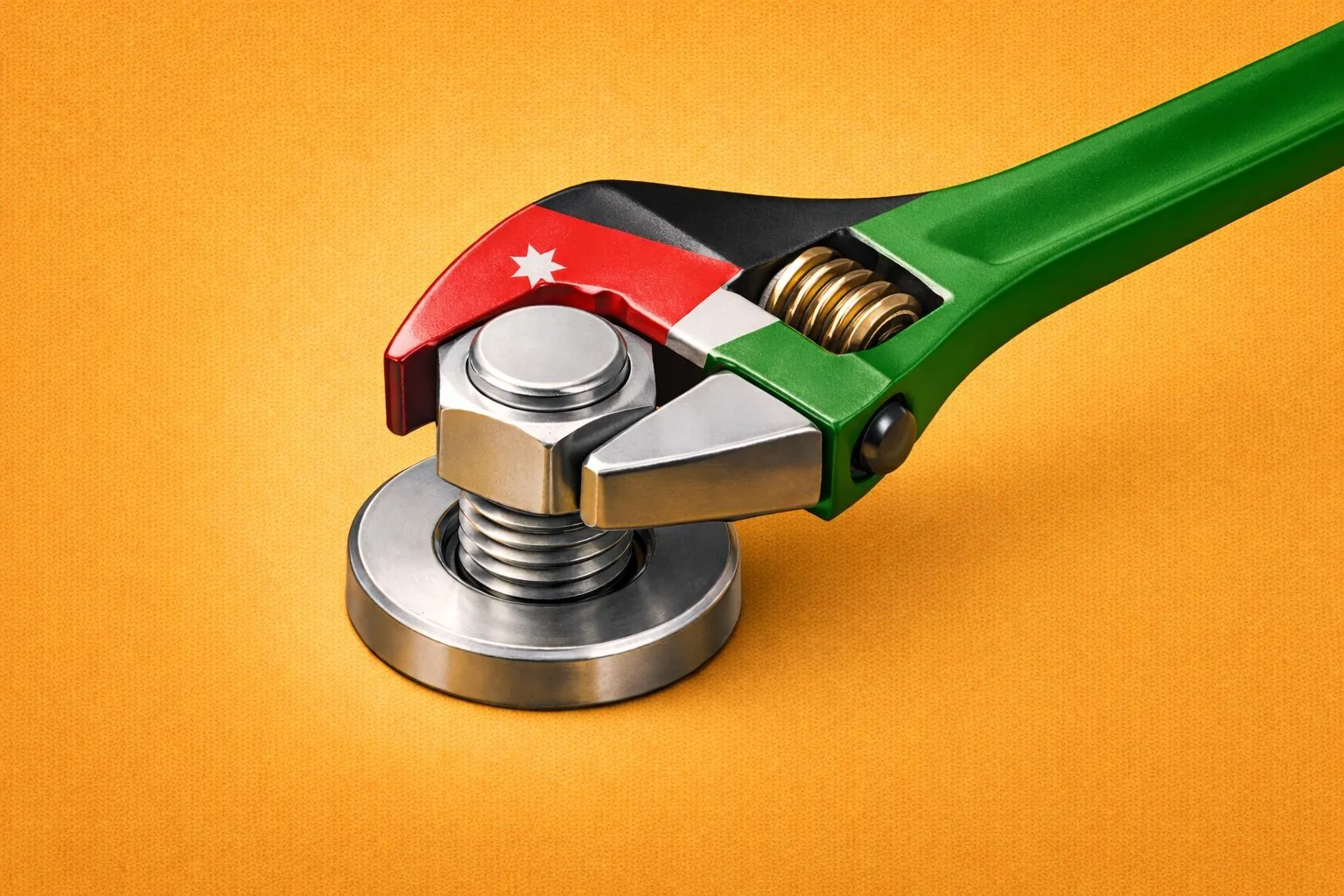
Jordan’s opportunity will be realized not by strategy alone, but by the disciplined execution needed to tighten each loose part of the economic machine.
Every opportunity described so far is real enough to take seriously, but every one of them is also fragile. Jordan’s first constraint is still cost. It remains an energy importer, water scarcity is severe, and transport economics must improve if the country is to become more than a symbolic corridor. The good news is that the government appears to understand this. The Prime Minister’s January 2026 remarks linked industrial competitiveness directly to gas-network expansion and the goal of Risha production covering over 80 percent of gas needs by 2030, while the National Carrier project would deliver 300 million cubic meters of desalinated water annually from Aqaba to Amman. Reuters’ October 2025 report on the $6 billion Aqaba-Amman desalination project reinforces the scale of this ambition. But ambition is not the same as completion. Jordan will capture the geopolitical upside only if water and energy projects actually reduce the cost base felt by firms, households, and industrial zones. Otherwise, the country will still look stable, but too expensive for the scale of opportunity it hopes to attract.
The second constraint is scale. Jordan is not Egypt, Saudi Arabia, or the UAE. It does not have the same domestic market, fiscal firepower, or shipping scale. That sounds like a weakness, but it becomes a strategic weakness only if Jordan pursues the wrong model. The correct response is specialization. Jordan should not try to win every category. It should concentrate on high-trust tourism, Aqaba-centered logistics, medical and educational services, residency-linked quality of life, export processing tied to mining and rail, and selective regional intermediation through Iraq and Syria. In other words, Jordan must become more valuable per unit of scale. That requires precision in policy design: fewer broad promises, more targeted wins. Aqaba, for example, should not be sold as a generic mega-city. It should be sold as a managed Red Sea platform for logistics, living, and long-stay capital. The same is true for Amman’s role in health, education, and professional services. Jordan wins by being highly usable, not by pretending to be massive.
The third constraint is execution speed. Jordan’s policy language is often intelligent; the question is whether implementation can become faster, smoother, and more investor-friendly than in the past. This is where the residency reforms, the one-stop procedures in ASEZA, and the Ministry of Investment’s 14-day residency promise are encouraging. They show that parts of the state are trying to reduce friction. But more is needed: quick land assembly, reliable permits, digitally traceable approvals, faster customs, better dispute resolution, and visible improvement in investor aftercare. For tourism, that means not just marketing, but visitor experience, site management, transport links, and multilingual service. For logistics, it means customs discipline and operating predictability. For residency, it means property registration, municipal services, schooling access, and healthcare integration. Trust is built operationally. Jordan has enough credibility to attract interest; now it must prove that interest will not drown in procedures.
Finally, Jordan must communicate its strategy clearly. The country should present itself as the region’s high-trust platform for selective capital, advanced services, and reopening corridors. That is a far stronger and more believable identity than vague claims about being a generic hub. Jordan can say, with evidence, that it has restored tourism growth, grown FDI, improved Aqaba throughput, expanded investor incentives, eased residency rules, strengthened its medical-tourism platform, and reopened trade with Syria while building faster links through Iraq. These are not slogans. They are the raw materials of a national narrative. If the state tells that story coherently and matches it with execution, then the country can emerge from this period not unscarred, but more valuable. If it fails, then its advantage will remain what it has too often been in the past: understood in theory, under-monetized in practice.
Jordan’s opportunity will be decided less by the war itself than by whether the Kingdom can make specialization, lower friction, and lower operating costs feel concrete to the market.
What the execution goalposts leave us with once optimism is disciplined by state capacity and cost reality: (i) water and energy delivery are preconditions for competitiveness, not side projects; (ii) Jordan’s smaller scale becomes an advantage only if it chooses specialization over imitation; (iii) administrative speed is as important as incentives; (iv) operational trust determines whether interest becomes capital and residency or merely conversation; (v) the country’s narrative will work only if every pillar of the platform story is backed by visible execution.
Close-Out: Jordan’s Best Path Is to Become More Valuable Than Its Size

The strongest case for Jordan is not a case of regional domination. It is a case of strategic overperformance. Jordan can become more valuable than its size because it sits at the intersection of several needs that a war-torn region is likely to intensify: the need for a stable Red Sea outlet, the need for manageable and trusted tourism, the need for medical and educational service exports, the need for selective safe-haven capital placement, the need for long-stay residential options outside the most exposed jurisdictions, and the need for reliable corridors into Iraq and a recovering Syria. Aqaba is the anchor of that vision. Amman is the services brain. The southern rail, mining, gas, and water stack is the productive backbone. The residency and tourism reforms are the soft connectors. Put together, they form something more powerful than a set of isolated initiatives. They form the outline of a platform state—one that does not rely on massive scale, but on making itself unusually useful to flows of people, cargo, care, and capital.
This is also why Jordan’s opportunity may prove intellectually cleaner than Egypt’s. Egypt’s upside is vast but heavily tied to a giant chokepoint and to a much larger and more complex domestic system. Jordan’s upside is narrower, but in some ways easier to design. It does not depend on replacing anyone. It depends on excelling in niches where trust outruns size: medical tourism, targeted residency, logistics quality, corridor facilitation, mining-linked exports, and investor confidence in a smaller jurisdiction that appears politically intelligible. The official data already points in that direction. Tourism recovered in 2025. FDI increased. Aqaba throughput rose. Medical tourism expanded. Syria trade rebounded sharply. Iraq-linked overland routing became faster. Aqaba’s incentive regime remains one of Jordan’s most underused national assets. None of this proves that Jordan will win. It proves that a platform strategy is plausible.
The real test is discipline. Jordan must resist the temptation to overpromise, because overpromising is exactly how smaller states lose credibility. Instead, it should pursue visible, compounding wins: make Aqaba faster and more livable; make rail and dry-port plans real; lower the cost base through gas and water delivery; market medical and wellness tourism as a regional flagship; deepen residency reform; support property-linked but productive long-stay demand; and treat Syria and Iraq corridor normalization as serious economic policy rather than background diplomacy. If it does these things, Jordan can come out of this era stronger not because conflict made it rich, but because conflict made the market value what Jordan could already become. In strategy, that is often the most powerful opening of all: not the chance to become someone else, but the chance to become more fully yourself in a moment when the world suddenly needs it.
Jordan’s true opportunity is not to grow into a giant, but to become the small and serious platform that a fractured region repeatedly finds itself needing.
The set of takeaways: (i) Jordan’s advantage is strategic overperformance, not sheer scale; (ii) the country wins most clearly where trust, quality, and intermediation matter more than size; (iii) Aqaba, Amman, and the southern corridor should be treated as one national system; (iv) the best gains will come from visible compounding wins rather than spectacular promises; (v) if Jordan executes well, the present crisis could end by revealing not a new country, but the latent platform logic of the country it already is.
Jordan will not become the region’s largest economy because of this conflict, but it can become one of the region’s most valuable interfaces if it turns stability, specialization, Aqaba, and corridor intelligence into a disciplined national platform.
OHK has been active in Jordan for more than two decades, supporting clients in understanding how infrastructure, logistics, industrial development, and regional connectivity translate into real economic value. At OHK, we help clients look beyond the rhetoric surrounding corridors, ports, free zones, rail, water, energy, and cross-border trade to assess the institutional, geographic, commercial, and geopolitical conditions that determine whether such initiatives can succeed over the long term. Our work links ambition to implementation by examining demand, state capacity, financing, execution risk, competitiveness, and strategic resilience. Across strategy, planning, and investment assessment, our aim remains consistent: clearer judgment, stronger systems thinking, and more durable outcomes. To discuss how OHK can support your next phase of infrastructure, corridor strategy, and economic transformation in Jordan and the wider region, please contact us.