

30 Quants That Question the Logic of Trojena’s Artificial Lake in the Saudi Desert
An OHK stress test of the lake’s financial, operational, and environmental logic and what it reveals about NEOM’s broader departure from its original master planning vision
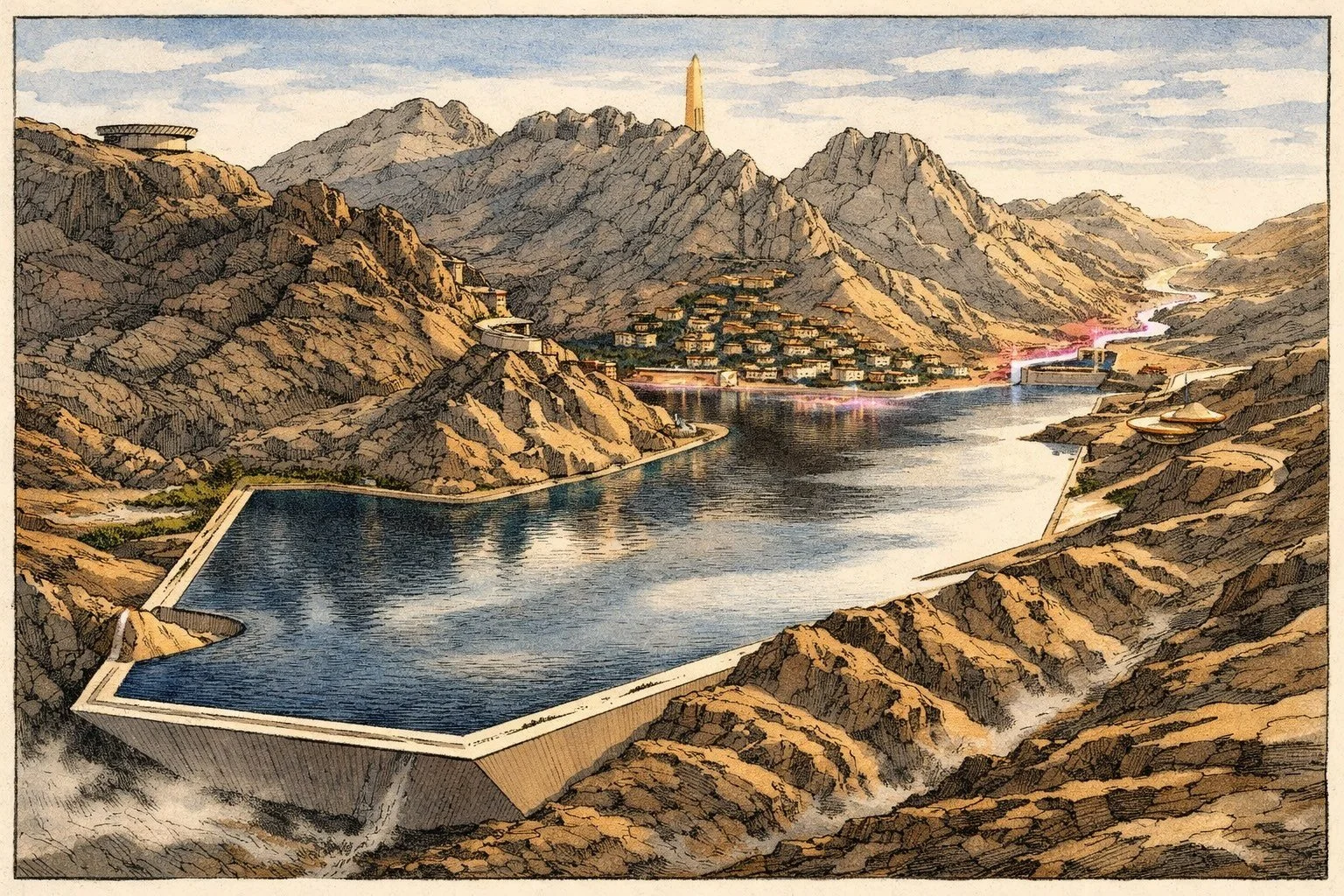
An imagined view of Trojena’s artificial lake, rendered as a landscape illustration: a sharply engineered reservoir set within a rugged mountain valley, where monumental infrastructure meets a highly choreographed vision of leisure urbanism. The image captures the central tension explored in this article, between landscape and imposition, and between territorial logic and spectacle. What appears serene at first glance is, in fact, a deeply constructed environment, held in place by dams, excavation, water management, and continuous technical support. As such, the lake is not merely a visual amenity, but a symbol of a broader planning question: when does ambition cease to work with the land and begin to overpower it?
Because OHK was part of the earliest master planning thinking behind NEOM, we have the unusual vantage point of having seen both the original ambition and the version now taking shape in reality. The distance between the two is no longer minor. What has emerged on the ground often reflects a very different reading of the city and the territory than what was first envisioned. In that context, Trojena’s artificial lake stands out as another departure, less an organic response to landscape and climate than a highly engineered one. This article was not conceived as part of a NEOM series, yet it is ending up as one. Following our full-length piece on The LINE, this project once again compels a broader reflection on how far NEOM’s flagship ideas have drifted from the discipline of planning into the theater of spectacle.
Reading Time: 45 min.
All illustrations are copyrighted and may not be used, reproduced, or distributed without prior written permission.
Summary: Written from the perspective of a team involved in the earliest master planning thinking behind NEOM, this article argues that the lake should not be understood as an isolated engineering gesture or a bold tourism amenity, but as part of a broader pattern in which landscape, infrastructure, and economic logic are increasingly being subordinated to image-making. The article explores the widening gap between NEOM’s original spatial and place vision and what is now taking shape on the ground, the significance of the recent termination of the Trojena lake package, and the reasons this project stands out as another departure from climate-responsive and place-based planning. We then translate those concerns into 30 quantitative benchmarks covering capital intensity, water loss, desalination burden, maintenance complexity, embodied carbon, land transformation, seasonality, engineering scale, commercial thresholds, and water opportunity cost, using globally recognizable comparisons to make the scale legible. The overall arc is: original planning vision versus built reality → Trojena as a departure → cancellation as a moment of reflection → quantified stress test of cost, maintenance, and environmental burden → 30 benchmark comparisons → broader implications for how NEOM’s flagship ideas have moved from urban logic toward spectacle.
Note on Methods: This is a directional commercial and environmental stress test, not a detailed engineering due diligence report. We are using public project parameters for the Trojena lake package: $4.7 billion contract value; 2.8 km lake length; 1.55 km² lake area; 145 m / 84 m / 38 m dam heights; 2.7 million m³ main RCC dam volume; 0.8 million m³ additional RCC; 4.0 million m³ rockfill; 225 m tunnel at 24×10 m section; 0.3 km pipeline; 700,000 annual visitors and 7,000 residents by 2030; three months of snowfall; and a 1,413 km² mountain region with 57 km² dedicated to construction/development. For water and energy, we use scientific/official benchmarks of roughly 3,000 mm/year evaporation in water-stressed reservoirs, 2.5–6 kWh/m³ desalination electricity intensity, and a Saudi grid factor of about 0.56 kg CO₂e/kWh.
Disclaimer: OHK offers this analysis in a constructive spirit and with a clear desire to support the Kingdom’s long-term success, not to criticize for its own sake. As a team that was involved in the earliest master planning thinking, we remain deeply respectful of the scale of Saudi Arabia’s ambition and of the importance of getting transformative projects right. It is also important to note that with the termination taking of this project, the analysis below is not intended as a claim that this exact project is proceeding unchanged, but rather as a broader reflection on why a project of this type raises important questions in principle. Publicly available material had described the terminated contracts as including three dams, a 2.8-kilometer freshwater lake, and “The Bow” built over the main dam. Our purpose in raising these issues is ultimately to contribute to a more grounded conversation about how major projects can better align with the Kingdom’s environmental realities, economic priorities, and original planning vision.
The upfront capital cost is enormous before the project even begins to prove demand: Capital intensity is exceptionally high for an amenity-led asset
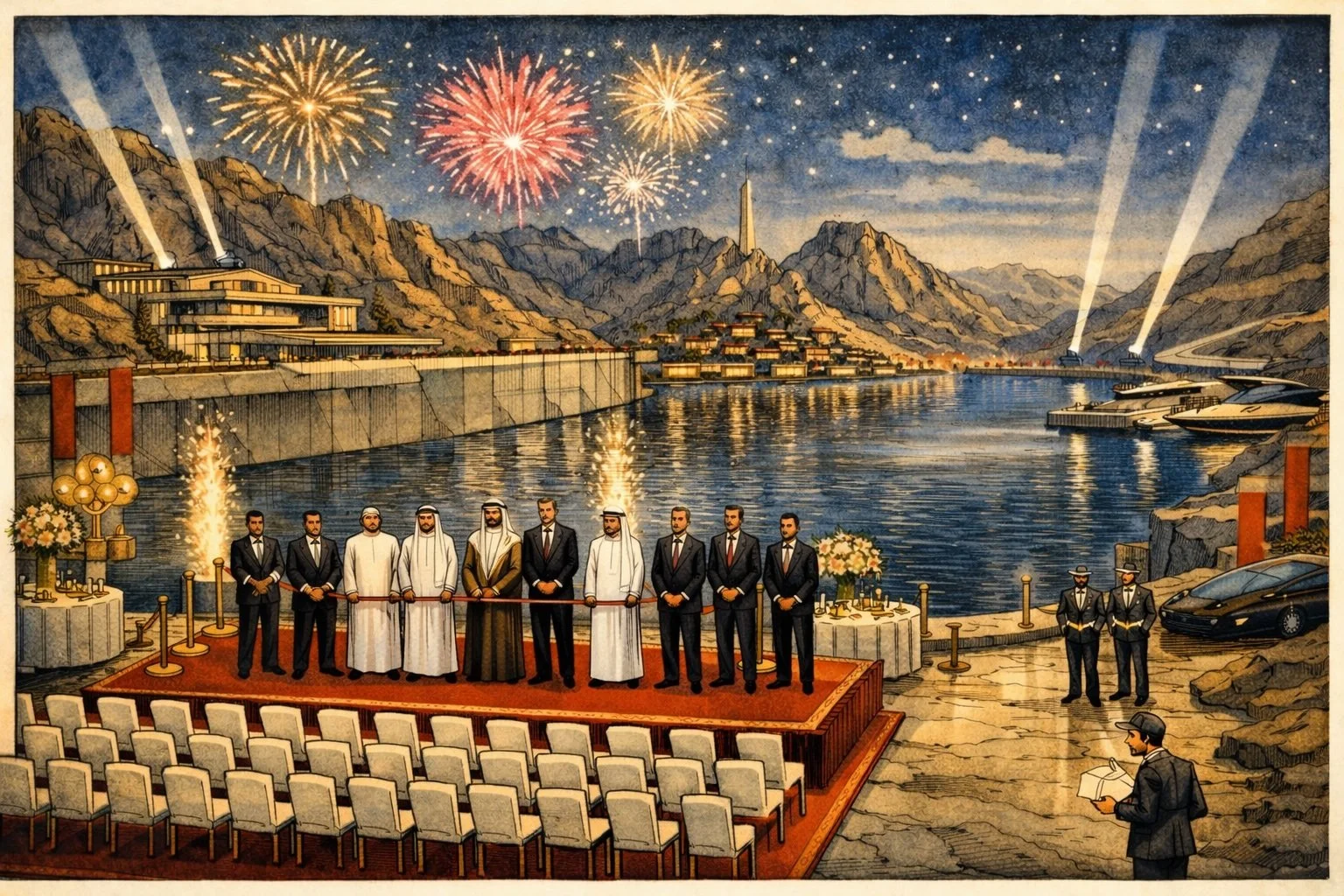
This illustration distills one of the article’s central findings: the project’s capital intensity arrives long before demand has been proven. The infrastructure is complete, polished, and theatrical, yet the audience is missing. That imbalance reflects the broader argument developed here, that Trojena’s artificial lake is not merely an ambitious amenity, but a high-CAPEX, high-maintenance, resource-intensive landscape intervention whose economics depend on exceptional visitor conversion and sustained technical support. In that sense, the scene is less a celebration of arrival than a portrait of exposure: a destination built at monumental scale before the market, the climate, and the long-term logic of place have fully justified it.
A project like this is questionable first because its capital structure is upside down: it requires very large, highly specialized, front-loaded spending long before anyone can know whether the destination will generate enough year-round demand to justify the outlay. In Trojena’s case, the announced package alone was $4.7 billion for the dams, lake works, and “The Bow,” not for the full resort ecosystem around it. Studio Pietrangeli, a project contractor, described a 145-meter roller-compacted concrete dam, a second 84-meter rockfill dam, a third 38-meter concrete dam, a 2.8-kilometer freshwater lake, and associated tunnel and liner works. That means the lake is not a side amenity. It is a major civil-engineering megaproject embedded inside a tourism scheme.
That matters because tourism assets usually work best when capital can be phased. You build a hotel, test demand, add rooms, expand attractions, then iterate. But a man-made alpine lake held by three dams does not scale gently. You commit a huge sum up front to earthworks, concrete, rockfill, geotechnical treatment, waterproofing, and access logistics in a mountain desert environment. If the market underperforms later, the most expensive part cannot easily be repurposed. A half-empty hotel can at least discount rooms. A giant artificial lake and dam complex still has to be monitored, stabilized, powered, and maintained whether visitor numbers are strong or weak. That is why this kind of project has unusually high stranded-asset risk.
The recent contract termination makes that concern stronger, not weaker. When a major contract of this scale is terminated after award, it does not by itself prove the concept was unsound, but it is a warning sign that schedule, affordability, priorities, or project structure may have shifted materially. It is reported that said costs accrued up to termination and demobilization would be reimbursed, which implies that even stopping can be expensive. In other words, the downside of overbuilding appears early, while the upside remains speculative. So the cost problem is not merely “it’s expensive.” The deeper problem is that billions are being locked into fixed infrastructure whose value depends on uncertain tourism flows, uncertain operations, and a built environment that is difficult to simplify later. In normal real-estate development, optionality is valuable. In a project like this, optionality gets sacrificed for spectacle.
What we calculate. We test how much capital is being committed per unit of “experience asset”: per kilometer of lake, per hectare of water surface, and per forecast annual visitor.
Why it matters. These ratios show whether the project is economically flexible or whether it locks in very high sunk cost before demand is proven.
How we calculate it. Using the announced $4.7 billion lake-and-dams package, divided by 2.8 km of lake length, 1.55 km² = 155 hectares of lake area, and 700,000 annual visitors.
Outcome and benchmarks:
$1.68 billion per kilometer of lake. This means each kilometer of artificial lake corridor carries a capital burden larger than the total cost of many globally known landmark buildings. Trojena’s artificial lake sits in a very different cost universe from even some of the world’s best-known man-made lakes. By comparison, Singapore’s Marina Barrage created Marina Reservoir with a S$226 million project cost across a 350-meter barrage, a 240-hectare urban reservoir, and a catchment covering one-sixth of the island; Trojena’s lake package is therefore about 20 times more expensive in headline terms for a far smaller and more specialized water body. At the other end of the scale, Hoover Dam created Lake Mead, a reservoir roughly 180 km long, at a construction cost of about $49 million in the 1930s, commonly cited as about $980 million in today’s dollars, meaning Trojena’s lake package alone is about 4.8 times that cost while producing a lake only 2.8 km long. In simple terms, Trojena’s cost density is not merely high for a resort feature; it is extraordinary even when set beside historic lake-making projects of far greater territorial scale.
$30.3 million per hectare of lake surface. This is an extremely high capital intensity for a water body whose function is primarily recreational and branding-led rather than utility-led. Trojena’s artificial lake is not just expensive; it is extreme even by the standards of major reservoir projects. For comparison, the proposed Indio River reservoir for the Panama Canal has been reported at about $1.5 billion over roughly 4,600 hectares, which implies a capital intensity of about $0.33 million per hectare. That would make Trojena roughly 93 times more capital-intensive per hectare. At a much larger historical scale, the Three Gorges project in China is widely cited at about $31.8 billion with a reservoir area of about 1,084 km², or 108,400 hectares, implying roughly $0.29 million per hectare. On that basis, Trojena comes out at about 103 times the per-hectare capital intensity of one of the world’s largest and most consequential reservoir systems. In other words, this is not merely a costly lake; it is a recreational and branding-led water body priced at a density far beyond even major utility-scale reservoir benchmarks.
$6,714 of CAPEX per projected annual visitor. Put differently, the physical lake package alone costs roughly 4.4 times Saudi Arabia’s 2024 average inbound visitor spend per trip of about $1,513. That does not prove failure, but it does indicate a very demanding commercial conversion threshold. A revealing benchmark is to compare the $4.7 billion terminated package not to one visitor’s spend, but to the annual tourism economy of established lake destinations. In 2024, visitors to the Reno–Tahoe economy spent about $3.4 billion, while Travel North Tahoe Nevada has described direct spending across the wider Lake Tahoe tourism economy as just under $5 billion; by comparison, Trojena’s lake alone is equivalent to roughly 1.4 years of Reno–Tahoe visitor spending or nearly a full year of the broader Lake Tahoe tourism economy. Lake Mead is an even sharper contrast: in 2024, 6.4 million visitors spent about $408 million in communities around the Lake Mead park, which means Trojena’s lake is equivalent to roughly 11.5 years of Lake Mead visitor spending. This shows that the asset starts with a capital burden comparable to the annual tourism economy of one of the world’s best-known lake regions and more than a decade of spending around another.
This is not the cost profile of a resort amenity; it is the capital profile of a landmark infrastructure project disguised as one.
For planners, designers, and engineers, the lesson here is clear: (i) capital intensity must be tested against the true necessity of the intervention rather than the attractiveness of the image, (ii) signature infrastructure should only be introduced when its public and economic value is demonstrably higher than lighter alternatives, (iii) the larger the fixed upfront investment, the greater the need for phasing and optionality, (iv) amenity-led projects should be designed so that demand can validate expansion rather than the other way around, and (v) master planning should distinguish rigorously between what is essential to place-making and what is simply expensive to dramatize.
Maintenance costs do not end with construction; they begin there: Evaporation alone creates a permanent replacement-water burden
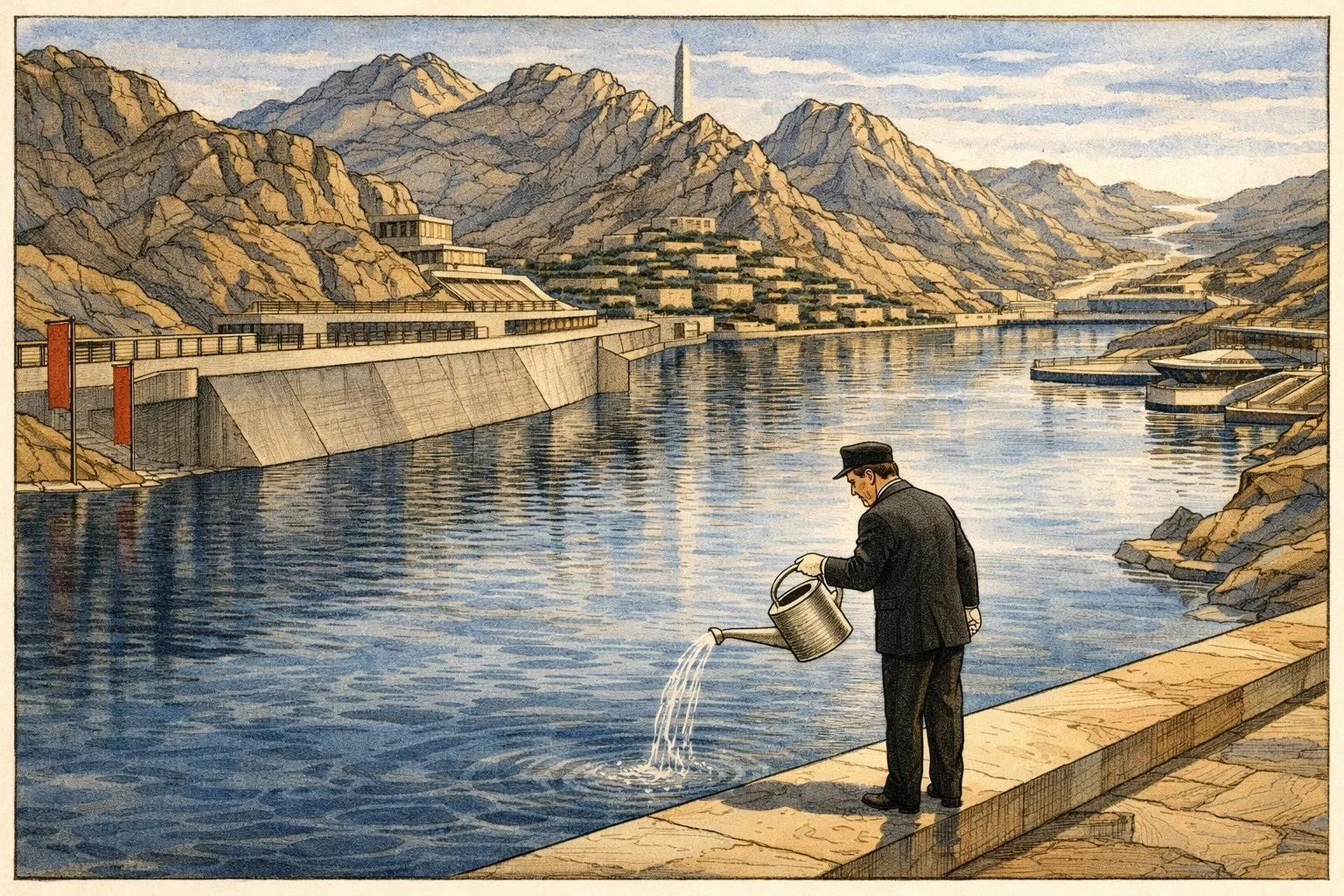
This illustration captures one of the article’s clearest arguments: maintenance does not begin after construction; it begins with it. The lake appears finished, calm, and monumental, yet the tiny act of pouring water into it reveals the deeper reality. What looks like a completed landscape is, in fact, a continuous operational obligation, one that must be sustained through replenishment, water management, energy input, and long-term technical care. In the context of Trojena, the image gives visual form to a central finding of the analysis: that evaporation alone creates a permanent replacement-water burden, turning what seems like a static amenity into a system that must be continually fed in order to preserve the illusion of permanence.
The second reason is that even if the engineering works are successfully built, the operating burden can remain punishing for decades. Dams and reservoirs require inspections, slope monitoring, seepage control, instrumentation, spillway maintenance, liner integrity checks, sediment management, emergency planning, and specialized staffing. Add to that a resort district, water-quality management, pumping systems, tunnels, landscaping, public-space cleaning, hospitality services, and a signature structure suspended above a valley, and the maintenance stack becomes unusually layered and permanent. The project description framed the contract as both water infrastructure and landmark architecture, which means the site must function simultaneously as utility asset, safety-critical structure, and premium destination product.
Water itself raises recurring costs. NEOM promotes a circular water supply, while Saudi Arabia as a whole has long depended heavily on desalination because of severe water scarcity. The World Bank notes desalination’s central role in water-scarce regions, and the IEA has highlighted rising energy demand in the Middle East and North Africa partly because of desalination. If freshwater for Trojena must be produced, transported, pumped uphill, treated, recirculated, or replaced after losses, then the resort effectively imports operating cost every day. That is very different from a resort built around a naturally replenished lake or river system.
Then there is the mountain-desert setting. Remote sites typically increase the cost of every routine task: spare parts, specialist crews, heavy-equipment access, emergency response, corrosion control, and weather-related wear. A leak in a liner, biofouling in pumps, cracking in exposed concrete, or a problem in a tunnel is not just a maintenance event. It can become a logistics event. The more iconic the architecture, the less forgiving maintenance tends to be, because visible deterioration undermines the premium brand. That pushes operators toward constant intervention.
There is also a financial asymmetry here. Visitors may pay for views, activities, and novelty, but they do not directly pay for sediment removal, dam instrumentation, hydro-mechanical inspections, or water chemistry balancing. Those costs sit in the background, year after year, regardless of occupancy. That is why these projects can look glamorous in renderings yet prove structurally expensive in real life. A normal resort can mothball a wing if demand drops. A dam-lake system cannot simply be “turned off.” It must be managed continuously because neglect becomes a safety issue, not just an aesthetic one.
What we calculate. We quantify annual evaporative loss from the lake, the daily replenishment requirement, and the scale in familiar global units.
Why it matters. In a dry region, water loss is not a side issue. It becomes a core operating burden.
How we calculate it. Lake area 1.55 million m² multiplied by ~3 meters/year evaporation gives annual loss volume. We use 3 meters per year as an upper stress-test evaporation case, not as a claim of exact annual loss. Because the proposed lake sits at roughly 2,000 meters elevation in a mountain environment, actual evaporation would depend on final lake geometry, depth, exposure, wind, humidity, and operating conditions. But for feasibility analysis, the purpose of the figure is to test whether the concept still holds under a demanding yet plausible upper-end arid-climate scenario. In that sense, the 3-meter assumption is not false precision, but a directional stress test of the replacement-water burden.
Outcome and benchmarks:
4.65 million m³ of water lost per year to evaporation at a 3 m/year assumption. To put that in perspective, Lake Mead’s average annual evaporation has been estimated by the USGS at about 1,079 million m³, meaning Trojena’s yearly evaporative loss would equal roughly 0.43% of Lake Mead’s. Put differently, Lake Mead loses a Trojena-sized annual evaporation volume in only about 1.6 days. A second benchmark comes from the Dead Sea, whose average annual inflow has been estimated at roughly 265–325 million m³ per year; on that basis, Trojena’s annual evaporation would amount to about 1.4% to 1.8% of the Dead Sea’s yearly inflow. The point is not that Trojena rivals these lakes in scale, but that even a relatively small luxury lake in an arid setting can carry a hydrological burden that is materially significant when measured against much larger and much better-known water bodies.
Average replacement requirement equals 12,740 m³ per day. This is roughly 0.05% of Lake Nasser’s average daily evaporative loss and about 0.39% of Lake Powell’s estimated daily evaporation at full-pool conditions. Yet those percentages have to be read in context. Lake Nasser underpins the Aswan High Dam system, supporting national-scale irrigation storage, flood control, and hydropower, while Lake Powell functions as a strategic drought reserve and hydropower reservoir for the Colorado River system. In other words, Trojena’s daily replacement need may be tiny beside those reservoirs, but unlike them it would be incurred not in service of national water security or regional utility infrastructure, but to sustain a highly engineered leisure landscape.
That is equivalent to about 1,860 Olympic-size pools per year, using a 50 m × 25 m × 2 m benchmark pool volume of roughly 2,500 m³. This is the scale of water one must effectively recreate every year just to hold the visual and recreational product steady. By comparison, a publicly compiled UK inventory lists only 11 Olympic-standard 50 m pools across the entire country. In other words, Trojena’s annual evaporative loss would equal enough water to fill Britain’s Olympic-standard pool stock nearly 169 times over every year, simply to keep a branded artificial lake visually full.
The lake does not simply need to be built once; in climatic terms, it has to be rebuilt in water every year.
For planners, designers, and engineers, this section underlines five important principles: (i) water bodies in arid climates must be evaluated first as hydrological liabilities before they are marketed as visual assets, (ii) evaporation should be treated as a design-defining parameter rather than a secondary operating issue, (iii) surface area, depth, orientation, and exposure must all be shaped to reduce long-term loss, (iv) any project that depends on permanent replenishment should be tested against less water-intensive alternatives, and (v) good planning in water-scarce regions begins by respecting scarcity rather than concealing it behind spectacle.
In an arid climate, evaporation and water loss are not side issues; they are central: Replacing evaporative loss with desalinated water carries a real energy and carbon cost
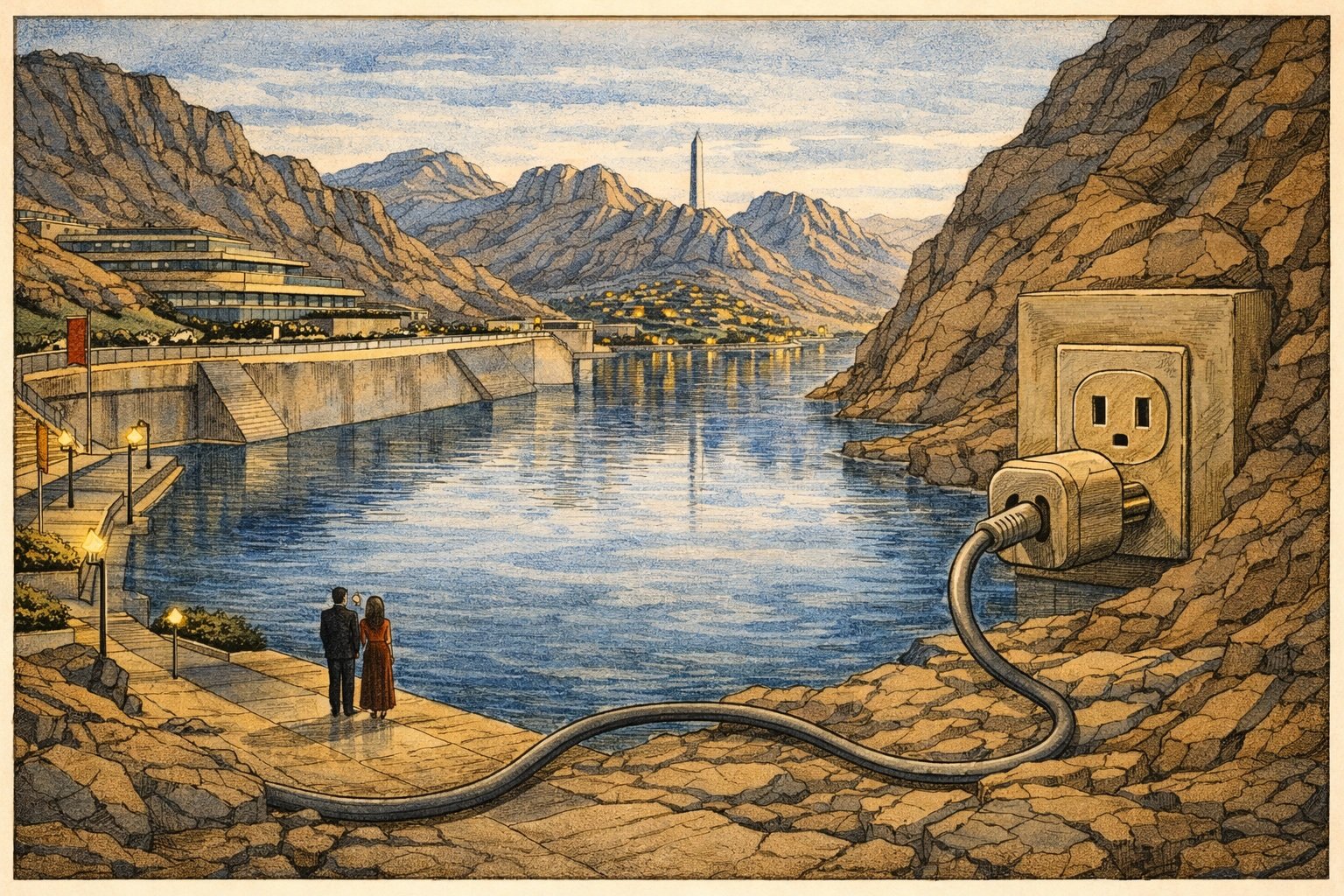
This illustration gives visual form to one of the article’s central arguments: in an arid climate, water loss is not a side issue but a permanent operational condition. The serene lake appears natural and complete, yet the oversized plug reveals the deeper logic beneath the image. What must be replaced through desalination must also be powered, pumped, and paid for. In that sense, the lake does not simply sit in the landscape; it is continuously produced by energy and infrastructure. The image captures the article’s broader point that evaporative loss is not only a water question, but also an energy and carbon question built into the project from the start.
The third reason is that a large open freshwater surface in or near an arid environment has a built-in enemy: evaporation. Research summarized through FAO AGRIS notes that evaporation from reservoirs in arid and semi-arid areas can greatly reduce the effective use of stored water. Other studies on hyper-arid reservoirs likewise focus on evaporation as a major design and management issue. So even before debating whether the lake is technically feasible, one has to ask a simpler question: how much water will be lost simply by existing?
That problem matters more here because the lake is not being created primarily to secure scarce agricultural or municipal supply. It is being created as the centerpiece of a leisure district. Studio Pietrangeli describes it as a 2.8-kilometer artificial freshwater lake, including an island for botanical exploration and walking. NEOM describes the Valley cluster around the lake as a place for kayaking, paddleboarding, and water biking. In other words, this is not just a storage basin with secondary public use. It is a destination lake whose visual and recreational value depends on remaining full, clean, and attractive. That means water losses are not acceptable background inefficiency; they directly threaten the visitor experience the project is meant to sell.
To compensate for evaporation, operators would need replenishment. That replenishment has to come from somewhere: local capture, imported water, desalinated supply, or some blend. Each option carries cost, infrastructure burden, and environmental tradeoffs. If the lake level falls, the project either accepts degraded aesthetics and reduced activities or spends more water and energy to maintain the illusion of abundance. That is a bad structural position for any resort, because it turns climate into an ongoing operating tax.
Losses are not only from evaporation. Large artificial basins can also face seepage risk, liner aging, shoreline erosion, and water-quality decline. Once a resort is built around a lake edge, even small fluctuations in level or quality become reputationally visible. Guests notice murky water, algae, exposed banks, or access restrictions. So the project is not merely fighting hydrology. It is fighting hydrology while promising luxury. That is why an artificial freshwater lake in a dry mountain region is environmentally and economically questionable: it creates a permanent requirement to defeat natural loss processes in order to preserve a man-made image of abundance.
What we calculate. We estimate the electricity needed to replace evaporative loss with desalinated water, then translate that into carbon and population-scale electricity equivalents.
Why it matters. This is where a “beautiful lake” becomes an energy system.
How we calculate it. We apply the IEA desalination range of 2.5–6 kWh/m³ to the 4.65 million m³/year replacement volume, then apply a Saudi grid factor of about 0.56 kg CO₂e/kWh.
Outcome and benchmarks:
11.6–27.9 GWh/year of electricity just to replace evaporation. It is equivalent to roughly 0.95 to 2.28 times the Sydney Opera House’s annual electricity use, based on the Opera House’s reported 12,221 MWh of electricity consumption in FY2021. Put differently, just maintaining the lake’s water level against evaporation could require anywhere from almost one to more than two Sydney Opera Houses’ worth of annual electricity. That comparison is especially striking because the Opera House is not merely an iconic building; It is estimated that in FY2022–23 it generated A$1.2 billion in economic value for New South Wales, including A$824 million from tourism alone. In other words, Trojena’s evaporative replacement energy could approach or exceed the annual electricity use of a cultural asset that contributes more than a billion Australian dollars a year to the economy.
That implies roughly 6,510–15,624 tonnes CO₂e per year if powered at current grid intensity. Using the EPA benchmark of 4.6 tonnes CO₂ per passenger vehicle per year, that is comparable to the annual emissions of about 1,415 to 3,396 cars.
In electricity terms, that is enough to cover the annual per-capita electricity use of roughly 7,650 to 18,355 people in Saudi Arabia, using IEA’s 1.52 MWh per capita benchmark. So even the evaporative make-up water alone can carry a city-scale energy signature.
What appears visually as a lake functions operationally as a permanent energy-dependent water machine.
For planners, designers, and engineers, the broader lesson is that (i) every water decision in an arid region is also an energy decision, (ii) operational energy should be modeled as seriously as embodied construction cost, (iii) designs that appear passive but rely on continuous mechanical or utility support should be identified early for what they are, (iv) resilience is strengthened when environmental performance depends less on constant technical compensation, and (v) planning should prioritize systems whose beauty and usefulness remain credible even when energy becomes more costly, constrained, or politically sensitive.
The water source itself creates a hard ethical and economic question: The maintenance burden is large because the asset base itself is unusually extensive
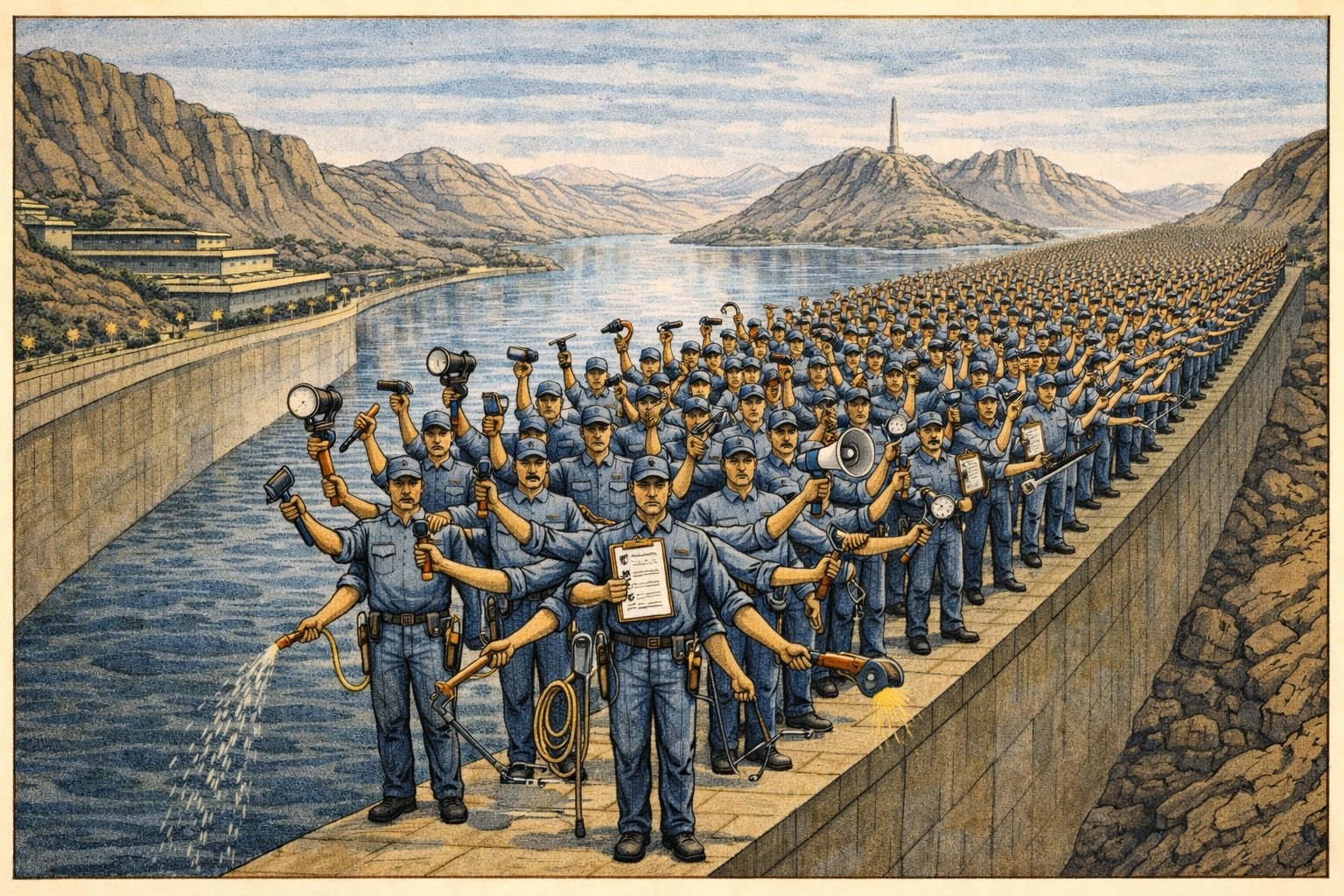
This illustration translates one of the article’s central findings into a single image: the maintenance burden does not sit at the margins of the project; it is built into its very scale. The many-armed workers stand in for the impossible range of tasks required to keep such an engineered landscape functioning as intended. What appears from a distance to be a singular, serene destination is, in practice, an extensive operational estate of surfaces, systems, edges, structures, and water that must all be monitored, repaired, and sustained at once. The image makes the article’s deeper point visible: the challenge is not only building permanence, but maintaining it continuously.
The fourth reason is that every liter committed to a prestige lake has an opportunity cost. Saudi Arabia is one of the world’s most water-stressed countries and has long relied on desalination to meet demand. The World Bank and other sources treat desalination as indispensable in such settings, not because it is cheap or simple, but because natural freshwater is limited. So when a project proposes a large artificial freshwater body for leisure in a water-scarce region, the key question is not only “can it be done?” but “what other uses of water, energy, and money are being crowded out to do it?”
That question becomes sharper because Trojena is not a local village reservoir. It is part of a luxury tourism and real-estate vision tied to Vision 2030 and the 2029 Asian Winter Games. NEOM promotes recreation on the lake and skiing in the mountains. There is nothing inherently wrong with tourism, but a freshwater spectacle in a dry region invites scrutiny because it symbolizes allocation choices very clearly. The same infrastructure that can create premium leisure value could also have been directed toward resilience, municipal efficiency, leak reduction, wastewater reuse, or less water-intensive tourism.
There is also a public-legitimacy problem. Megaprojects often defend themselves by saying they attract investment, jobs, and diversification. Sometimes that is true. But if the project relies on resource inputs that are socially scarce, then the bar should be higher. It is harder to argue that a mountain leisure lake is the best use of high-value desalinated water, pumping energy, and engineering capacity than it would be to justify housing, transport, or industrial water systems. The more artificial the attraction, the more the resource allocation has to be defended in public-interest terms, not just branding terms.
And because desalination links water to power, the water question is also an energy question. The IEA has repeatedly linked desalination with rising electricity demand in the region so the “opportunity cost” is double: using scarce capital and scarce low-carbon electricity to sustain an amenity that nature does not provide there. That is why the project feels questionable on first principles. It is not simply an expensive lake. It is a system that potentially converts energy into prestige water in a country where water security is already a strategic issue.
What we calculate. We quantify the physical asset surfaces and interfaces that must be maintained: crest length, liner area, and underground civil works.
Why it matters. Maintenance cost follows asset complexity. A large resort can scale staffing up or down; a dam-lake system cannot avoid baseline stewardship.
How we calculate it. We sum the crest lengths (475 m + 490 m + 700 m), use the stated 1.55 km² lakebed liner area, and calculate tunnel excavation volume from 225 m × 24 m × 10 m.
Outcome and benchmarks:
1,665 meters of dam crest require inspection and upkeep. That is the length of nearly 16 FIFA-standard pitch lengths laid end to end. The dam crest system is longer than Hoover Dam’s crest by about 4.4 times and longer than Glen Canyon Dam’s by about 3.5 times, while still amounting to only about 43% of the Aswan High Dam’s 3,830-meter crest. That is precisely what makes the benchmark revealing: Trojena is already operating at the dimensional scale of famous utility dams, but in support of a tourism-led artificial lake rather than irrigation, flood management, or large-scale power generation.
1.55 km² of lakebed liner must remain intact. That is about 217 FIFA-standard football pitches of liner surface. The liner area equals roughly 45% of Central Park. That comparison matters because Central Park is not only a famous landscape; it supports more than $1 billion in annual economic activity and revenue for New York City. In other words, Trojena would require maintaining a hidden artificial liner surface approaching half the area of a park that generates city-scale public and economic value, yet here that surface would exist primarily to preserve the visual permanence of a branded artificial lake.
The tunnel volume alone is 54,000 m³, equivalent to about 22 Olympic pools of underground space. That is before adding the pipeline, lake-edge infrastructure, pumps, public realm, and hospitality interfaces. The tunnel volume is already in the territory of real transport infrastructure. It is equivalent to a full Silvertown-scale tunnel bore in London and, while much smaller than the Channel Tunnel, it still amounts to about 2.4% of one of its 50.5-kilometer rail bores. For a leisure-led lake project, that is a telling benchmark: the hidden support infrastructure is beginning to resemble metropolitan tunnelling rather than background resort engineering.
The true project is not only the lake people see, but the continuous maintenance estate they do not.
For planners, designers, and engineers, this section points to a familiar but often neglected truth: (i) every dramatic structure creates an invisible maintenance estate behind it, (ii) lifecycle stewardship must be designed at concept stage rather than added as a facilities concern later, (iii) linear assets, liners, tunnels, and water-control structures should be valued not only by how they perform on opening day but by how inspectable and repairable they remain over decades, (iv) the more complex the system, the more institutional discipline it demands, and (v) durable planning favors forms and systems that reduce hidden operational burden rather than multiplying it.
The carbon footprint of construction is likely to be huge even before operations are counted: The material and embodied-carbon burden is very large even before resort operations begin
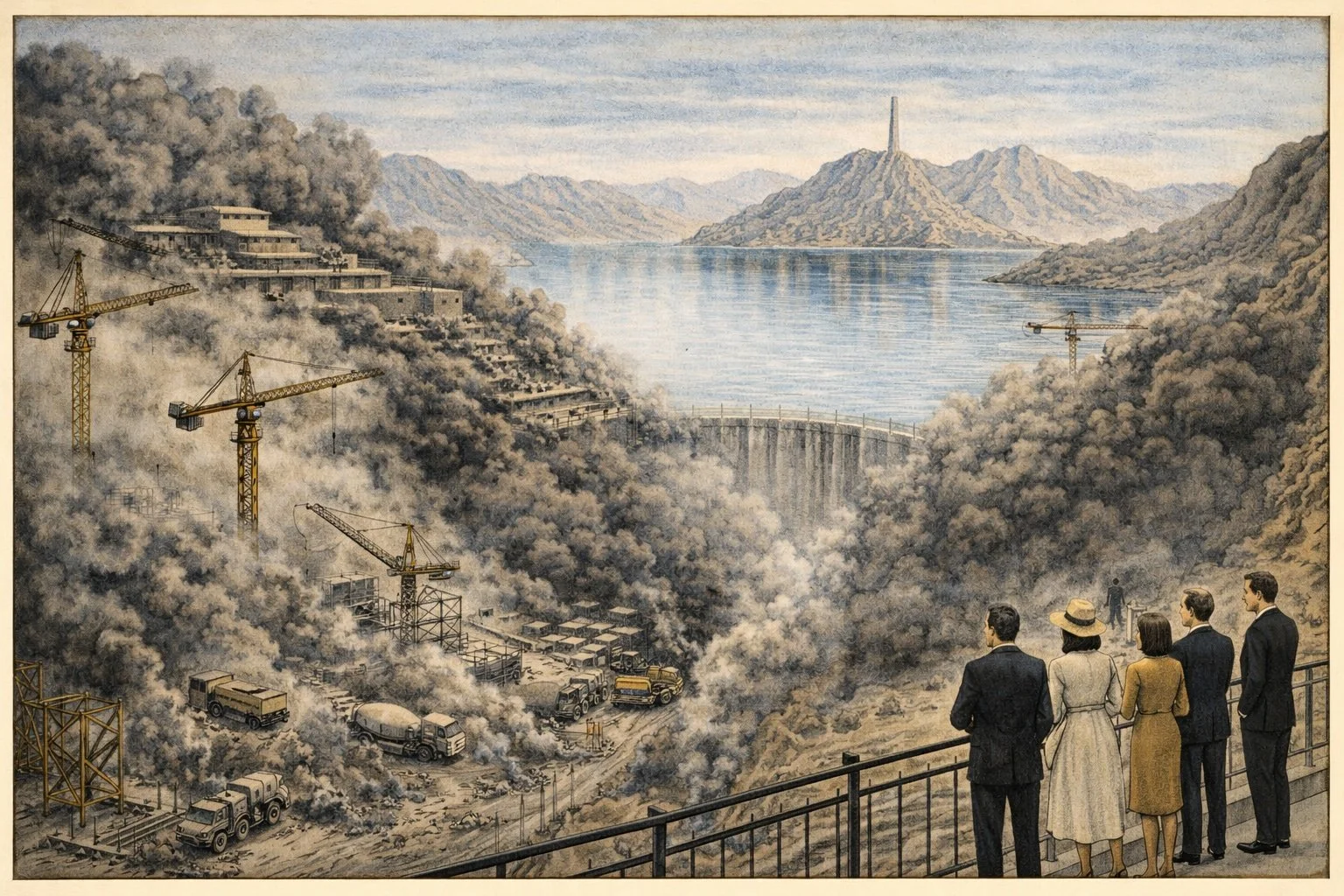
This illustration captures one of the article’s central arguments: the environmental burden of the project begins long before the first visitor arrives. The lake appears serene in the distance, but the dam, terraces, and resort seem to rise out of smoke, dust, cement, and exhaust, making visible what development rhetoric often hides. In Trojena’s case, the issue is not only how the destination would operate, but what it must first consume in materials, excavation, transport, and embodied carbon in order to exist at all. The image turns that logic into a single scene: a landscape of beauty whose permanence is being assembled, quite literally, out of emissions.
The fifth reason is embodied carbon. Even if a developer plans to power operations with cleaner electricity later, the act of constructing three dams, a lined artificial lake, mountain roads, tunnels, utilities, hotels, lifts, cooling systems, and a giant overhanging structure requires extraordinary material throughput. Concrete, steel, quarrying, blasting, excavation, transport, and heavy machinery all carry major emissions. The project announcement described more than 10,000 people, including direct and third-party personnel, being involved in construction. That gives a sense of scale before one even counts the full resort, supporting infrastructure, and associated real estate.
This matters because environmental marketing often emphasizes operating-stage sustainability while downplaying construction-stage emissions. A project may claim renewable power, circular water, conservation zones, or net-positive biodiversity aspirations. NEOM does make broad commitments on environmental protection, protected areas, circular water supply, and biodiversity. But those commitments do not erase the embedded carbon in mass concrete, steel fabrication, transport logistics, and extensive earthworks. Critics of NEOM have highlighted that problem directly, arguing that the material and construction footprint could offset much of the sustainability narrative.
The lake concept makes the embodied-carbon issue worse because it adds infrastructure whose main purpose is not unavoidable public utility but destination-making. If a city needs a water dam for essential supply, the climate case may still be argued on necessity grounds. Here, the emissions are being spent to manufacture a landscape effect: a freshwater mountain lake where one does not naturally exist at that scale and permanence. That makes the carbon harder to justify, because the same ton of cement or steel could serve more basic or more productive purposes elsewhere.
There is also a temporal mismatch. The emissions from construction are immediate. The promised economic and environmental gains are distant and uncertain. If demand underwhelms, if operations prove expensive, or if plans are scaled back, then the construction carbon has already been spent. The reported termination of the project contract reinforces that concern: a project can incur heavy environmental cost during the building phase even if the final vision changes or stalls. That is one reason megaprojects can be environmentally questionable even when they market themselves as green. The harm comes early and concretely; the benefits often arrive late, conditionally, or not at full scale.
What we calculate. We estimate total dam material volume, RCC volume, and directional embodied carbon from the concrete portion.
Why it matters. Even if later operations are powered more cleanly, embodied emissions are paid upfront.
How we calculate it. We use public material volumes: 2.7 million m³ main RCC dam, 0.8 million m³ additional RCC, and 4.0 million m³ rockfill. For directional embodied carbon, we use the WEF’s cited order of magnitude of up to 300 kg CO₂ per m³ of conventional concrete.
Outcome and benchmarks:
7.5 million m³ of combined major dam material. In volume terms, that is about 3,000 Olympic pools of material. Trojena’s major dams is already on the scale of large national infrastructure. It equals about 17% of the Aswan High Dam’s total embankment volume of 44.3 million m³, and about 2.9 times the Great Pyramid of Giza’s volume, which is commonly estimated at roughly 2.6 million m³. In other words, even before asking whether the lake makes planning sense, the project is already committing material at a scale that begins to register against one of the Arab world’s great hydraulic works and exceeds one of the world’s most iconic monuments several times over.
3.5 million m³ of RCC concrete across the two stated RCC dams. Trojena’s dam material is already in the range of serious national infrastructure: nearly twice the total concrete in Glen Canyon Dam and more than one-quarter of the freshwater dredging volume undertaken for the Panama Canal expansion. For a tourism-oriented lake package, that is an unusually heavy material commitment.
At 300 kg CO₂/m³, that concrete alone implies up to roughly 1.05 million tonnes of CO₂ before counting steel, transport, buildings, roads, or mechanical systems. Using EPA’s 4.6 tonnes CO₂/year per passenger vehicle, that is comparable to the annual emissions of about 228,000 cars. But another way to read it is this: if Three Gorges Dam incorporates about 28 million m³ of concrete, then Trojena’s 3.5 million m³ of RCC is about 12.5% of that volume. In other words, this leisure-oriented lake could lock in roughly one-eighth of the concrete volume of one of the world’s largest hydroelectric dams, before counting steel, transport, roads, buildings, or mechanical systems.
Before the project proves its value, it has already spent a megaproject’s worth of material and carbon.
For planners, designers, and engineers, the key implications are that (i) material volume is not neutral and should be treated as a first-order planning question, (ii) embodied carbon must be considered alongside operational sustainability claims from the beginning, (iii) large-scale concrete and earthworks require a higher threshold of public justification when they serve discretionary rather than essential functions, (iv) low-carbon thinking is not only about material substitution but about asking whether the scale of intervention itself is necessary, and (v) the most responsible projects are often those that achieve identity through spatial intelligence rather than sheer material force.
Fragile mountain ecosystems are easier to damage than to restore: The ecological footprint is substantial in absolute land terms
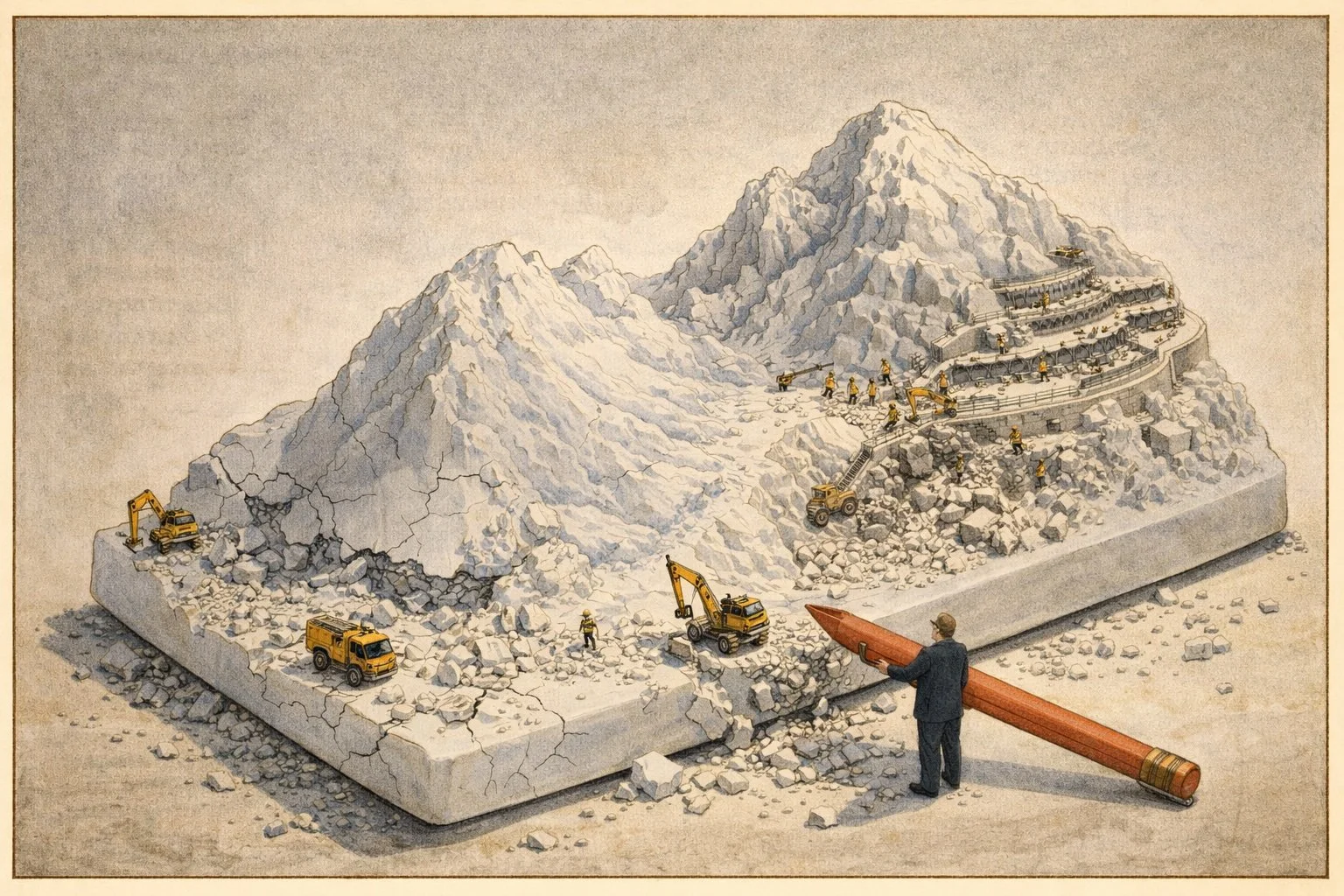
This illustration gives visual form to one of the article’s ecological arguments: fragile mountain systems are far easier to damage than to restore. By rendering the terrain as porcelain, the image makes visible what planning drawings often conceal, namely that landscapes can appear monumental while remaining deeply vulnerable to incision, fragmentation, and cumulative disturbance. The tiny machines and crews seem orderly, even precise, yet their work leaves behind cracks, breakage, and irreversible marks. In the context of Trojena, the point is not only that the footprint is large in absolute land terms, but that the act of transforming such terrain is never as reversible as the neatness of the plan suggests.
The sixth reason is ecological disturbance. Jabal al-Lawz and the surrounding highlands are not blank space. Key Biodiversity Areas information describes the broader mountain group as having peaks above 2,000 meters, permanent running water in places, densely vegetated rocky high-mountain habitats, and clear ecological zoning. UNESCO’s tentative-list material on bioclimatic refugia notes that Jabal ad-Dubbagh / Jabal al-Lawz lies within the NEOM project area and is zoned for nature conservation and restoration. NEOM itself has publicized biodiversity discoveries and broad conservation ambitions in the region. All of that means the area is ecologically significant enough that major landscape engineering deserves a very high burden of proof.
Large dam and resort works fragment habitat through roads, blasting, noise, lighting, traffic, workforce camps, slope stabilization, and altered drainage. Even if only part of the zone is intensively built, mountain ecosystems often depend on connectivity, seasonal runoff patterns, and relatively low disturbance. A freshwater leisure lake also changes local ecological conditions: shoreline habitats become artificial, new landscaping may introduce non-native species, and visitor pressure rises in areas that previously had limited footfall. The problem is not just direct land take. It is the conversion of an ecological landscape into a performance landscape optimized for access, views, and recreation.
Artificial snow, if pursued at meaningful scale, adds another layer of stress. Trojena’s planned ski slopes were likely to endanger mountain biodiversity because of artificial snow use and the project’s wider water demand. One can debate their broader framing, but the ecological concern itself is straightforward: snowmaking, grooming, piste preparation, road access, and hospitality development all intensify land-use pressure in places where habitats evolved without those systems.
The hardest part environmentally is that restoration after heavy intervention is not the same as preservation before it. A developer can replant, offset, monitor, and create protected zones, but once drainage, slopes, vegetation patterns, and wildlife behavior are changed by megascale construction, returning to the original ecological condition is often impossible. So the environmental skepticism is not just ideological. It reflects the asymmetry between the speed of disturbance and the slow, uncertain pace of ecological recovery.
What we calculate. We test how large the development footprint is within the wider mountain region and compare it with familiar urban landscape scales.
Why it matters. Ecological fragmentation is partly a function of how much landscape is converted, not just what is built.
How we calculate it. We use Vision 2030’s figures of 1,413 km² mountain region and 57 km² dedicated to construction and development, alongside the 1.55 km² lake area.
Outcome and benchmarks:
57 km² of construction/development area is about 4.0% of the full mountain region. That percentage may sound limited, but in absolute terms it is almost the size of Manhattan itself (the U.S. Census gives Manhattan a land area of 22.7 square miles, or about 58.8 km²). In other words, the footprint dedicated to construction is not a small enclave in the mountains, but a district-scale intervention approaching the land area of one of the world’s most recognizable urban territories.
That construction footprint is about 16.7 Central Parks, using Central Park’s 843 acres. The comparison matters not only because of area, but because of function. Central Park alone receives around 42 million visits annually, supports more than 18,000 trees, removes roughly 1 million pounds of CO₂ from the air each year, and provides habitat for over 200 bird species, while serving the daily recreational and environmental needs of Manhattan’s roughly 1.6 million residents. Put differently, 16.7 Central Parks would ordinarily describe an enormous civic and ecological asset at metropolitan scale. At Trojena, that same order of land area is being mobilized instead as a development footprint.
The lake alone, at 1.55 km², would cover roughly 74% of Monaco’s 2.084 km² territory. That matters because Monaco is not just small; it is one of the most economically productive territories in the world, with official 2024 GDP of €10.279 billion. Put differently, the lake’s footprint would approach three-quarters of the land area of a sovereign state that supports over €10 billion in annual economic output. This is not a minor visual feature. It is a territorial-scale intervention. It is larger than Hyde Park in London, which covers about 142 hectares, or 1.42 km². In other words, a water body slightly larger than one of the world’s most recognizable urban parks.
This is not a light-touch insertion into the landscape; it is a landscape-scale act of replacement.
For planners, designers, and engineers, this section reinforces that (i) land transformation should be measured in ecosystem terms, not just in percentage terms, (ii) mountain and desert ecologies require a particularly careful reading of fragmentation, access, runoff, and edge effects, (iii) the footprint of a project includes not only buildings but roads, utility corridors, lighting, visitor pressure, and altered hydrology, (iv) conservation language must be matched by equally rigorous limits on disturbance, and (v) the strongest planning response is often the one that knows where not to build as much as where to build.
The whole concept fights the local climate instead of working with it: the natural winter window is short and the business model is exposed to seasonality
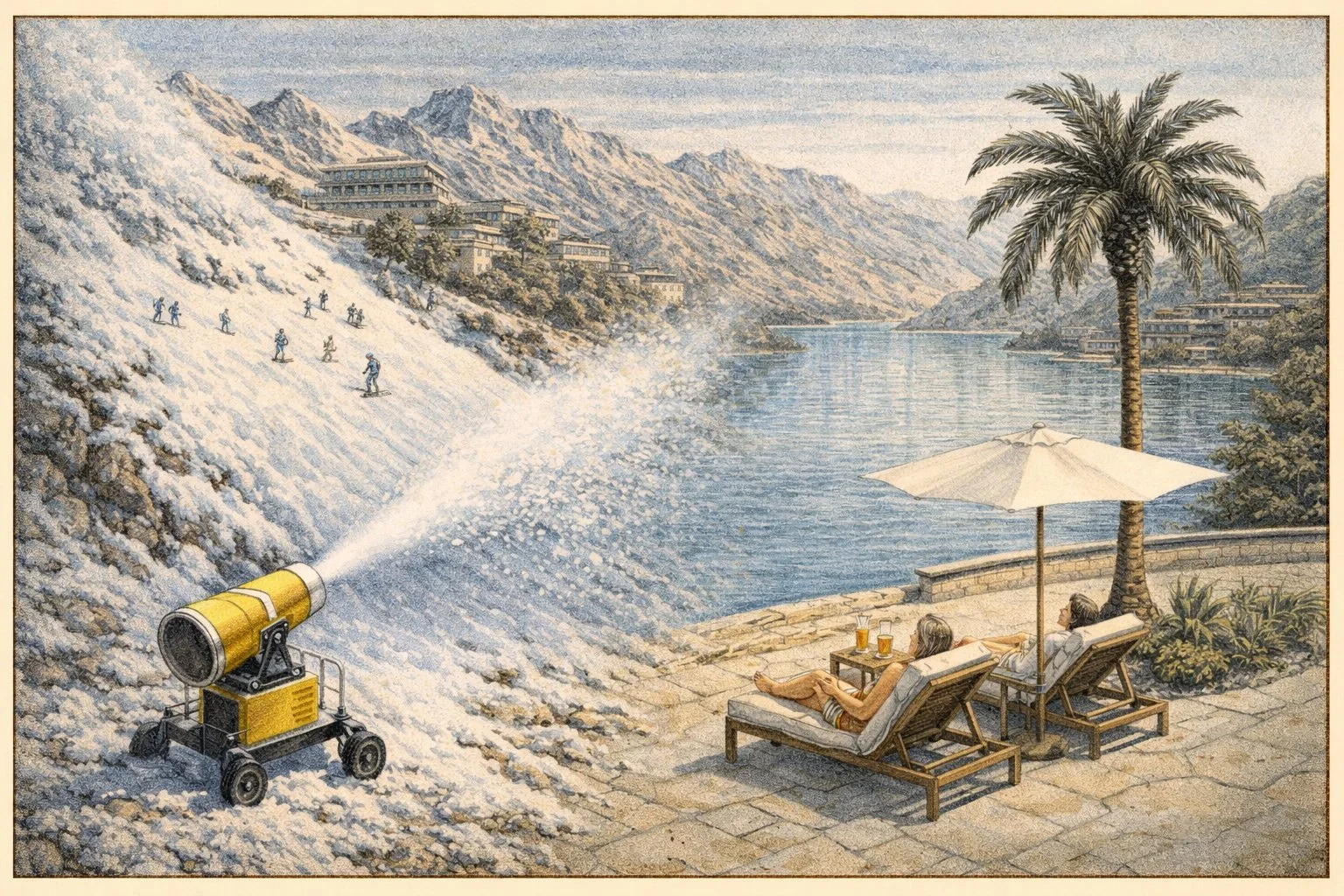
This illustration gives visual form to one of the article’s central critiques: Trojena appears to be built around a climatic contradiction. The snow cannon, the skiers, the lakeside loungers, and the palm together suggest a destination being asked to perform as winter resort and warm-weather retreat at the same time. In that sense, the issue is not whether the mountains can ever be cold. It is whether a marginal seasonal condition can credibly support a fully marketable alpine identity without heavy technical correction. The image reflects the article’s broader argument that what the climate does not naturally provide, engineering must repeatedly compensate for, with all the cost, energy, and operational burden that implies.
The seventh reason is conceptual: the project appears to be built around climatic contradiction. NEOM promotes Trojena as cooler than surrounding areas, with winter temperatures dropping below zero, about three months of winter snowfall, and more than 30 kilometers of slopes. That may be enough to support some winter activity, but the very sales pitch is that this will be the Gulf’s first outdoor ski experience combined with a freshwater lake and year-round destination programming. That means the project is trying to stretch a marginal mountain climate into a globally marketable alpine product.
There is a big difference between taking advantage of a naturally cool mountain microclimate and manufacturing an alpine destination identity. The first is adaptation and the second is climatic overreach. Once you promise skiing, snow reliability, premium hospitality, and a visually full freshwater lake, you become dependent on technical systems to smooth out the gap between what the site naturally offers and what the brand promises. Those systems can include snowmaking, pumping, cooling, water treatment, artificial landscaping, and extensive building services. The result is that the project may be “possible,” but only by layering energy-intensive correction onto a location that does not naturally deliver the full product at the scale marketed.
That is one reason the project feels environmentally suspect even before exact operating data are disclosed. Sustainable place-making usually means designing with local constraints: building forms, materials, tourism products, and public spaces that fit water, heat, ecology, and seasonality. A desert-mountain region can support beautiful, distinctive tourism without pretending to be the Alps. By contrast, building a lake-and-ski spectacle risks becoming a permanently subsidized battle against climate variability. A warm winter, a dry period, or unexpectedly high operating cost does not just reduce profit; it undermines the identity of the destination itself.
So the issue is not whether the mountains ever see cold weather or occasional snow. They do. The issue is whether that is a robust enough natural base to justify an entire capital-intensive resort narrative centered on water and snow. Skepticism is reasonable because the concept appears to depend less on what the climate naturally gives and more on what engineering can repeatedly compensate for.
What we calculate. We compare the natural snow window to the annual demand ambition and show how much visitation pressure gets compressed if winter is the anchor product.
Why it matters. A short natural season means the project must work much harder operationally to monetize the asset base year-round.
How we calculate it. It is stated that there is about three months of snowfall and a target of 700,000 annual visitors. We compare annual daily average demand to a 90-day winter concentration.
Outcome and benchmark.
The project is commonly described as having about a three-month winter snow or snow-sports window, which is 25% of the year. There is evidence of cold temperatures and occasional/seasonal snow, but not enough verified data in the sources we researched to say that Trojena naturally receives reliable snow depth sufficient for sustained winter sports. It was also reported that test snowmaking has taken place and that the resort is expected to rely on snowmaking or synthetic/all-weather surfaces for year-round or even robust winter operations. One source describes a mix of artificial surface slopes, all-weather snowmaking, and conventional snowmaking “when conditions are right in winter.” That points toward a model where engineering support, not natural snow depth alone, carries the sports proposition.
It is claimed that Trojena will attract 700,000 visitors by 2030. The annual target implies about 1,918 visitors per day on average. Trojena is targeting a visitor throughput that sits in the same broad band as Ski Dubai. Public reporting around Ski Dubai points to an initial target of 500,000 visitors a year and later annual attendance of more than 750,000 (over 11 million guests since 2005, implying a long-run average of roughly 733,000 a year.) The comparison is important because Ski Dubai is a compact indoor facility located inside a major metropolitan mall, with all the advantages of dense urban catchment, tourism flow, and retail footfall. Trojena, by contrast, would be asking a remote and capital-intensive mountain development to achieve broadly similar visitor volumes.
If demand clusters around a 90-day winter window, that rises to about 7,778 visitors per day, or just over 4 times the annualized daily average. In other words, the economics require either strong non-winter demand or very intense winter monetization. That is a classic seasonality stress point for a high-fixed-cost asset. This is about 3.8 to 3.9 times Ski Dubai’s annualized daily throughput which is a demanding comparison because Ski Dubai sits inside Mall of the Emirates, one of the region’s highest-footfall urban retail environments, where access, population catchment, and tourist flow are already in place. Trojena would be asking a remote, high-CAPEX mountain destination to achieve winter-day volumes several times higher than a mature indoor ski attraction embedded in a major city.
A three-month climate window cannot comfortably carry a twelve-month economic promise without heavy artificial support.
For planners, designers, and engineers, the design lesson is that (i) climatic seasonality must shape the business model rather than be edited out of it, (ii) a short natural operating window should trigger caution about fixed capital intensity, (iii) year-round success should come from diversified place-based programming rather than expensive artificial correction, (iv) access, logistics, and service capacity must be planned around realistic demand distribution rather than idealized averages, and (v) resilient destinations are those that align revenue expectations with what the local climate can naturally and repeatedly support.
Geotechnical, hydrological, and sediment risks get harder in steep terrain: Engineering complexity is high because the project combines dam works, lake works, tunnels and destination real estate in one mountain system

This illustration reflects one of the article’s central claims: measured honestly, the lake reads less as a leisure feature and more as a managed mountain water system. The guests above see calm water, scenic mountains, and a finished resort landscape. Beneath the surface, however, the image reveals a dense world of machinery, hydraulics, pipes, pumps, and control systems, suggesting that the apparent serenity depends on constant engineering beneath it. In the context of Trojena, the point is not only that the lake is large, but that its true character lies in the infrastructure required to hold, manage, and sustain it.
The eighth reason is engineering risk in steep mountain valleys. Even when world-class engineers are involved, mountain reservoir schemes must deal with slope stability, flash runoff, sediment inflow, erosion, foundation conditions, and access constraints. Trojena’s described infrastructure includes a 145-meter-high RCC dam, an 84-meter rockfill dam, a third concrete dam, lakebed lining, and tunnel connections. That is not simple amenity landscaping. It is a serious hydraulic and geotechnical intervention in rugged terrain.
Steep landscapes can be deceptive because they may look dry most of the year yet produce highly energetic runoff during storm events. When water does come, it can arrive suddenly, carrying sediment and debris. Sediment is particularly troublesome because it reduces storage efficiency, complicates water quality, damages hydraulic equipment, and creates a recurring maintenance cost. In a utility reservoir, society may accept that burden because the stored water is essential. In a leisure reservoir, sediment management becomes an expensive effort to preserve an artificial aesthetic and recreation platform.
The more architecturally ambitious the scheme, the narrower the safety margin for deferred maintenance. A resort lake overlooked by hotels and public walkways cannot tolerate visible shoreline degradation, uncontrolled drawdown, or recurring closures without reputational damage. And because the site would attract visitors, any engineering issue gets folded into public safety, evacuation planning, and liability concerns. That raises the threshold for inspection and conservative operation.
There is also the problem of long-term uncertainty. A project can be engineered to a high standard and still face outcomes that are difficult to model perfectly over decades: changing rainfall patterns, more intense storms, unexpected sediment behavior, freeze-thaw stress, or material aging in a high-altitude environment. Those are manageable risks in principle, but they add cost and complexity. When the whole purpose is discretionary tourism rather than unavoidable public necessity, it is reasonable to ask whether society should be taking on this class of risk at all. The engineering may be impressive. The question is whether it is proportionate to the public value created.
What we calculate. We quantify the size of the main structures and the geometry of the lake corridor.
Why it matters. Complexity raises CAPEX risk, interface risk, and lifetime inspection burden.
How we calculate it. We use public dimensions for the three dams and derive average lake width from 1.55 km² / 2.8 km. We also use the stated tunnel section and length.
Outcome and benchmarks:
The main dam alone is 145 m high, 475 m long, with 2.7 million m³ of RCC. That is a utility-scale dam embedded in a leisure project. The height matches the Grand Ethiopian Renaissance Dam’s 145-meter main dam, although GERD stretches much farther at 1,780 meters and serves a 5.15 GW hydropower system. Trojena’s main dam is also the same height as Lesotho’s Mohale Dam, a 145-meter structure built to support regional water transfer and supply. In other words, the main structure at Trojena is already comparable in vertical scale to major African water and energy infrastructure, yet here it would sit inside a leisure-led mountain destination.
The second and third dams add 84 m and 38 m of height respectively, taking cumulative stated dam heights to 267 m across the system. That cumulative vertical scale is about 1.8 times the 150-meter height of France’s Roselend Dam and about 1.84 times the 145-meter height of Mohale Dam. This is not how one normally thinks about resort amenities; it is how one thinks about stacked hydraulic works.
The lake averages about 554 m wide by our calculation, which is roughly 5.3 FIFA pitch lengths across at its mean width, while the tunnel volume is another 54,000 m³. The point is simple: this is not one structure; it is a multi-interface mountain hydraulic system. That is wider than the full 475-meter crest length of the main dam itself and about 1.17 times the crest length of Glen Canyon Dam, which is also 475 meters, while the tunnel volume adds another 54,000 m³ of underground civil works. Put differently, the water body is broad enough that its average width already exceeds the crest length of a major utility dam, reinforcing the point that this is not a decorative basin but a large engineered hydraulic landscape.
Once measured honestly, the lake reveals itself less as an amenity and more as a mountain hydraulic system.
For planners, designers, and engineers, this section offers five direct lessons: (i) the scale of engineering should always be made legible in planning discussions rather than hidden behind visual language, (ii) multi-structure systems demand special care at their interfaces, where risk often accumulates, (iii) hydraulic, architectural, geotechnical, and public-use systems should never be designed in isolation from one another, (iv) complexity should only be accepted where it produces durable value rather than symbolic effect, and (v) the role of design leadership is to know when simplification is the more intelligent act than technical escalation.
The business case is vulnerable to demand shocks and prestige overestimation: The economic hurdle is high even before financing cost and maintenance are included
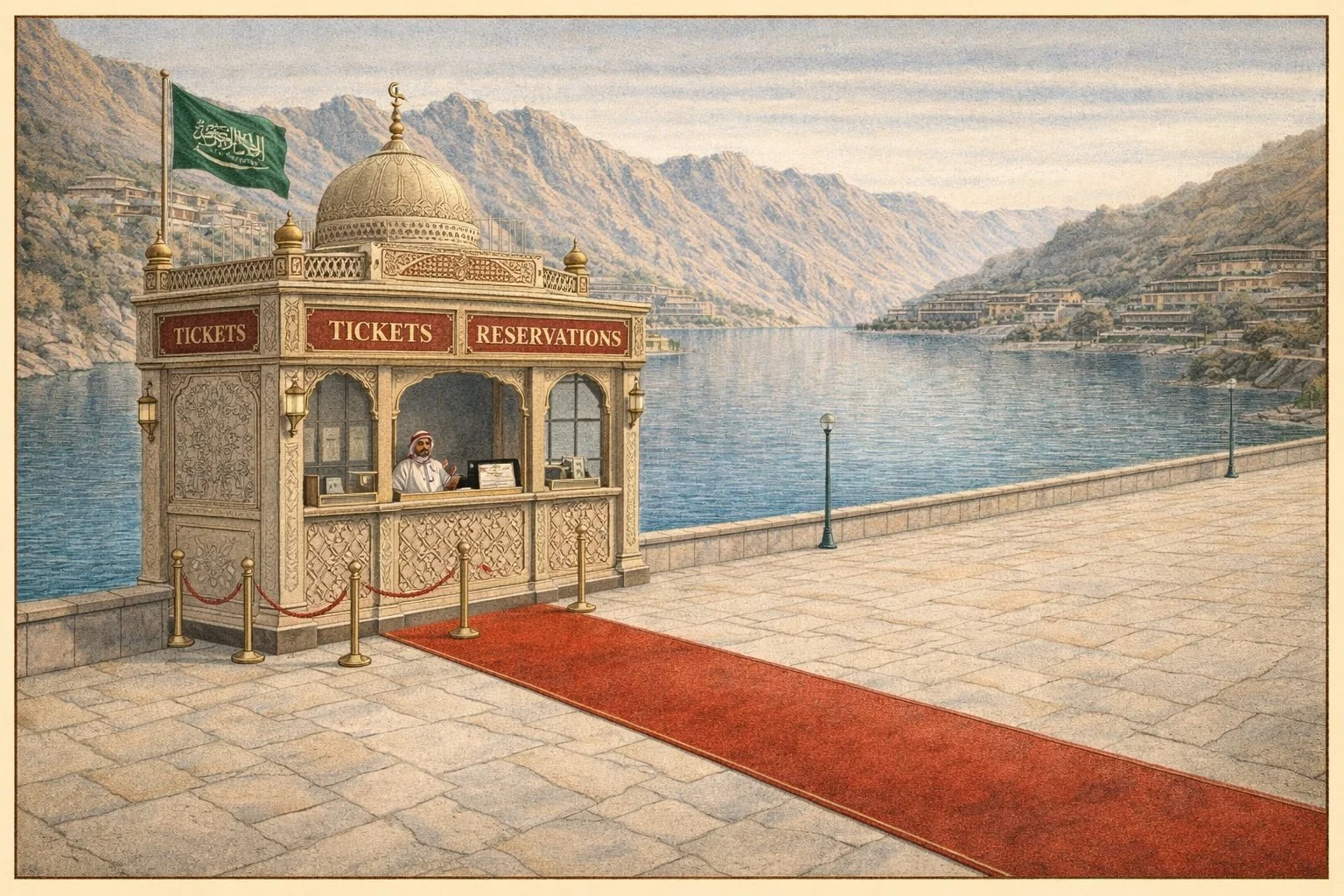
This illustration reflects the article’s central commercial argument: the spectacle may be built, but demand remains the harder question. The booth is ornate, the setting immaculate, and the lake framed as a finished destination product. Yet the long empty red carpet says what the architecture cannot. In the case of Trojena, the challenge is not simply attracting attention or symbolic value, but generating enough real visitors, spending, and repeat demand to justify a highly capital-intensive and operationally demanding landscape. The image gives form to that imbalance: an expensive arrival prepared in full, waiting for an audience that has not yet materially appeared.
The ninth reason is commercial fragility. Mega-destination projects often assume that signature architecture and novelty will automatically create durable demand. Sometimes they do create buzz. But tourism demand is cyclical, reputation-sensitive, and dependent on access, geopolitics, airline capacity, pricing, weather reliability, and repeat visitation. Trojena was tied to Vision 2030 and the 2029 Asian Winter Games, which can generate visibility, but visibility is not the same thing as long-term occupancy or profitable operations. A place can be famous online and still struggle financially once the event cycle passes.
Why does that make the concept questionable? Because the infrastructure is not very forgiving if demand disappoints. A conventional resort can cut staffing, postpone upgrades, or reposition itself for a different market. But a destination built around costly fixed hydraulic works, signature overhang architecture, and year-round climate-managed attractions has a higher break-even burden. If the top-end tourism market softens, or if customers decide the destination is too expensive, too artificial, or too inconvenient, the physical asset base remains oversized.
There is also a prestige trap. Because the project is marketed as transformational, decision-makers may become reluctant to scale it down even when economics argue for caution. That can lead to more sunk-cost spending in order to defend the original vision. The termination is relevant here because it suggests that even a very high-profile scheme can hit implementation reality. So the business-case concern is not abstract. Projects like this can become examples of how icon-driven development overrates symbolic value and underrates the difficulty of turning spectacle into steady cash flow.
What we calculate. We test payback against claimed GDP contribution, the implied GDP contribution per visitor, and the relationship to actual Saudi visitor spend.
Why it matters. This shows how hard the project must work commercially to justify the initial outlay.
How we calculate it. We use the lake CAPEX of $4.7 billion, Trojena’s stated $800 million GDP contribution, and Saudi Arabia’s 2024 inbound tourism spending of SAR 168.5 billion across 29.7 million inbound tourists.
Outcome and benchmark:
The simple CAPEX-to-GDP ratio is about 5.9 years even before financing cost, maintenance, replacement CAPEX, and operating expenditure. A useful comparison is the Sydney Opera House: the Opera House’s original construction cost would be about A$1 billion in today’s terms, while its FY2022–23 contribution to the New South Wales economy was A$1.2 billion, implying a much shorter payback-like ratio of about 0.8 years on that simple basis. By contrast, Gardens by the Bay in Singapore was announced at an estimated S$900 million cost and was expected to generate S$1 billion in tourism receipts over 10 years, which works out to a much gentler annual return profile than Trojena’s implied headline economics. In other words, Trojena’s ratio is demanding not because such benchmarks never exist, but because it is asking a remote, highly engineered destination to behave economically more like a mature global icon than a newly created landscape intervention.
The implied GDP contribution is about $1,143 per visitor if the 700,000 annual visitor target is met. The implied figure is really a destination-economics number, so it makes sense to compare it to what visitors actually spend in established destinations rather than to buildings or dams. That is a demanding benchmark when compared with premium destinations. Dubai, for example, reported roughly $2,845 average visitor spending per trip in 2024, which is about 2.5 times Trojena’s implied per-visitor GDP contribution. Morocco’s 2024 tourism receipts were reported at about $10–11.3 billion on 17.0–17.4 million visitors, implying roughly $590–$665 per visitor nationally. On that basis, Trojena’s implied $1,143 per visitor is about 1.7 to 1.9 times Morocco’s national tourism revenue per visitor. In other words, Trojena is not being asked to perform like an ordinary destination. It is being asked to monetize visitors at a level far above broad national averages and much closer to premium urban-tourism economics.
Saudi Arabia’s actual 2024 average inbound visitor spend was about $1,513 per inbound tourist. So this one sub-destination would need to convert a very large share of an average inbound trip’s full spending into GDP contribution merely to support the headline economics. That is an aggressive requirement. Can Trojena really convert roughly 76% of the full average inbound trip spend into GDP value at a single destination? High-yield destinations tend to be dense global hubs, luxury urban destinations, casino or shopping economies, or places with long-established premium ecosystems. Trojena would be trying to reach near-premium destination yield in a remote, capital-intensive, climate-managed setting.A useful benchmark is Dubai. Dubai’s tourism economy supports very high per-visitor spending because it combines aviation connectivity, dense hotel supply, retail, real estate, events, beaches, nightlife, and globally recognized urban attractions in one integrated metropolitan platform. Trojena would be asking a single remote destination node to capture a very large share of premium-destination economics without enjoying urban density, catchment, or ecosystem depth. A good benchmark is Las Vegas/Southern Nevada, where the tourism economy generated $55.1 billion in aggregate visitor spending in 2024 from 41.7 million visitors. That works out to about $1,321 of visitor spending per visitor. On this comparison, Trojena’s implied GDP contribution per visitor is about 86.5% of Las Vegas visitor spend per visitor. That is revealing because Las Vegas is one of the clearest examples of a destination that monetizes visitors very intensively through hotels, gaming, entertainment, conventions, food and beverage, and retail and across a huge, mature, and highly optimized tourism machine. Trojena’s implied per-visitor value is therefore within range of a globally successful high-yield destination, but it would be trying to do this with a much narrower product base and a much heavier fixed infrastructure burden.
The commercial challenge is not attracting attention, but generating enough real value to justify such fixed intensity.
For planners, designers, and engineers, the deeper takeaway is that (i) spatial ambition must remain proportionate to likely value creation, (ii) revenue assumptions should be stress-tested against realistic visitor behavior rather than aspirational branding, (iii) projects with high fixed costs should be especially cautious about dependence on premium pricing and flawless execution, (iv) economic resilience often comes from adaptability and mixed-use coherence rather than from a single iconic proposition, and (v) planning should protect institutions from having to defend excessive sunk costs with ever more aggressive assumptions later on.
The sustainability narrative is hard to verify from public information: The opportunity cost of water is socially significant in a water-scarce country

This illustration reflects the article’s final argument that a mountain lake in an arid country cannot be understood as a visual amenity alone. The crystal decanter suggests refinement, surplus, and control. The camels and dry town below suggest something else: water as livelihood, settlement, and scarcity. In Trojena’s case, the issue is not only how beautiful the lake appears, but what it represents in strategic terms. The image gives visual form to the article’s central point that in a water-scarce country, visible abundance is never just aesthetic. It is also a question of allocation, priority, and the social meaning of water itself.
The tenth reason is transparency. NEOM publicly states strong environmental commitments, including circular water supply, conservation, and “net positive biodiversity” aspirations. Those are ambitious claims. But a project as resource-intensive and ecologically sensitive as an artificial freshwater lake with three dams in a mountain desert setting should ideally be supported by detailed, publicly scrutinizable data: water sourcing volumes, replenishment assumptions, evaporation estimates, energy intensity, sediment-management plans, biodiversity baselines, mitigation commitments, and long-term monitoring frameworks. From public-facing material, what is easiest to find are visionary summaries, company announcements, and promotional descriptions, not the full operating logic a skeptic would need in order to be convinced.
That matters because without transparent operating assumptions, sustainability can become a branding layer rather than a tested proposition. For example, if a developer says circular water systems will solve the problem, the obvious next questions are: what percentage of lake replenishment comes from recycled water, what percentage from desalination, what are the pumping lifts, what are the annual losses, and what is the marginal electricity demand? Those are not hostile questions. They are the basic due-diligence questions for any desert water spectacle. Yet the public narrative tends to emphasize aspiration and design more than measurable long-run burden.
Transparency also matters for environmental trust. If an area overlaps or adjoins conservation-sensitive mountain habitats, the public should be able to see what tradeoffs are being made and how success or failure will be measured over time. Otherwise, “protect 95% of nature” and “build a major artificial lake and ski destination” sit awkwardly beside each other without enough disclosed detail to judge compatibility. So in the end, the project sounds questionable not only because of cost, maintenance, and ecology individually, but because those three issues reinforce each other. High cost requires strong utilization. High utilization increases operational intensity. Operational intensity raises environmental burden. And the public case for all of it remains harder to evaluate than the renderings suggest.
The bottom-line view: a project like this is questionable because it appears to convert scarce water, high capital, heavy engineering, and long-term maintenance into a prestige landscape whose economics and environmental logic are much less secure than its imagery.
Why it matters. This is the clearest way to show that “prestige water” has a real social and strategic cost in an arid state.
How we calculate it. We compare 4.65 million m³/year of evaporative loss to the World Bank/UN basic-needs band of 50–100 liters per person per day, and compare the $4.7 billion CAPEX to the World Bank Saudi desalination tariff example of $0.92/m³.
Outcome and benchmarks:
The lake’s annual evaporative loss equals roughly 4.65 billion liters of water. Saudi Arabia’s water minister said in October 2025 that the Kingdom’s desalinated-water production capacity exceeds 16 million m³ per day. On that basis, Trojena’s annual evaporative loss would equal only about 0.08% of one year of Saudi desalination capacity, or roughly 7 hours of national desalinated-water output.
At 100 liters/day, that is enough to cover the basic domestic water needs of about 127,000 people for a year; at 50 liters/day, it is about 255,000 people for a year. This is roughly the scale of a large Saudi secondary city such as Al Jubail, or about two-thirds of Al Kharj based on public population estimates. In other words, the annual water lost from the lake would be enough to supply a real Saudi urban population for a year, depending on the basic-consumption benchmark used.
At $0.92/m³, the $4.7 billion CAPEX is equivalent to roughly 5.1 billion m³ of desalinated water value. That is not just 1,099 years of the lake’s annual evaporation replacement volume of 4.65 million m³; it is also equivalent to about 87% of Saudi Arabia’s stated desalinated-water production capacity, based on 16 million m³ per day (5.84 billion m³ per year if annualized). Another way to read it is against major reservoir systems: 5.1 billion m³ is about 3.0% of Lake Nasser’s gross storage capacity of 169 billion m³ behind the Aswan High Dam. In other words, the capital committed to this one package is equivalent to nearly a full year of Saudi Arabia’s current desalination capacity, or to a strategically meaningful fraction of one of the region’s largest freshwater storage systems. The strategic question then becomes obvious: is this the highest-value use of scarce capital and scarce water?
In a water-scarce country, prestige water is never just aesthetic water; it is always strategic water.
For planners, designers, and engineers, the final lesson is perhaps the most important: (i) in water-scarce territories, every design choice involving water must be understood as strategic, (ii) prestige uses of water should be weighed against their social and economic alternatives, (iii) visible abundance should never be created without full awareness of what invisible systems are required to sustain it, (iv) the ethics of planning matter as much as the aesthetics of planning where scarce resources are concerned, and (v) the most intelligent design response in arid regions is not to imitate wetter landscapes, but to create forms of beauty and value that are truthful to scarcity.
OHK’s Closing Assessment: Beyond the Numbers
From an OHK advisory perspective, the issue is not that Trojena’s artificial lake is impossible to engineer. The issue is that it appears to solve the wrong problem at the wrong scale, with the wrong hierarchy of priorities. Taken together, the evidence points to a project that substitutes engineering force for landscape logic, capital intensity for planning discipline, and spectacle for long-term coherence. Its burden does not sit in any one category alone. It sits in the way cost, water, energy, maintenance, seasonality, and environmental exposure reinforce one another. What emerges is not simply an ambitious tourism proposition, but a highly managed and structurally demanding landscape whose viability depends on sustained technical correction and unusually strong economic performance. For OHK, that is the deeper concern: not whether such a project can be built, but whether it represents the most intelligent use of place, resources, and institutional ambition within the larger trajectory of NEOM.
A team from OHK Consultants developed the first concept of NEOM, bringing together bold vision and grounded feasibility in one of the most ambitious urban projects of our time. As a hybrid consulting firm, we combine management consulting, spatial planning, and international development into a unified practice that spans sectors and disciplines. Our expertise extends across land policy, infrastructure investment, and governance reform, but it is our management consulting ethos that binds it all together. This ethos informs everything we do—from designing spatial and economic strategies to advising on institutional reform—ensuring that accountability, transparency, and human impact are embedded in every project. We help governments, development institutions, and private sector leaders navigate ethically complex environments while upholding international norms and delivering long-term social value. Contact OHK to learn how our planning capabilities can help you make better city, urban, and data-driven decisions.